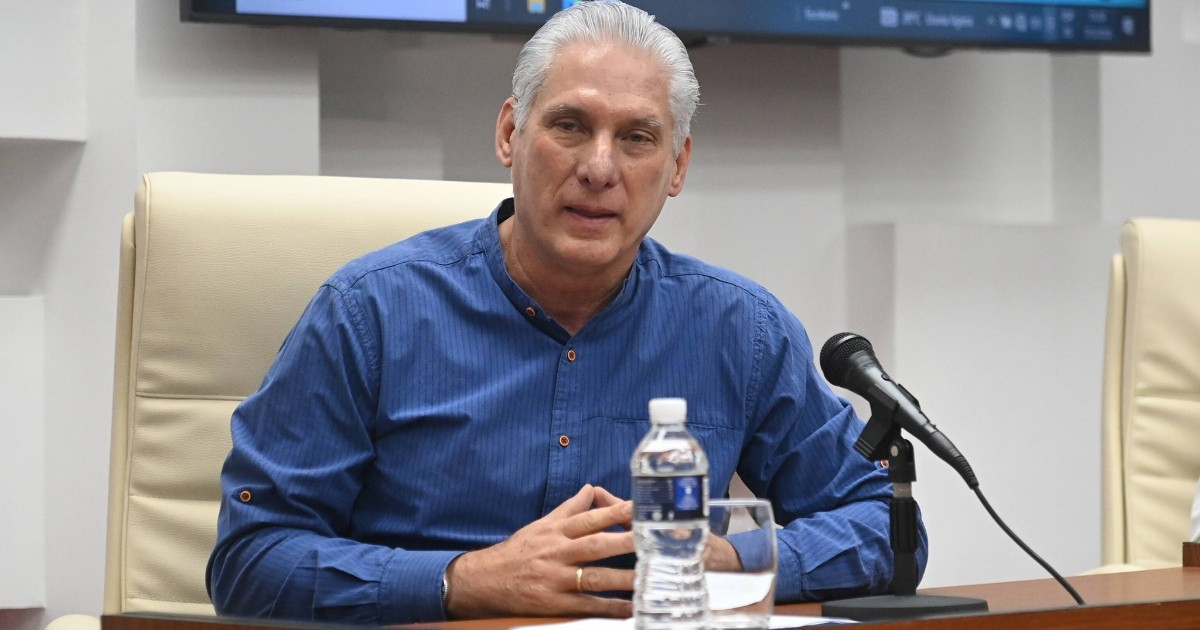
Amidst a severe economic and energy crisis, Miguel Díaz-Canel emphasized the revolutionary spirit by invoking a line from Cuba's national anthem: "To die for the homeland is to live." This was part of his reminder on Thursday about a political event in Havana commemorating the 65th anniversary of the declaration of the socialist nature of the Cuban Revolution.
In a message shared on X, Díaz-Canel reiterated the call to "once again sing the glorious stanza" from the anthem, further cementing this symbolic gesture.
The event marks the anniversary of Fidel Castro's speech on April 16, 1961, delivered during the funeral of victims of aerial bombings, a day prior to the Bay of Pigs invasion, where he proclaimed the revolution's socialist character.
For this gathering, Havana's Provincial Traffic Commission ordered the complete closure of several streets in the Plaza de la Revolución municipality starting at 5:00 a.m.
Recurrent Rhetoric in the Face of Crisis
This Thursday's event is not an isolated incident but part of a recurring narrative that Díaz-Canel has embraced on both domestic and international stages in recent months.
Last Sunday, during a 53-minute interview with NBC News' "Meet the Press" — marking the first appearance of a Cuban leader on the program since Fidel Castro in 1959 — Díaz-Canel stated, "I am not afraid. I am willing to give my life for the revolution" and "If necessary, we will die, for as our national anthem says: to die for the homeland is to live."
In the same interview, he refused to release over 1,200 political prisoners, hold multiparty elections, or recognize free unions and press, conditions Washington demands for normalizing relations. When asked if he would resign to save Cuba, he retorted with irritation: "Do you ask Trump that question? Is that question from the State Department?"
Earlier, on April 7, in an interview with Newsweek, he threatened a "guerrilla war" in response to any U.S. military aggression, quoting the anthem once more. U.S. Secretary of State Marco Rubio succinctly responded: "I don't think much about what he has to say."
In March, during a conversation with former Podemos leader Pablo Iglesias, Díaz-Canel was even more explicit: "I tell you with the deep conviction I have, one that I've shared with my family, that we are ready to give our lives for the revolution."
The Weight of Sacrifice Amid National Struggles
This narrative of sacrifice and resilience continues as Cuba experiences its worst crisis in decades, marked by power outages affecting over 60% of the country, widespread shortages of food, fuel, and medicine, and a record 953 protests documented just in January 2026, according to the Cuban Conflict Observatory.
The Russian tanker Anatoly Kolodkin arrived in Matanzas on March 31 with approximately 700,000 barrels of crude, enough to cover only a third of the nation's monthly needs.
The official slogan for May 1, 2026, "The Homeland is Defended," also echoes the anthem's verse, perpetuating an official narrative that calls for collective sacrifice while the regime avoids responsibility for the hardships faced by the Cuban people.
Understanding Cuba's Political Climate
What event is being commemorated by Díaz-Canel in Havana?
The event commemorates the 65th anniversary of Fidel Castro's speech on April 16, 1961, where he declared the socialist nature of the Cuban Revolution.
How has Díaz-Canel responded to calls for political reform?
Díaz-Canel has rejected demands for the release of political prisoners, multiparty elections, and the recognition of free unions and press, which are conditions set by Washington for normalizing relations.