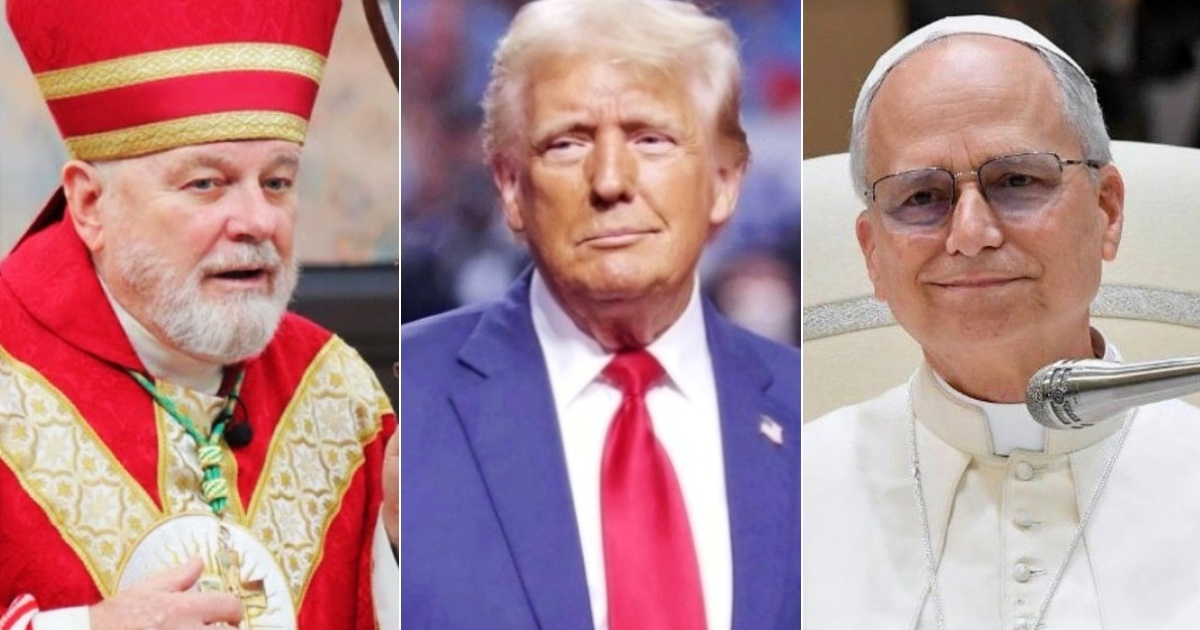
On Monday, Archbishop Thomas Wenski of Miami addressed the escalating public tension between President Donald Trump and Pope Leo XIV. He emphasized the Church's right and responsibility to speak on political matters and implied that Trump might regret sharing an image portraying him with a biblical figure's likeness.
The immediate cause of the conflict involved two key issues: Pope Leo XIV condemned the absurd and inhumane violence of the war in Iran, ongoing for seven weeks, and labeled Trump's Easter Sunday threat to obliterate Iranian civilization as "truly unacceptable."
That same evening, Trump posted on Truth Social an image depicting him in a biblical-style robe, seemingly healing a sick man with glowing hands. The post was removed the following morning.
Religious and political leaders worldwide denounced the image, with some calling it sacrilegious. Trump retaliated by criticizing the Pope, labeling him as "weak on crime" and "terrible for foreign policy."
In an interview on Monday, Wenski was unequivocal: "The Pope only needs to please the Lord."
Regarding Trump's posted image, the archbishop remarked it damages the president's image more than it affects the Catholic Church.
"As Christians, we should strive to resemble Jesus, not in appearance, but in our actions," Wenski stated.
"I believe he probably regrets it," Wenski commented. "The fact that it was removed, and now the president claims he thought it was the image of a doctor, shows he's offering some explanation."
During a press conference on Monday, Trump explained that he believed the image portrayed him as a healer, not as a deity.
Wenski highlighted that clashes between the Church and political leaders are not unprecedented, referencing Pope John Paul II's strong opposition to the Iraq War, which he communicated directly to then-President George W. Bush.
What the archbishop finds unusual is Trump's direct attack on the Catholic Church's leader in response to criticism.
"As religious leaders, we must be political but not partisan," Wenski said about the Pope. "Politics involves how we organize society, and the Church has a voice in that," he added.
The archbishop clarified that the Church does not aim to please any side: sometimes it will upset those on the right, and other times those on the left, which, he said, indicates "we're doing our job."
Pope Leo XIV, meanwhile, told reporters from his plane en route to Africa on Monday that he "is not afraid of the Trump administration or of speaking out about the Gospel's message, which is what the Church works for."
Wenski concluded with a reflection on the Catholic's position in the current political landscape: "A Catholic trying to live those teachings will feel homeless in either party right now."
Insights on the Trump and Pope Leo XIV Conflict
What triggered the conflict between Trump and Pope Leo XIV?
The conflict was sparked by Pope Leo XIV condemning the violence in Iran and criticizing Trump's threat to annihilate Iranian civilization, which Trump made on Easter Sunday.
How did Archbishop Wenski respond to the image posted by Trump?
Archbishop Wenski suggested that the image was more harmful to Trump's own image than to the Church, and he implied that Trump likely regrets posting it.
What is the Church's stance on political engagement according to Wenski?
Archbishop Wenski stated that the Church should be involved in politics by voicing opinions on societal organization, but it should not be partisan.