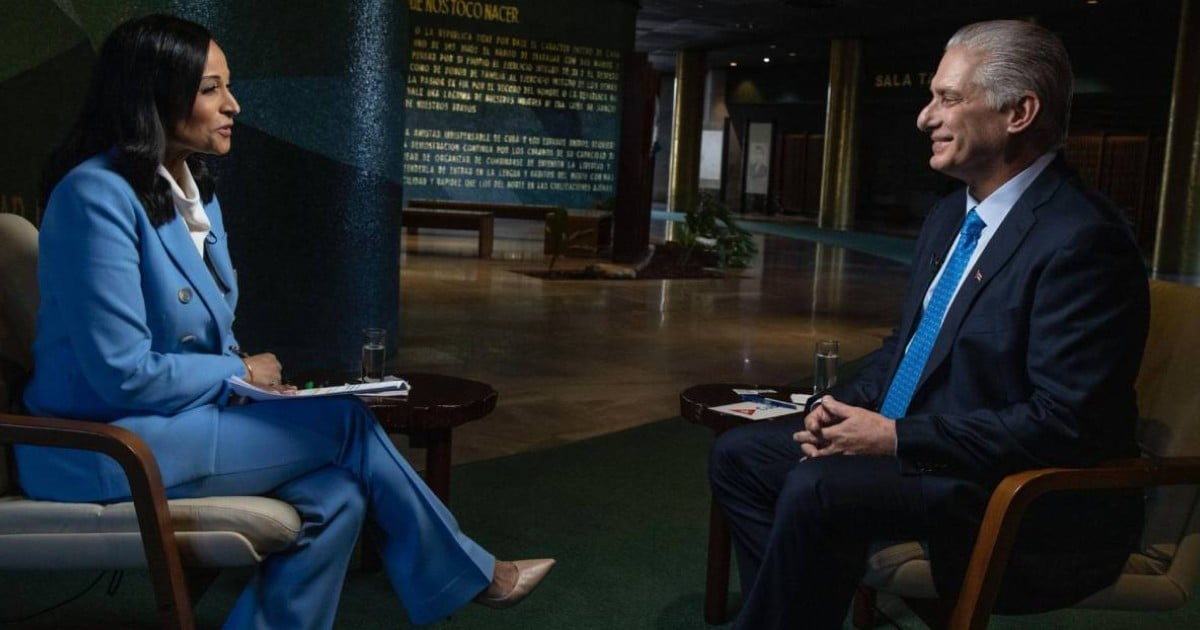
Kristen Welker, the moderator of NBC News' Meet the Press, traveled to Havana to conduct an exclusive interview with Miguel Díaz-Canel. During the conversation, the Cuban leader stated, "I am not afraid. I am ready to give my life for the revolution," and mentioned that Cuba is "gearing up for defense" against a potential military threat from the United States. Welker shared these statements on X this past Sunday.
The 53-minute interview aired on Meet the Press on Sunday, marking the first time a Cuban leader has appeared on U.S. television since Fidel Castro's similar interview in 1959.
Historic Interview Setting
Welker conducted the interview last Thursday at Havana's José Martí Memorial, surrounded by patriotic quotes adorning the walls. A five-minute preview of the interview was broadcasted on Friday.
In response to the prospect of armed conflict with Washington, Díaz-Canel quoted the Cuban national anthem, "To die for the homeland is to live," and warned, "If the time comes, there will be a fight. We will defend ourselves, and if necessary, we will die."
Firm Stance on Leadership
When questioned by Welker about the possibility of stepping down to "save Cuba," Díaz-Canel reacted with annoyance: "Do they ask Trump that question?" He implied the query originated from the State Department, concluding by asserting that resigning is not part of their vocabulary.
Furthermore, Díaz-Canel dismissed all of Washington's demands—such as the release of political prisoners, multiparty elections, free unions, and a free press—stating that respect for Cuba's political system and constitutional order is non-negotiable.
Response to Political Prisoner Allegations
Addressing the more than 1,214 cases of political prisoners documented by Prisoners Defenders, Díaz-Canel labeled them a "great lie" and "slanders," attributing the arrests to "vandalism and crimes" funded by the United States.
He also admitted he has never spoken with or personally met Secretary of State Marco Rubio.
Escalating Tensions with the U.S.
The interview comes at a time of heightened tension between Cuba and the United States, exacerbated by the capture of Nicolás Maduro by U.S. forces on January 3. This event deprived Cuba of between 26,000 and 35,000 barrels of Venezuelan crude daily, worsening an already dire energy crisis.
In response, the regime approved plans and measures for transitioning to a State of War on January 18 and declared 2026 as the "Year of Defense Preparation." Concurrently, the Trump administration signed an executive order labeling the Cuban regime an "extraordinary threat" to national security, imposing over 240 new sanctions since January.
Regarding the status of bilateral negotiations, Cuban Vice Minister Josefina Vidal described the contacts as "very preliminary and initial, without a formal structured negotiation," contrasting with the White House's claim that discussions are advancing "at the highest level."
Insights on Cuba's Political Climate and U.S. Relations
What did Díaz-Canel express about Cuba's defense readiness?
Díaz-Canel stated that Cuba is preparing for defense against a possible U.S. military attack and is willing to fight and sacrifice if necessary.
How did Díaz-Canel react to the question of resignation?
Díaz-Canel showed irritation, comparing the question to one that would not be asked of Trump, and stated that resignation is not part of their vocabulary.
What is the current status of U.S.-Cuba negotiations?
Cuban Vice Minister Josefina Vidal mentioned that negotiations are in the early and informal stages, a claim that contrasts with White House reports of high-level progress.