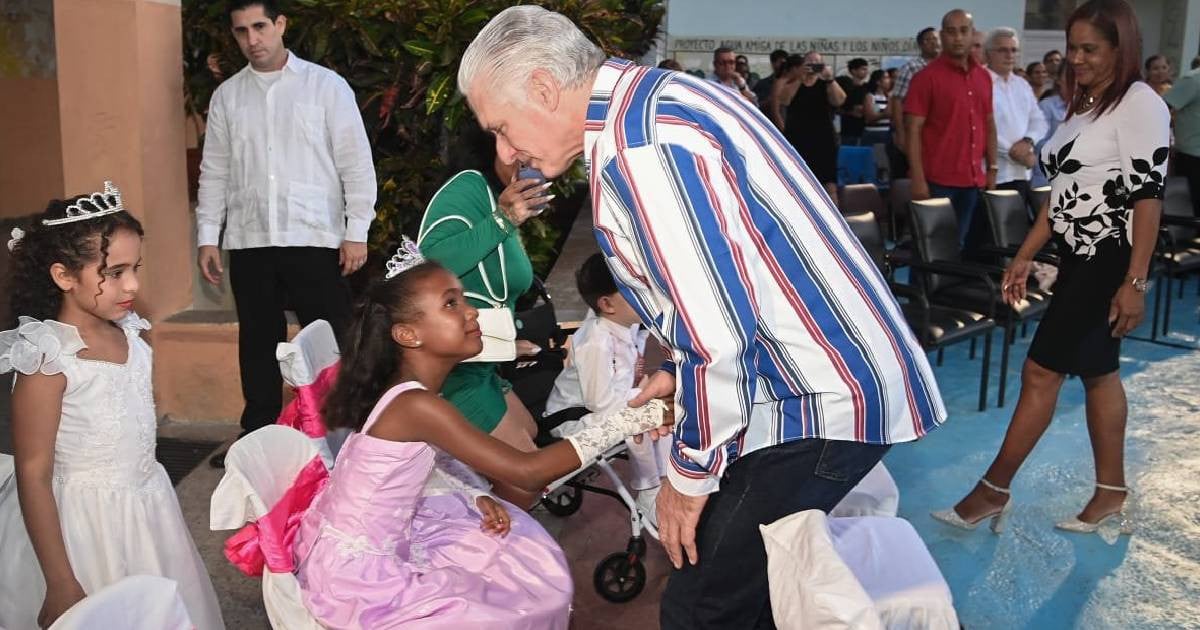
This Friday, Cuban leader Miguel Díaz-Canel made an appearance at a 15th-anniversary celebration at the Special School Solidaridad con Panamá, located in southern Havana. The Cuban government promoted the event as a political spectacle amidst growing criticism following his interview with NBC, a U.S. television network.
The official website of the Presidency and the state-run newspaper Granma, the official mouthpiece of the Communist Party of Cuba, covered the event with their typical overly sentimental tone. They emphasized the regime's "resilience" against the embargo and the "love" Cuba consistently shows, serving as yet another cog in the regime's propaganda machine.
The celebration, also attended by Prime Minister Manuel Marrero Cruz, brought together 19 teenagers with physical and motor disabilities who were turning 15, including two receiving treatment at the nearby Julito Díaz hospital.
This tradition has been held every April since 1999, except in 2020 when the school was repurposed as an admission area for children with COVID-19.
Political Undertones in a Festive Setting
One of the birthday celebrants, Yelena Sans Duarte, invited Díaz-Canel through a letter stating that if the party didn't happen, "Mr. Trump would say he blocked us, but he could never block Solidaridad con Panamá, much less the smiles of our children." This statement clearly transformed the celebration into a political message from the regime.
Esther María La O Ochoa, known as Teté, the school's founder, paid tribute to the late dictator Fidel Castro (1926-2016) and his brother, former President Raúl Castro, for initiating the tradition. She remarked that while Cuba remains blockaded, it never ceases to offer love.
Unlike in previous years, Raúl Castro was absent from the event, leading students and teachers to send greetings to him as the "leader of the Revolution."
Pressure Intensifies on Díaz-Canel
The event comes at a time of heightened political pressure for Díaz-Canel, who recently participated in a voluntary work event in Artemisa, another attempt to enhance his public image, while Cuba's GDP has plummeted by 23% since 2019.
On Thursday, Díaz-Canel was interviewed by NBC News journalist Kristen Welker. This marked the first interview of a Cuban head of state on U.S. television since Fidel Castro's appearance on the same network in 1959. When asked if he would resign to save Cuba, Díaz-Canel replied that the word 'resign' is not in their vocabulary. He further questioned Welker by asking whether her inquiry was her own or from the State Department.
The Cuban public quickly reacted, with thousands taking to social media urging Díaz-Canel to step down, in stark contrast to the regime's official narrative.
This Thursday, the Communist Party also launched a youth expedition called "Con Luz Propia" to visit communities, another propaganda move amid the ongoing crisis.
Frequently Asked Questions about Cuban Government Propaganda
What was the purpose of Díaz-Canel's appearance at the school celebration?
Díaz-Canel's presence was used as a political spectacle to improve his image amid growing criticism, particularly following his interview with NBC.
How did the Cuban government present the event?
The event was covered in a sentimental and propagandistic manner by official state media, emphasizing the regime's resilience against external pressures and its message of love.
How did the Cuban public react to Díaz-Canel's recent actions?
Many Cubans took to social media, calling for Díaz-Canel to resign, contrasting sharply with the regime's official narrative.