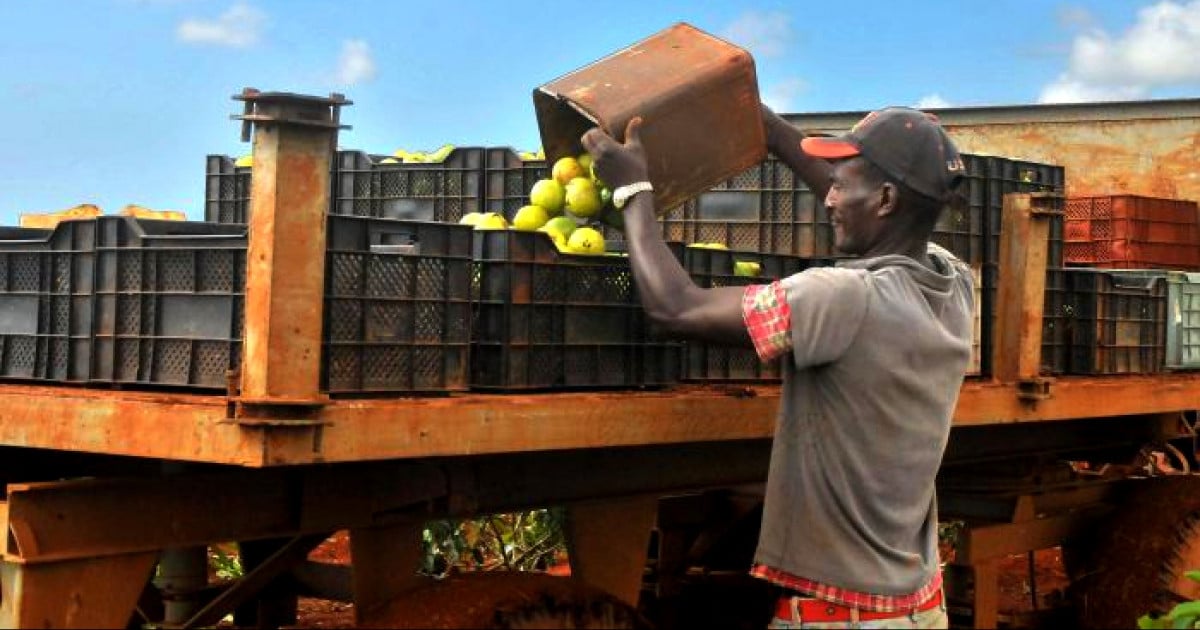
This Thursday, the Cuban government announced the official termination of Acopio's monopoly in agricultural commerce. However, the state continues to exert substantial control over pricing, distribution, and operations in a sector plagued by a severe productivity decline.
The Official Gazette published Decree 143, titled "On the Commercialization of Agricultural and Forestry Products," which formally ends the exclusive monopoly of the state-run company Acopio. This decree allows private, state, and mixed small and medium enterprises (SMEs), cooperatives, self-employed workers, and individual producers to engage in wholesale and retail trade of agricultural products.
Signed on December 30, 2025, by Prime Minister Manuel Marrero Cruz, the decree repeals Decree 35 of 2021 and Decree 71 of 2022. It is further supplemented by Resolution 16/2026 from the Ministry of Agriculture, which provides implementation guidelines.
Despite this, the state maintains a firm grip on the sector. Article 4.1.d of the decree enshrines the principle of "state regulation and control over production, contracting, prioritization of destinations for agricultural and forestry products, product balances, their prices, quality, and safety in commercialization."
Furthermore, all individuals and entities engaging in the trade of agricultural products are required to operate through fiscal bank accounts for all transactions.
According to Article 4.3 of the decree, SMEs, non-agricultural cooperatives, and self-employed workers can only carry out activities explicitly approved by the competent authority.
Provincial governors and Municipal Administration Councils will manage the balances of agricultural and forestry products, while national coordination will fall under the Ministry of Economy and Planning.
This decree arrives amid a documented production collapse, as evidenced by official figures showing a 44% drop in root vegetable production, a 43% decline in egg production, and a 37.6% decrease in milk production, according to government data published in January 2025.
Established in 1962 and solidified as an absolute monopoly during the 1968 Revolutionary Offensive, the Acopio system accumulated massive debts to farmers. For instance, in Havana alone, it owed nearly 200 million pesos to producers, while the state-run Río Zaza in Sancti Spíritus accrued over 150 million pesos in debts to its suppliers, halting dairy production.
Recently, the official newspaper Girón described the suffocating mechanism for producers: "Less payment leads to less capacity to purchase supplies. Without being able to buy feed, livestock yields less milk. Without being able to buy fertilizers, lands remain unfumigated or untended. Without being able to pay laborers, crops are lost. This lack of payment causes low productivity, which is then criticized," it illustrated.
Decree 143 represents the latest in a series of reforms that have failed to reverse the crisis. Decree 35 of 2021 attempted to update agricultural marketing, the 63 measures of May that year sought to energize the sector, and the 2022 Food Sovereignty Law 148 set a general framework, none of which achieved visible production results.
Vice President Salvador Valdés Mesa acknowledged on March 27 that inflation can only be tackled by supplying the market, but admitted that "we cannot achieve this in the short term."
Frequently Asked Questions About Cuba's Agricultural Reforms
What is the significance of Decree 143 in Cuba?
Decree 143 formally ends Acopio's monopoly, allowing various entities to engage in agricultural commerce, yet the state retains significant control over the sector.
How does the Cuban government control agricultural production under the new decree?
The government maintains control over production, pricing, and distribution through state regulation and prioritization of product destinations as outlined in the new decree.
Why is the termination of Acopio's monopoly significant?
Ending Acopio's monopoly is significant because it opens the agricultural market to private and mixed enterprises, potentially increasing competition and efficiency.