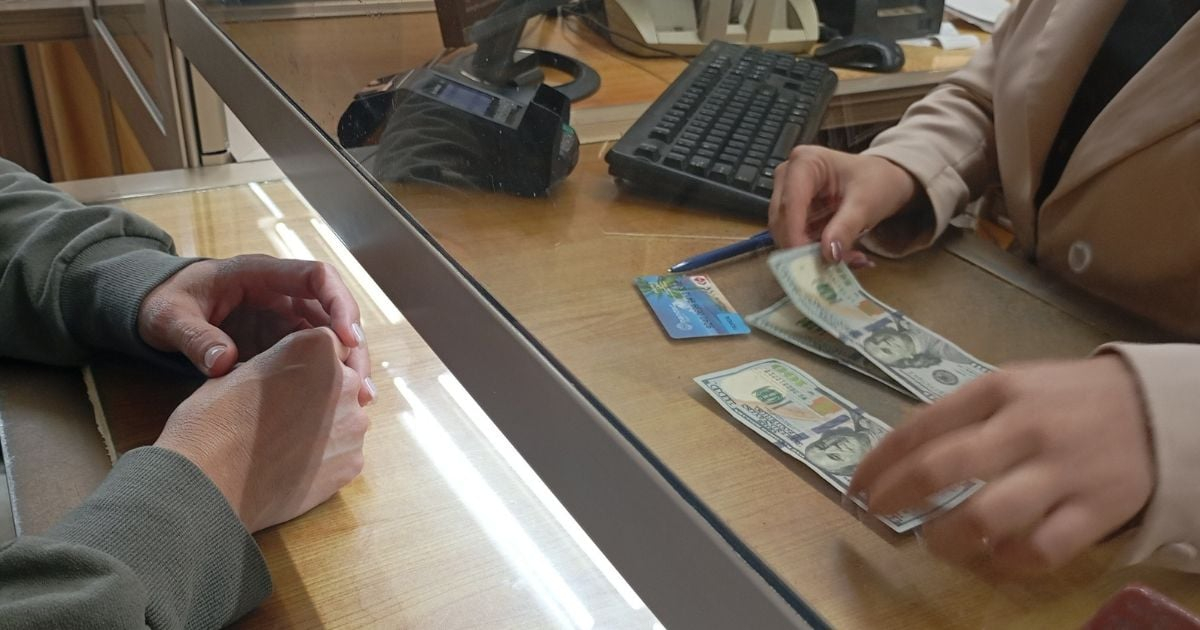
On April 7, Fincimex S.A. revealed a major change in Cuba's remittance system, announcing that funds sent from anywhere in the world could now be collected in cash in U.S. dollars at CADECA offices across all 15 provinces of Cuba. This was presented by the Cuban regime as one of the most significant updates to the remittance process in recent years.
Just two days later, on April 9, CADECA proudly showcased what it called the "first operation" of this new service on social media. They highlighted an event at a branch in Guantánamo, featuring images of a woman receiving dollars at the counter, symbolizing the launch of this mechanism.
However, responses from Cubans largely reflected skepticism. "Did they have a connection? It's a miracle... that was just for show," one social media user commented. Another was more blunt: "Western Union has been doing this since 1871."
The Process and Costs Involved
According to Fincimex, the procedure involves three key steps. Initially, the sender abroad must register with a partner remittance agency, create a user profile, validate their email, and designate a beneficiary.
Once registration is complete, the system provides a code to the sender, who then shares it with the beneficiary in Cuba.
The recipient must visit an authorized CADECA office, present their ID card, and provide the assigned code to collect their money in U.S. dollars.
The sender bears all operational costs, with no commission charged to the beneficiary. It costs $111.29 to send $100 to a Clásica card and $110.97 to a Tropical card.
Remittances can be sent from any country and in any currency. CADECA applies the current exchange rate to convert the funds to dollars, which the beneficiary receives in cash.
Additionally, Fincimex promotes the Clásica card as a complement to this service. Priced at four dollars, it is reloadable only in dollars and offers discounts between 4% and 10% in state-owned stores like CIMEX, Tiendas Caribe, Trimagen, and Gaviota. However, prices in these stores can be up to four times higher than those in U.S. supermarkets, even with the discounts.
Concerns and Doubts Persist
One of the most notable concerns among Cubans is the actual availability of cash. The system's inherent flaw is that the amount of dollars available at each branch is contingent on daily collections, meaning there's no guarantee every beneficiary will receive their funds when needed.
"This is a trap: you go and there's no cash," warned one user. "Anyone sending money this way is crazy... later they'll say there's no cash," commented another. A third user added, "If there's power, of course..."—a nod to the chronic blackouts that plague the island.
The Collapse of Formal Remittance Channels
The introduction of this new service comes amid a breakdown of the formal remittance system. From 2019 onwards, remittances contributed between $2,055 and $3,700 million annually. However, a series of U.S. sanctions since then dismantled these formal channels.
In June 2020, Fincimex was sanctioned by the Office of Foreign Assets Control (OFAC) due to its ties with GAESA, the Cuban military conglomerate, forcing Western Union to halt operations in November that year. In response, the regime created Orbit S.A. as an alternative operator, but it was added to the State Department's Restricted List on March 10, 2025, leading to the indefinite suspension of Western Union services from the U.S. in February 2025.
This had a catastrophic impact on state coffers: GAESA collected merely $81.6 million in formal remittances in 2024, a mere 4.13% of the total, compared to $1,972 million in 2023. Over 95% of remittances shifted to approximately 150 "informal banks" operating outside the state system.
Analysts suggest the Cuban state retains 74.3% of every $100 sent through formal channels, through taxes and markups in stores with freely convertible currency, with margins up to 240%. Fincimex, a GAESA subsidiary, controls around 41% of formal remittances and operates CADECA as a collection network.
Additionally, since January 2026, a 1% federal tax on cash remittances, money orders, or cashier's checks has been in effect in the U.S., part of the legislative package known as the "One Big Beautiful Bill," further discouraging use of formal channels from the United States.
Simultaneously, Correos de Cuba reactivated its international money order service in April 2026, aligning with the state's strategy to expand formal currency collection mechanisms during a time of dire need.
The accumulated mistrust from years of broken promises heavily influences the public's perception of this new service. "Let's wait and see what stories surface about not being able to withdraw money," one user wrote. "I'm still skeptical," another summarized, encapsulating the sentiment of those who have learned to question every announcement from the regime.
Understanding the New Remittance Process in Cuba
How does the new remittance system in Cuba work?
The system involves three steps: the sender registers with a partner remittance agency, receives a code, and shares it with the beneficiary in Cuba, who then collects the cash at a CADECA office.
What are the costs associated with sending remittances to Cuba?
The sender bears the transaction costs. Sending $100 to a Clásica card costs $111.29, while sending the same amount to a Tropical card costs $110.97.
What challenges does the new remittance system face?
The primary challenge is the unpredictable availability of cash at CADECA offices, which depends on daily collections, and the general mistrust among Cubans towards government promises.