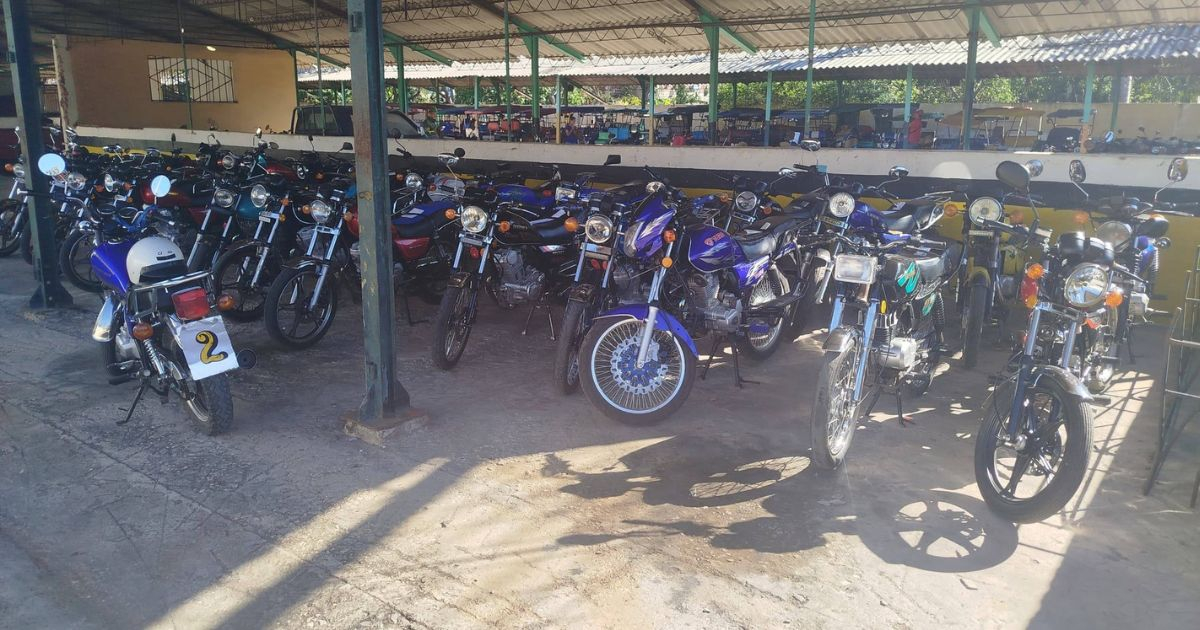
A significant crackdown targeting motorcycle riders and horse-drawn carriage operators in Santiago de Cuba led to the seizure of more than 200 motorcycles and at least 20 carriages on Thursday, according to reports received by journalist Yosmany Mayeta Labrada.
One of the individuals affected, Fernando Mendoza, explained that authorities are confiscating motorcycles and carriages "for any reason," causing alarm among the city's informal transport workers.
The images shared depict a large gathering of people near what appears to be a holding area, with numerous vehicles impounded and citizens waiting for updates on their means of transportation.
As of now, no official statement has been released regarding the reasons behind the operation or the regulations under which these seizures are being carried out, exacerbating the uncertainty among those impacted.
The February Operation and Public Backlash
This April operation surpasses the scale of a previous one on February 19, when authorities immobilized 181 vehicles—including motorcycles, electric tricycles, and motor tricycles—at Santiago de Cuba's Provincial Holding Center, citing violations of the Law 109 of the Road Safety Code.
In February, the state-run radio station CMKC reported that the vehicles were seized due to illegal parking, driving without a license, poor technical condition, and unauthorized modifications to exhaust systems.
The February crackdown also sparked a wave of public criticism. "Seriously, given the situation we're living in? Now that transportation is so poor, they decide to be this extreme and take away the little that's moving people on the streets. This is madness," wrote social media user Adri Diva.
Other users were equally outspoken. "They've chosen the worst time for that law," remarked user Wik, while Raul Oscar summed up the authorities' actions: "Seizure, prohibition, fines, confiscation, those are the government's favorite words."
Transportation Crisis Worsens
The impact of these actions is particularly severe given the collapse of public transportation in the province. Out of 196 routes in Santiago de Cuba, only 126 are operational—about 64.3%—with reduced frequencies due to fuel shortages, lack of spare parts, and the deterioration of nearly 70% of the roadways.
In this void, motorcycles, electric tricycles, and informal carriage transport have become the backbone for the daily mobility of thousands of Santiagueros, who lack any other options for getting around the city.
Government's Contradictory Measures
The situation appears even more contradictory considering that in February 2026, the Ministry of Transport issued temporary licenses for unregistered motorcycles and tricycles, valid until December 2026. Moreover, on March 24, Resolution 7/2025 from the Ministry of the Interior came into effect, expanding motorcycle and moped license plates from five to six digits to regularize thousands of unregistered vehicles.
While the regime introduces regularization measures with one hand, it launches mass seizure operations with the other, directly affecting those who sustain the population's transportation during one of Cuba's most critical crisis moments.
Understanding the Transportation Crackdown in Santiago de Cuba
What triggered the massive vehicle seizure in Santiago de Cuba?
The operation, which resulted in the confiscation of over 200 motorcycles and several carriages, lacks an official explanation. However, previous crackdowns cited violations of the Road Safety Code as justifications.
How has the public reacted to these operations?
The public has expressed significant criticism and frustration, particularly given the dire state of public transportation. Many see these actions as extreme measures that worsen the daily struggle of transportation for residents.
What is the current state of public transportation in Santiago de Cuba?
Public transportation in Santiago de Cuba is in a critical condition, with only 64.3% of routes operating due to shortages in fuel and parts, as well as deteriorating infrastructure.