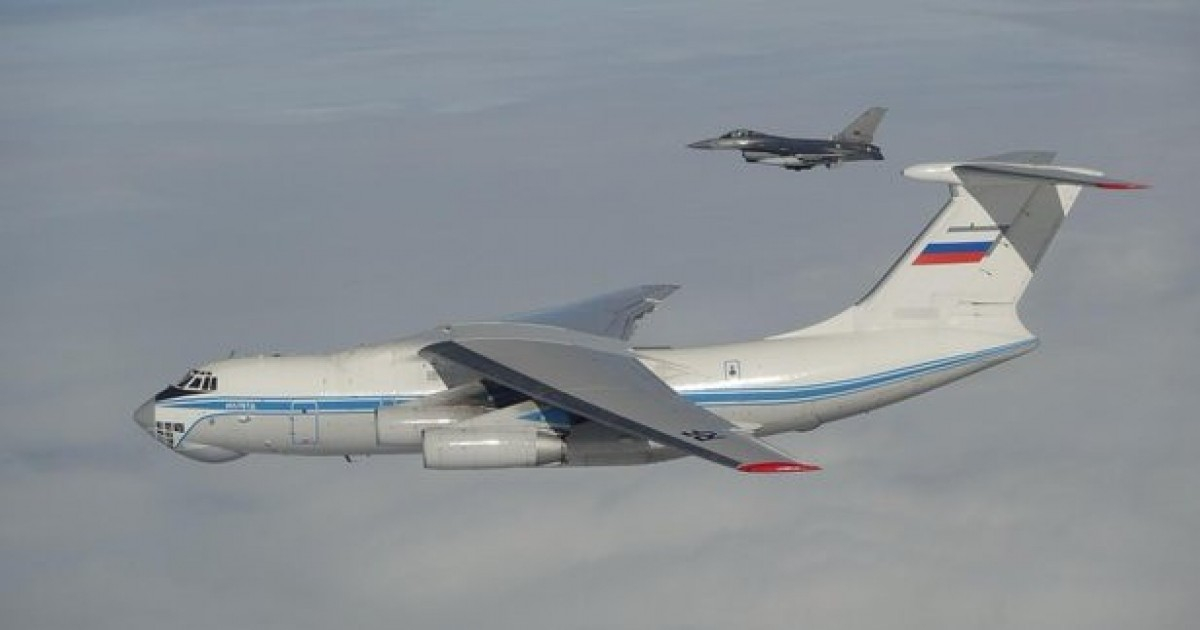
Last Monday, Portuguese Air Force F-16AM jets intercepted a Russian Ilyushin Il-76 military transport aircraft flying close to NATO airspace over the Baltic Sea. This marked the first emergency deployment by the Portuguese detachment since they took over the NATO Enhanced Air Policing mission.
The NATO Air Command reported the incident on Tuesday via its official X account.
"Yesterday, Portuguese F-16s scrambled urgently to identify a Russian Ilyushin Il-76 'Candid' flying near NATO airspace. This was the first Alpha Scramble by the Portuguese detachment since assuming the Enhanced Air Policing mission at Ämari Air Base, Estonia, replacing the Italian Air Force," the tweet detailed.
The Portuguese contingent, consisting of four F-16AM fighters and approximately 95 military personnel, took over from the Italians—who operated Eurofighter Typhoons—on April 1 and are assigned the mission until July 31.
The intercepted aircraft, an Ilyushin Il-76TD—designated "Candid" by NATO—is a primary strategic transport for the Russian Armed Forces. It can carry up to 60 tons or transport 128 paratroopers, reaching speeds of 900 km/h and has an operational range of 5,000 kilometers.
Images released by NATO showed the Russian aircraft bearing the Russian Federation flag on its fuselage. It was escorted by Portuguese jets without any reported violation of allied airspace.
Understanding NATO's Alpha Scramble Procedure
An Alpha Scramble is a NATO procedure that orders the urgent take-off of fighter jets armed with real air-to-air missiles to identify unidentified or potentially hostile aircraft. Pilots must be airborne within 15 minutes of the order.
This mission marks Portugal's ninth participation in NATO's Baltic missions and the second from Ämari base, located in Estonia. Estonia is one of the three Baltic countries without its own combat aviation, and its airspace has been permanently protected by the Alliance since 2004.
The incident occurred amid escalating aerial tensions in the region. On March 18, a Russian Su-30SM fighter violated Estonian airspace near the island of Vaindloo in the Gulf of Finland, remaining for approximately one minute without authorization or a flight plan.
On that occasion, Italian Eurofighter Typhoons—still operational in Ämari—responded to the incursion, and Estonia summoned the Russian chargé d'affaires to deliver a formal diplomatic protest note.
Russian activity in the Baltic intensified throughout the week. The same Wednesday that NATO announced the Portuguese interception, French Rafale jets deployed at the Šiauliai base also conducted their first interception since taking over the Baltic Air Policing mission there.
NATO recorded more than 500 scrambles in allied airspace during 2025, a figure only surpassed by the historic peak of 570 interceptions recorded in 2022, following Russia's full-scale invasion of Ukraine.
Key Insights into NATO's Baltic Air Policing
What is NATO's Enhanced Air Policing mission?
NATO's Enhanced Air Policing mission is a defensive measure aimed at protecting the airspace of member countries that do not have their own air defense capabilities. It involves the deployment of fighter jets to quickly respond to any aerial threats near NATO airspace.
How does an Alpha Scramble work?
An Alpha Scramble is an urgent order for fighter jets to take off and intercept unidentified or potentially hostile aircraft. The pilots must be airborne within 15 minutes to carry out the mission, which often involves escorting the aircraft away from NATO airspace.