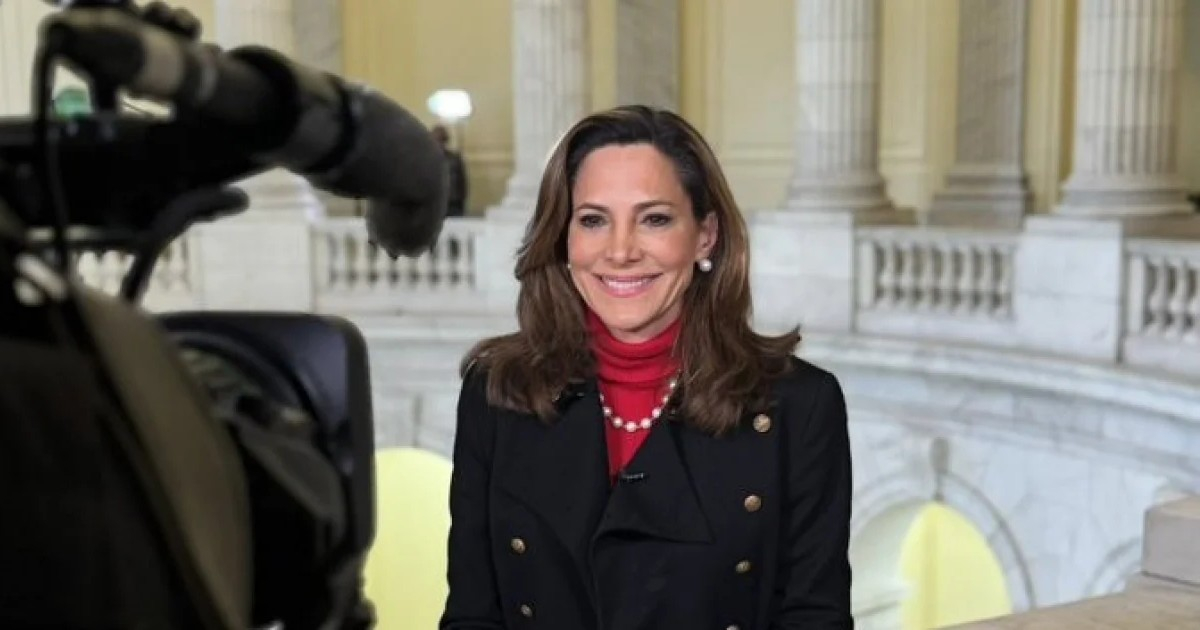
Cuban-American Republican Congresswoman María Elvira Salazar expressed her support on Wednesday for the statements made by White House Press Secretary Karoline Leavitt, asserting that the Cuban regime should be the next to fall because it "has never been weaker and can no longer suppress the will of its people."
Salazar shared her thoughts on X, directly responding to Leavitt, who had stated earlier that day from the White House podium that the Cuban regime is destined to collapse, describing the country as being "economically and financially very weak," with its people fed up with their government.
Representing Florida, Salazar expanded her viewpoint to a regional scale: "The tide is turning throughout the Western Hemisphere, and Cuba is next in line."
She also invoked history to highlight the urgency of the situation: "After 67 years of oppression, the Cuban people deserve to reclaim their nation."
She concluded her message with three words that encapsulate the stance of the most vocal Cuban-American legislators in Washington: "Freedom is coming."
Escalation of U.S. Signals Toward Cuba
Salazar's remarks align with a series of signals from the Trump administration. On March 27, the President declared in Miami that "Cuba is next," and three days later, from Air Force One, he predicted that "the regime will fail soon." Secretary of State Marco Rubio has also forecasted "significant developments quite soon" regarding the island.
Leavitt clarified on Wednesday that Trump's comments do not hint at military action but rather point to the political and economic collapse of the regime. She confirmed ongoing high-level discussions with Cuba, without providing specific details.
Challenges Facing Cuba Amidst Regional Shifts
In Havana, Deputy Foreign Minister Josefina Vidal acknowledged to AFP that there are contacts with Washington, yet described them as a "very initial phase, without formal negotiations."
The backdrop to these statements is an unprecedented crisis on the island. Following the fall of Nicolás Maduro in Venezuela on January 3, Cuba lost its supply of subsidized Venezuelan oil, which accounted for two-thirds of its energy imports, resulting in blackouts lasting up to 30 hours a day.
The Cuban economy has contracted by 23% of GDP since 2019, with an additional projected decline of 7.2% for this year, according to The Economist Intelligence Unit.
Increased Sanctions and Rising Protests
Since January, the Trump administration has imposed over 240 new sanctions on Cuba and signed Executive Order 14380, declaring the regime an extraordinary threat and imposing tariffs on countries supplying it with oil.
Protests on the island have surged in parallel: in January 2026 alone, there were 953 demonstrations and expressions of discontent. The regime responded with selective repression and released more than 2,000 prisoners on April 3, a move Salazar dismissed as propaganda for excluding political prisoners.
Salazar has been warning about the regime's end for months. On February 25, she stated it was in its "final phase"; on March 13, she demanded the release of all political prisoners, telling the dictatorship directly, "Your time is up."
On February 20, she declared that "the regime has nothing left to offer but repression."
Meanwhile, Díaz-Canel has threatened a "war of all the people" in response to any U.S. military actions, which analysts interpret as an attempt to deter the growing pressure from Washington.
Understanding the Current Situation in Cuba
Why is the Cuban regime considered weak?
The Cuban regime is considered weak due to its severe economic and financial troubles, exacerbated by the loss of subsidized Venezuelan oil and ongoing U.S. sanctions. This has triggered widespread dissatisfaction among the Cuban populace.
What has been the response from Cuban officials?
Cuban officials, including Deputy Foreign Minister Josefina Vidal, have acknowledged initial contacts with the U.S. but have downplayed them as being in a very early stage without formal negotiations.
How has the international community reacted to Cuba's situation?
The international community, particularly the U.S., has increased sanctions and diplomatic pressure on Cuba, with predictions of the regime's imminent collapse. There have been ongoing discussions at high levels, though specific outcomes remain unclear.