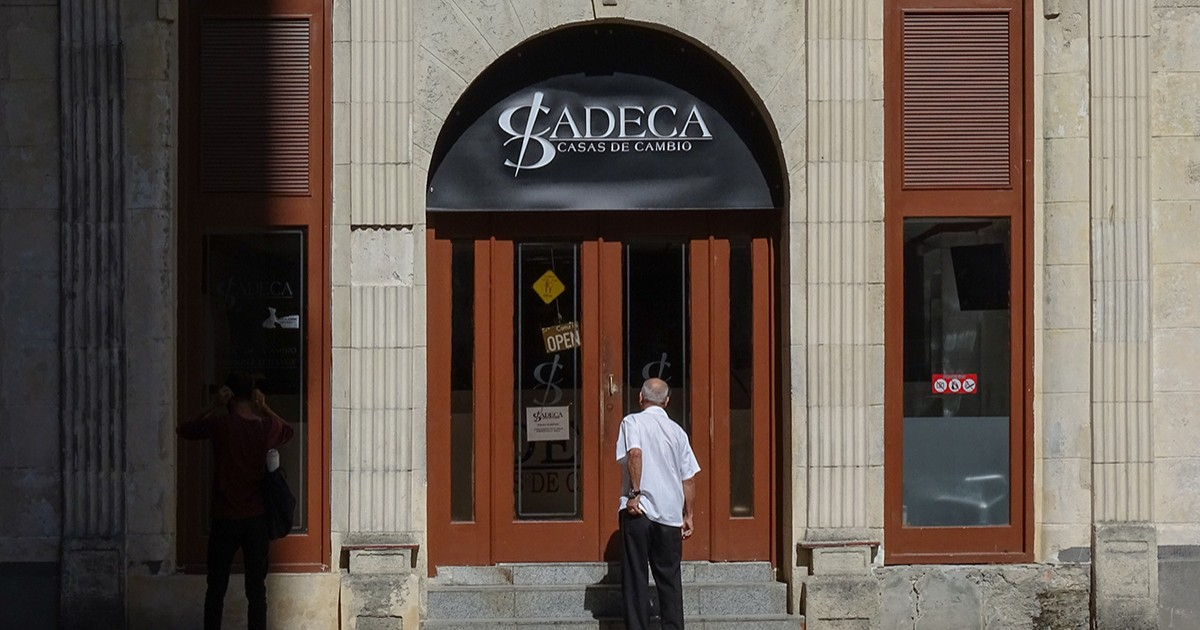
The financial entity Financiera CIMEX S.A. (Fincimex) has recently announced a new option for receiving remittances in Cuba. From now on, money sent from abroad can be collected in cash, specifically in U.S. dollars, directly at the Casa de Cambio (CADECA) offices. This service, described by Fincimex, promises to deliver funds "from anywhere in the world, within minutes."
Through a Facebook post, Fincimex explained that recipients have the option to deposit part or all of the funds into their Clásica card accounts. This financial product in dollars offers discounts and additional benefits in the state-run commercial network.
Expanding Financial Options in Cuba
Fincimex emphasized that this initiative is part of a broader strategy to enhance remittance management options. The goal is to improve access to foreign currency and encourage savings through the Clásica card.
Coinciding with the third anniversary of the Clásica card, the institution highlighted its role as a consolidated payment tool offering advantages to its holders. Fincimex asserts, "With Clásica, you always save more!" and encourages users to visit CADECA for easy and secure remittance management.
How Does This New Service Work?
According to information provided by Fincimex, remittances that are sent with the cash payment option can now be withdrawn in dollars at CADECA offices. However, if the remittance is sent for cash payment, it will only be paid in that mode. Despite this, the entity continues to promote the use of the Clásica card.
Nevertheless, the announcement lacks critical details such as which remittance companies offer this service, the applicable commissions, exchange rates used, and the exact procedure for sending money from abroad. These omissions have led to numerous questions among users.
Public Reaction: Skepticism and Unanswered Questions
The announcement sparked a flood of comments, mostly skeptical or critical. Some users argued that the measure was overdue: "This should have been done a long time ago... restoring trust in Cuban banks will be challenging," one user remarked, highlighting a persistent issue: "What matters is having the cash available when you go to pick it up."
Others questioned the actual availability of cash: "Will the money be there when I want to withdraw it?" asked another user. Concerns also arose about potential pressure to use the Clásica card: "The option to deposit into your Clásica card is just talk," commented one person, while another feared clients might be forced to deposit part of their money.
Critiques of the Clásica Card and Banking System
Much of the feedback also included broader criticisms of the state financial system and the Clásica card. "The good news is always for you," one user commented, while another questioned: "The benefits of Clásica are for the government that keeps your money."
Fincimex responded, stating, "You are mistaken. The benefits are the discounts available to cardholders." However, others rejected this argument: "It's not true that 'you always save more with Clásica.' There are no incentives when paying for fuel," noted a commenter.
Ongoing Structural Issues: Wait Times and System Failures
Even with the new option, many comments pointed to ongoing difficulties within the system. "With the lines, blackouts, and system failures at CADECA, the headache is immense," one user noted. Delays in receiving remittances were also highlighted: "In minutes... Not true," wrote a user who had been waiting days for a transfer.
Comparisons were made with informal channels: "Private individuals deliver instantly," contrasting with what was described as the slow pace of official platforms.
Accessibility and Service Coverage Concerns
Another critical issue is the service's availability across the country. Users from areas like the Isla de la Juventud questioned how it would operate in regions where CADECA reportedly does not provide services. The official response was brief: "For now, only in Cadecas."
Additionally, some users reported difficulties in obtaining the Clásica card in certain areas: "No Clásica card available until further notice," a user commented.
Demand for Clear Information
One of the most repeated complaints was the lack of detailed information in the announcement. "Give us the complete news," one user demanded. Another summarized the general sentiment: "Incomplete information; you have to go to Cadeca to ask."
Unanswered questions include: "Through which remittance company can cash be received?" "What is the procedure?" "Will it also be available in euros or only in dollars?" So far, Fincimex's public responses have not clarified these aspects.
Although receiving remittances in cash dollars theoretically expands options, the reaction on social media indicates that the measure does little to alleviate the accumulated distrust towards the state financial system.
With doubts about the real availability of cash, criticisms of the Clásica card's functionality, and questions about the transparency of the process, the announcement raises more questions than it answers. As one user summed it up: "I don't see the fine print..."
Complex Context for Remittance Flows
This measure comes amid a challenging environment for remittance flows to Cuba. In recent months, sending money to the island has faced multiple hurdles: the U.S. government included Orbit S.A. in the Restricted List, limiting available options for Cubans abroad.
Additionally, Western Union suspended its services for transfers from the U.S. to Cuba indefinitely, and Cubamax later halted its transfers in April, further reducing available channels. However, the Cuban regime has sought to restore some routes. At the end of 2025, the government authorized Cubamax Travel Inc. to resume operations, and similar authorizations were granted to the Spanish company Bagalso in the following months.
Furthermore, starting January 2026, a federal tax of 1% on foreign remittances came into effect in the United States, directly impacting those sending money to Cuba from that country. This occurs in a scenario where recent analyses indicate that GAESA controls 95% of the transactions in the Cuban economy.
Key Questions About Cuba's New Remittance Option
What is the new remittance option introduced by Fincimex?
Fincimex announced that remittances sent from abroad can now be collected in cash, specifically in U.S. dollars, at CADECA offices across Cuba.
What are the benefits of using the Clásica card?
The Clásica card offers financial benefits such as discounts and additional advantages within the state-run commercial network in Cuba.
Are there any concerns regarding the availability of cash dollars?
Yes, users have expressed skepticism about whether cash dollars will be readily available when they attempt to withdraw their remittances at CADECA.
How has the remittance flow to Cuba been impacted recently?
Remittance flows to Cuba have faced challenges, including restrictions on Orbit S.A. by the U.S. government, the suspension of Western Union services, and a new U.S. federal tax on foreign remittances.