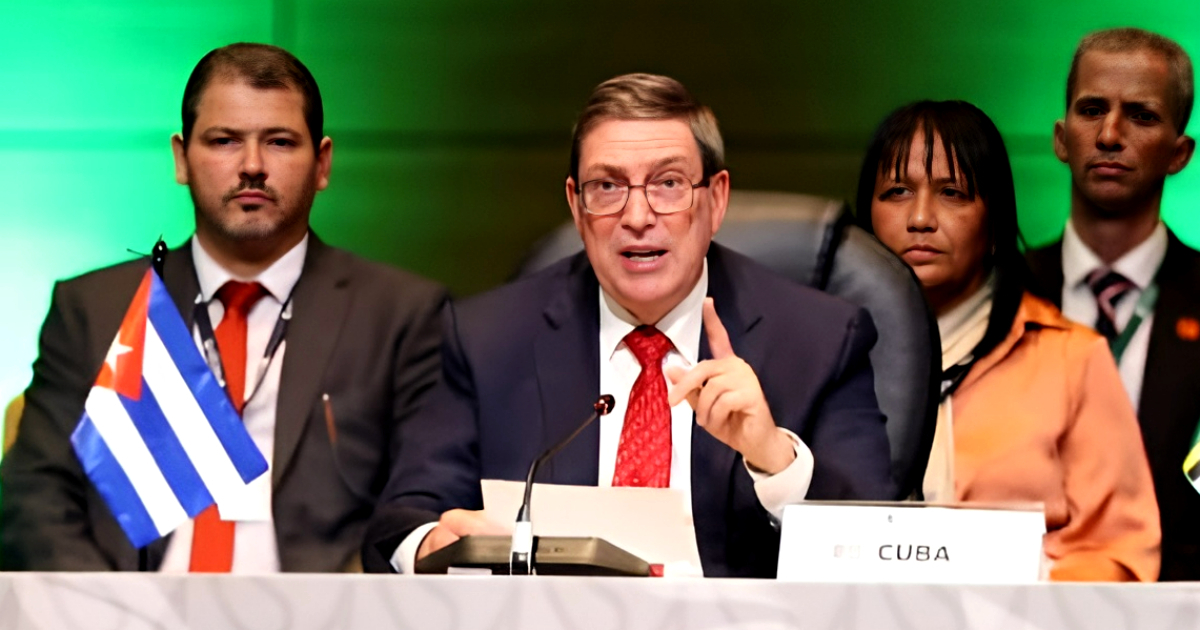
Once again, Cuban Foreign Minister Bruno Rodríguez Parrilla has resurrected a cornerstone of the regime's propaganda: the Mallory Memorandum.
According to the regime's well-worn narrative, this document is purportedly the "foundation" of a "genocidal" U.S. policy against Cuba. While the claim is not new, it remains profoundly misleading.
The memorandum, penned in April 1960 by a State Department official, was neither a law, an executive order, nor a government directive. Instead, it was an internal analysis during the Cold War, at a time when the Cuban regime had already begun seizing American properties and was moving toward a strategic alliance with the Soviet Union.
To claim this text as the origin of all U.S. policy towards Cuba is a deliberate distortion.
The Real Roots of the Embargo
The embargo imposed in 1962 did not arise from a single memo, but from a series of concrete events. Between 1959 and 1960, the Cuban government appropriated billions of dollars in U.S. assets—refineries, sugar mills, companies—without fair compensation. In retaliation, Washington revoked Cuba's sugar quota, a major source of foreign exchange for the island.
Havana responded by deepening its dependence on the Soviet Union, signing economic and military agreements. During the Cold War, the establishment of a Soviet ally just 90 miles from the United States was perceived as a direct strategic threat.
This context, rather than any document, explains the embargo. Reducing it to the Mallory Memorandum is not a mistake; it is propaganda.
A Convenient Narrative Tool
While Mallory's text does reflect a clear idea: applying economic pressure to weaken the Cuban regime, it is not the "manual" for the embargo nor the cause of the Cuban crisis.
The regime employs it because it fits perfectly into its narrative of an omnipotent external enemy responsible for all internal woes. However, the facts dismantle that narrative.
For over six decades, the Cuban economic model has demonstrated:
- Chronically low or negative growth
- Structural dependence on external subsidies (first the USSR, later Venezuela)
- Productive collapse in key sectors like agriculture and the sugar industry
- Failed monetary dualism and incomplete economic reforms
Even during periods of eased sanctions, such as under the Obama administration, the Cuban economy failed to take off or generate sustained prosperity.
Victimhood as State Policy
Rodríguez Parrilla's rhetoric is filled with terms like "energy siege," "cognitive warfare," or "genocidal blockade." This isn't technical language; it's political rhetoric designed to garner support and deflect blame.
Labeling economic sanctions as "genocide" is not only incorrect under international law but trivializes a term reserved for crimes of extermination.
Meanwhile, the regime avoids answering crucial questions: Why doesn't Cuba produce enough food? Why does it rely on basic imports after decades of state control? Why do economic reforms always come too late or get reversed?
The answer isn't found in Washington but in Havana and the totalitarian communist regime built over decades, now crumbling, exacerbating violence and corruption.
The Real Issue They Won't Acknowledge
The Mallory Memorandum is a historically relevant document, but using it as a comprehensive explanation for the Cuban crisis is a political strategy, not a serious analysis.
Six decades later, the regime continues to rely on the same argument because it allows them to avoid the essential: acknowledging that the economic and political model imposed in Cuba has failed.
Beyond external sanctions, that failure has internal culprits.
Understanding the Cuban Economic Crisis
What is the Mallory Memorandum?
The Mallory Memorandum is an internal document from April 1960, written by a State Department official, analyzing potential U.S. strategies during the Cold War.
Why does the Cuban regime focus on the Mallory Memorandum?
The regime uses the memorandum to support its narrative of an external enemy, diverting attention from the internal failures of Cuba's economic and political model.
How did the U.S. embargo on Cuba originate?
The U.S. embargo on Cuba was a response to the Cuban government's expropriation of American assets without compensation, and its strategic alliance with the Soviet Union during the Cold War.
What challenges does the Cuban economy face?
The Cuban economy faces challenges including low growth, dependency on foreign subsidies, a failed monetary system, and incomplete reforms.