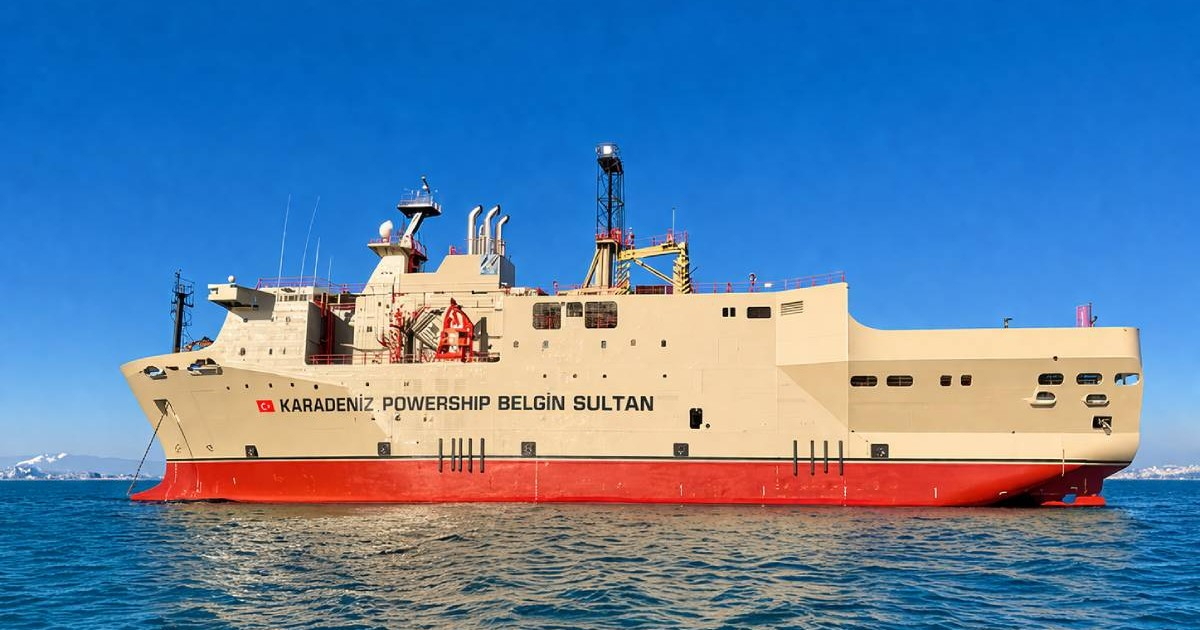
The Cuban Ministry of Energy and Mines has dismissed reports of a Turkish floating power plant, often referred to as a "turkish barge," arriving in Havana this Monday. However, it confirmed that the 'Belgin Sultan' is indeed operational within the country.
According to Turkish news outlet Yeniakit, the floating power plant 'Belgin Sultan,' operated by Turkish company Karpowership, docked at the Havana port and was set to start operations on Monday to help alleviate Cuba's severe energy crisis.
The presence of the vessel along Cuba's coast was verified through AIS tracking by analyst Falcon on platform X. This was also reported by national media outlets like Radio Progreso and CMKC Radio Revolución. Nevertheless, the Cuban government insists that no new barge has arrived in Havana.
"Currently, there are two barges in Cuba, Belgin Sultan and Erol Bay, with an installed capacity of 124 MW. No additional units have been added in recent hours. With the arrival of Russian fuel, they will begin generating electricity in the second half of this month," stated a post from the Ministry of Energy and Mines on X.
Energy Crisis Amidst Conflicting Reports
The Cuban government did not clarify how long the Belgin Sultan power plant has been on the island or its exact location. Their brief statement was followed by Radio Progreso removing its Facebook post, which had garnered over 800 interactions and numerous comments from Cubans.
The alleged appearance of a new Turkish floating power plant comes during a profound energy crisis in Cuba. This follows the confirmation that the Russian state shipping company Sovcomflot's tanker, 'Anatoly Kolodkin,' completed unloading 730,000 barrels of crude oil at Matanzas Super Tanker Base on April 4.
Karpowership's Global Reach
The 'Belgin Sultan,' part of the Orca class with an estimated maximum capacity of 235 megawatts, was transformed into a floating power plant in 2014 at the Sedef shipyard in Tuzla, Turkey. It has previously operated in the Havana Bay alongside other units from the same company.
Karpowership, a subsidiary of Karadeniz Holding, boasts the world's sole fleet of power-generating ships of this magnitude: over 45 units with a combined capacity exceeding 8,000 megawatts, operating in more than fifty countries.
These floating power stations can utilize liquefied natural gas, natural gas, and liquid fuels, integrating swiftly into terrestrial power grids, making them an emergency solution for crisis-stricken nations.
Strategic Foreign Assistance
The supposed return of the Turkish barge is part of a dual external support strategy employed by the Havana regime amid the collapse of its energy infrastructure. The plan involves Karpowership's technology alongside Russian crude oil.
Russian Energy Minister Sergey Tsivilev recently announced that a second oil ship was being loaded for dispatch to Cuba.
Cuba's energy crisis stems from structural issues primarily due to decades of neglect in thermal power plants and a lack of investment in the energy sector, which could otherwise boost industries like tourism.
Amid debates over the Turkish barge's arrival, the regime reported on Monday that the Antonio Guiteras thermal power plant began cooling its boiler after unexpectedly going offline at 3:00 AM while generating 170 megawatts (MW).
Understanding Cuba's Energy Challenges
What is the significance of the Turkish floating power plant in Cuba?
The Turkish floating power plant, operated by Karpowership, aims to mitigate the severe energy crisis in Cuba by providing additional power capacity amidst critical shortages.
How does the floating power plant operate?
These power plants can operate using liquefied natural gas, natural gas, and liquid fuels, and they quickly integrate with land-based power grids, offering a rapid solution in emergency situations.
What is the current status of Cuba's energy sector?
Cuba's energy sector suffers from decades of neglect and insufficient investment, particularly in thermal power plants, contributing to the ongoing energy crisis.