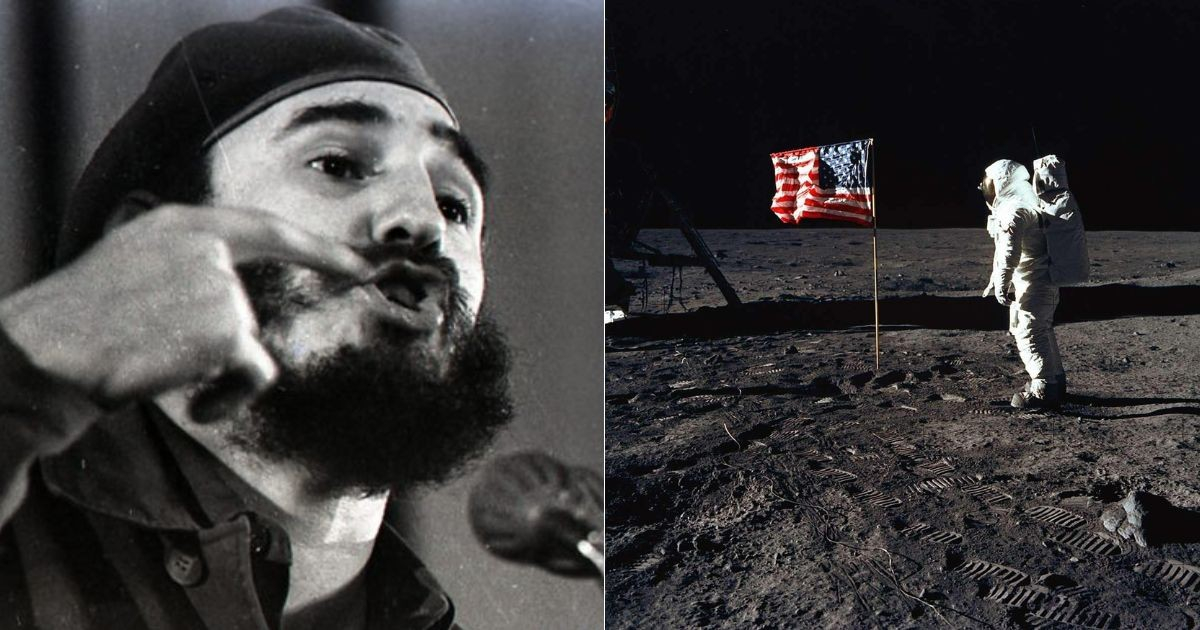
In a recently shared account, Cuban writer, producer, and former TV director Eugenio Antonio "Yin" Pedraza Ginori revealed that Fidel Castro's government prevented the Cuban people from witnessing the Apollo 11 moon landing on July 21, 1969. As Pedraza recounts, this censorship deprived the Cuban public of witnessing one of humanity's most significant achievements.
This testimony, part of the first volume of Pedraza's book Memorias Cubanas, was shared alongside the launch of NASA's Artemis II mission, which took off last Tuesday with four astronauts on board. "The event is being widely covered by news outlets worldwide, except in Cuba," Pedraza noted, highlighting the persistent pattern of censorship that dates back to 1969.
"The live broadcast of this historic event, watched by millions globally, was denied to Cubans. The decision, driven by clear political reasons, ensured that our people couldn't witness this scientific milestone," Pedraza elaborates.
The Secret Viewing of the Apollo 11 Landing
Days before the moon landing, the Cuban Institute of Broadcasting (ICR) set up a satellite viewing station on the sixth floor of Radiocentro, accessible only to a select few. Pedraza recalls that on the day of the landing, access to this area was restricted by an employee from the National Television News, ensuring that only a privileged group could watch the event.
Pedraza Ginori described how the passage to this area was blocked by a loyal guard determined to keep others out. Those interested in following the Apollo 11 mission had to do so clandestinely, tuning into shortwave broadcasts from Voice of America or other stations.
Resistance and Rebellion Against Media Control
Despite the intense censorship, some Cubans managed to watch the moon landing using homemade and illicit TV antennas. This act of defiance against strict censorship mirrors the lengths many Cubans have gone to over the years to watch Major League Baseball games, which were similarly banned for decades.
In October 1969, months after the landing, Pedraza Ginori was tasked with directing a TV program titled "Tuesday Panel – The Conquest of the Cosmos," which downplayed the moon landing in favor of Soviet space achievements. The ICR refused to allow footage of the moon landing to be shown.
During the program's recording, engineer Luis Larragoiti Alonso, a guest from Cuba's Academy of Sciences Astronomy Group, brought a special edition of Life magazine featuring extensive photographic coverage of Apollo 11. Pedraza recalls that for many Cubans, it was their first glimpse of these images. Mysteriously, the magazine disappeared during the recording, leading to a military investigation and questioning of all involved.
Enduring Censorship in Cuba's Media Landscape
The incident highlights the systemic censorship enforced by Cuba's government since 1959, when independent newspapers were shut down and all media was centralized under Communist Party control. During the Cold War, Soviet space successes were prominently featured in Cuban media, while American accomplishments were downplayed or ignored. For the Cuban regime allied with Moscow, the Apollo 11 moon landing was an uncomfortable political triumph for the United States.
In the present day, NASA's Artemis II, the first crewed mission to the Moon in over fifty years, is on its ten-day journey around the natural satellite, with a splashdown scheduled for April 10 in the Pacific Ocean. This past Sunday, the crew captured images of the Orientale Basin, a lunar geological formation never before seen in its entirety by human eyes.
As internet access becomes more widespread, albeit limited by poor connectivity, Cubans are finding ways to stay informed about such events. The regime's grip on information is increasingly challenged by the unstoppable march of new technologies.
Exploring Censorship and Media Control in Cuba
Why did Fidel Castro's regime block the Apollo 11 broadcast in Cuba?
The regime feared that broadcasting the moon landing would highlight American achievements, which was politically inconvenient for the Cuban government, allied with the Soviet Union during the Cold War.
How did some Cubans manage to watch the moon landing?
Some Cubans used illegal and homemade antennas to capture broadcasts from foreign stations, defying the government's strict media censorship.
What impact does internet access have on censorship in Cuba today?
Despite poor connectivity, increased internet access is allowing Cubans to bypass traditional censorship and access information from global sources.