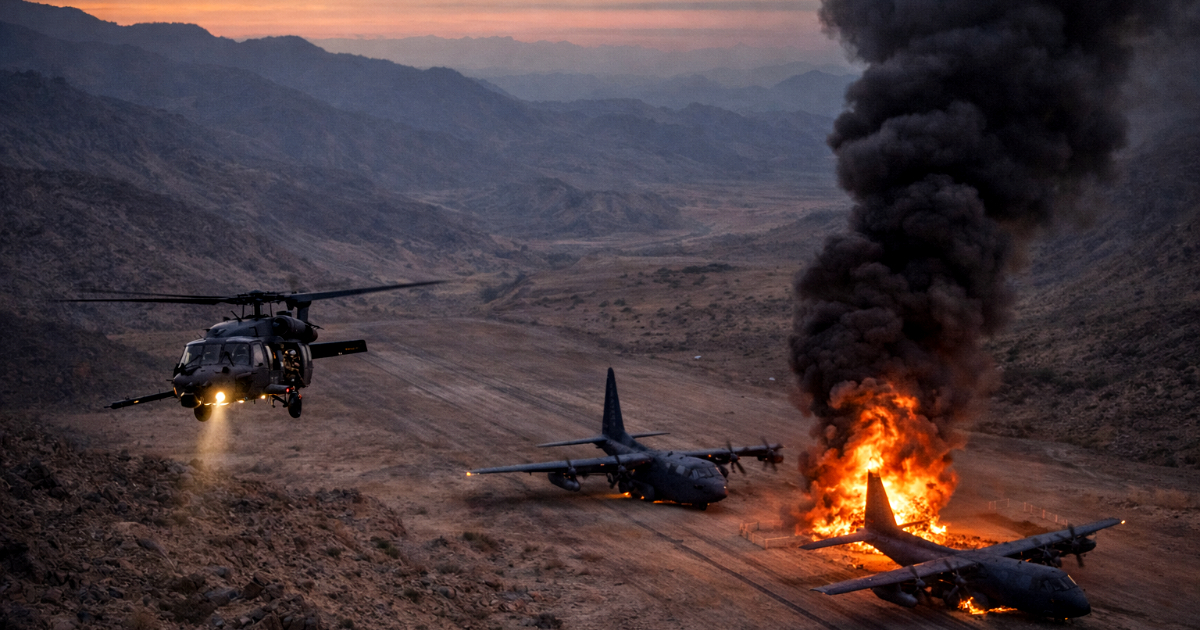
The daring rescue of the second crew member from a downed F-15E fighter jet in Iran was not only a high-stakes military mission conducted in enemy territory, but it also involved significant financial losses due to the destruction of highly valuable special operations aircraft.
The American serviceman spent over 36 hours hiding in a mountainous area in southwestern Iran, actively evading Iranian forces backed by the Revolutionary Guard and mobilized civilians. During his time in hiding, he relied on his survival training, activated an emergency beacon, and frequently changed locations to avoid capture.
Meanwhile, the U.S. military tracked his location in real-time and orchestrated a Combat Search and Rescue (CSAR) mission under extremely hostile conditions. This complex operation involved the deployment of numerous aircraft and special forces, including air cover, direct confrontations, and combat zone extraction.
According to reports from outlets like The Wall Street Journal, The Guardian, and The Times, the mission utilized HH-60 rescue helicopters, A-10 Thunderbolt II close support aircraft, and C-130 and MC-130 planes for command, refueling, and special operations roles.
President Donald Trump hailed the mission as “one of the most audacious in U.S. military history.”
Despite the rescue's success, various indications reveal that the operation did not proceed without complications. Specialized media confirmed that at least two helicopters sustained damage from Iranian fire, while an A-10 was hit during parallel operations, forcing its pilot to eject.
The most notable detail, as reported by The Wall Street Journal and other international media, is the deliberate destruction of at least two MC-130J Commando II aircraft by the United States. These special operations planes, valued between $90 and $110 million each, were reportedly immobilized or compromised on the ground within Iran, necessitating their self-destruction to prevent them from falling into enemy hands.
Additionally, the loss of the F-15E itself, estimated at $30 to $35 million, compounded by damages to other aircraft involved, suggests that the rescue operation may have led to material losses exceeding $200 million, according to Pentagon standard cost assessments.
Despite these setbacks, the White House has consistently portrayed the mission as a complete success, emphasizing that both crew members were rescued alive. However, discrepancies between the official narrative and independent reports indicate the operation was conducted under far greater pressure than publicly acknowledged.
This incident highlights both the operational capabilities of the U.S. military and the increasing risks of a conflict that continues to escalate in intensity, complexity, and financial cost.
Key Insights on U.S. Military Rescue in Iran
What was the main challenge faced by the U.S. military during the rescue operation in Iran?
The main challenge was conducting a high-risk rescue mission in hostile territory while avoiding capture by Iranian forces, which required complex coordination and real-time tracking.
How much were the aircraft losses estimated to cost the U.S.?
The aircraft losses, including the destruction of specialized planes and damages to others, were estimated to exceed $200 million.
How did President Trump describe the rescue mission?
President Trump described the rescue mission as "one of the most audacious in U.S. military history."