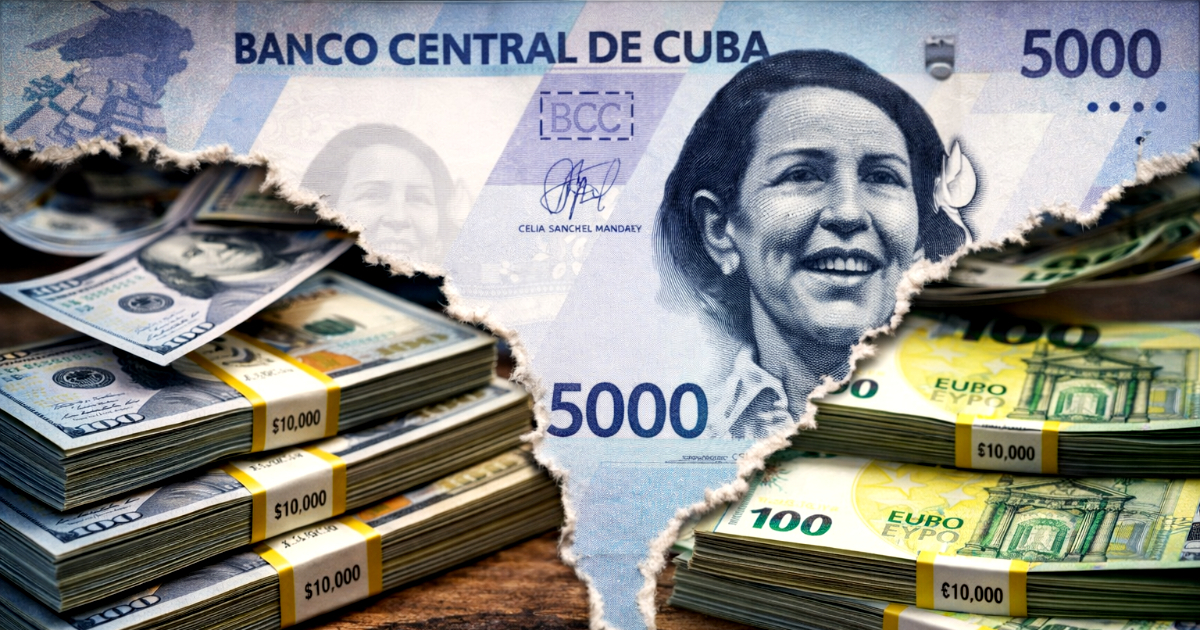
The informal currency market in Cuba has reported a fresh increase in the value of the U.S. dollar and the euro this Saturday, April 4th. This development emerges amidst growing skepticism towards the Cuban peso, following the regime's recent issuance of higher denomination banknotes.
Based on the monitoring conducted by the independent outlet elTOQUE, the U.S. dollar (USD) is currently trading at 518 Cuban pesos (CUP), while the euro (EUR) has climbed to 585 CUP. This continues an upward trend that began after nearly two weeks of stability in the parallel market.
This shift coincides with the Cuban Central Bank's (BCC) announcement of new 2,000 and 5,000 CUP banknotes. The authorities have justified this move as a response to rising prices and to facilitate cash transactions.
Nevertheless, beyond the official rationale, many Cubans perceive the introduction of these larger bills as a clear indication of the peso's declining value, prompting increased demand for foreign currencies as a safer haven.
In economies plagued by high inflation and little confidence in the national currency, such measures often have an immediate effect: they heighten perceptions of devaluation and accelerate the so-called “flight to the dollar.” In Cuba's case, where the informal market serves as the true exchange rate benchmark, this impact is swiftly reflected.
The recent uptick in the dollar — from 515 to 518 CUP over just two days — and the euro's rise to 585 CUP suggest a shift in trend following a period of prior stability.
Meanwhile, the MLC (Moneda Libremente Convertible) is exhibiting the opposite trend, dropping to 390 CUP, highlighting its volatility and dependence on domestic consumption.
In this context, the issuance of high-denomination bills does not seem to ease market tensions; rather, it exacerbates them by reinforcing the perception that the Cuban peso continues to lose value in everyday transactions.
The result is a market that is once again on the rise, driven not only by economic factors but also by expectations and a lack of trust in the national currency.
Insights on Cuba's Currency Market Dynamics
Why are the dollar and euro increasing in value in Cuba?
The rise in the dollar and euro's value is largely due to the introduction of high-denomination bills by the Cuban regime, which has led to increased distrust in the Cuban peso and a higher demand for foreign currencies.
How does the informal market affect currency exchange rates in Cuba?
In Cuba, the informal market acts as the real exchange rate benchmark, reflecting changes and trends swiftly. This market's dynamics significantly influence the perceived value of the Cuban peso against foreign currencies.