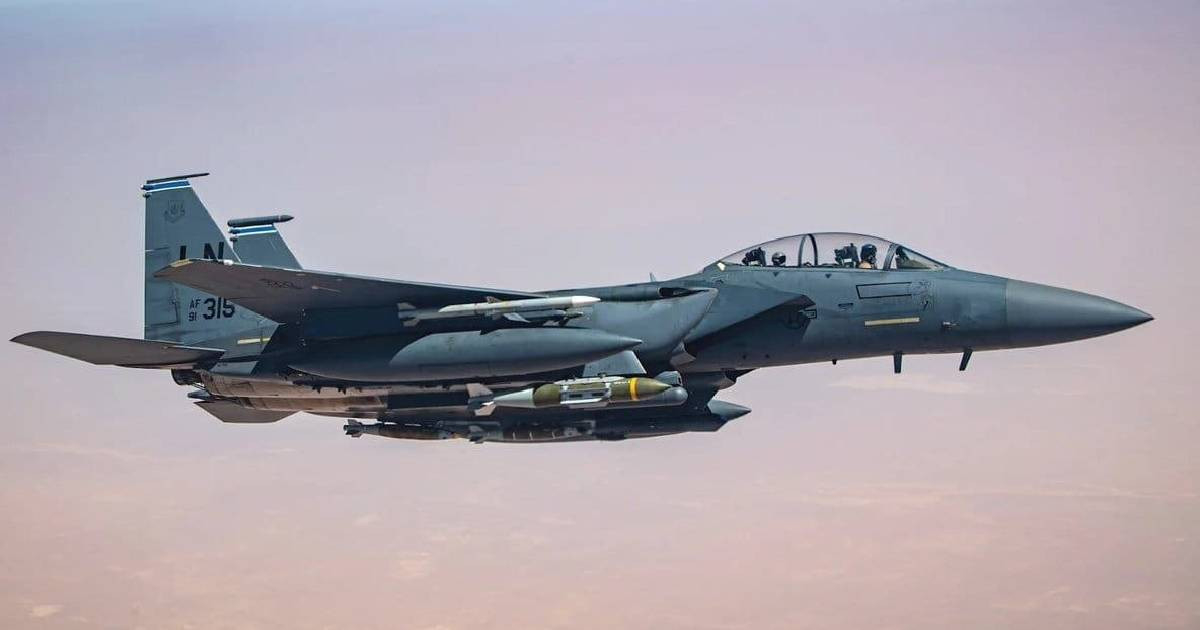
A United States Air Force F-15E Strike Eagle was shot down over Iranian territory on Friday, with one crew member successfully rescued by U.S. forces, according to anonymous sources from the U.S. and Israel who spoke to AP and CBS News.
This marks the first time a manned U.S. aircraft has been lost in Iranian territory since the conflict began on February 28, signaling a significant escalation in the five-week-old war.
Karoline Leavitt, the White House spokesperson, stated in a press release that President Donald Trump had been briefed on the situation, though no further details were provided.
The F-15E is operated by a two-person crew, and search and rescue missions for the second crew member were ongoing as of the report's publication.
Iranian Claims and Local Reactions
The Islamic Revolutionary Guard Corps claimed responsibility for shooting down the aircraft over central Iran, although it was initially unclear whether the jet was directly hit or crashed due to other reasons.
An Iranian state-affiliated TV channel in the Kohkilouyeh and Boyer-Ahmad province, a vast and mountainous region, urged locals to hand over any "enemy pilots" to authorities, offering a reward for doing so. The channel also broadcasted a message encouraging viewers to "shoot if they see" any U.S. aircraft in the area.
International Search and Rescue Efforts
Social media images depicted at least one U.S. C-130 aircraft and two Black Hawk helicopters flying at low altitudes over southwestern and central Iran, as part of what was described as a combat search and rescue operation. Israel is also reportedly aiding in the rescue efforts.
The downing of the aircraft contradicts statements made just a day earlier by Admiral Brad Cooper, head of U.S. Central Command, who claimed, "In our fifth week of the campaign, my operational assessment is that we are making undeniable progress. We do not see their navy sailing. We do not see their aircraft flying, and their air and missile defense systems have been largely destroyed."
Wider Conflict and Economic Impact
Since the conflict began, the U.S. has lost at least 16 MQ-9 Reaper drones over Iran, and three F-15 jets were mistakenly shot down over Kuwait early in the war without resulting in casualties, as reported by CBS News.
Concurrently, Iran heightened its attacks on Gulf energy infrastructures on Friday: Kuwait's Mina al-Ahmadi refinery was targeted, Saudi Arabia downed several Iranian drones, and the United Arab Emirates shut a gas field following debris fallout from a missile interception.
The price of Brent crude hovered around $109 per barrel on Friday, more than 50% higher than at the war's outset, driven by Iran's blockade of the Strait of Hormuz, a critical waterway for global oil and natural gas trade.
Former Iranian Foreign Minister Mohammad Javad Zarif proposed a negotiation framework in Foreign Affairs magazine on Friday to end the conflict: Iran "should offer to impose limits on its nuclear program and reopen the Strait of Hormuz in exchange for the lifting of all sanctions, a deal Washington might now consider accepting, though it had previously refused."
Key Developments in the Iran-U.S. Conflict
What aircraft was involved in the incident over Iran?
The incident involved a U.S. Air Force F-15E Strike Eagle fighter jet.
How has Iran's actions affected global oil prices?
Iran's blockade of the Strait of Hormuz has driven Brent crude prices over $109 per barrel, significantly higher than at the start of the conflict.
What was the response from local Iranian media to the downing of the aircraft?
Iranian state-affiliated media urged residents to capture and hand over U.S. pilots, even offering rewards, and encouraged viewers to shoot at U.S. aircraft.