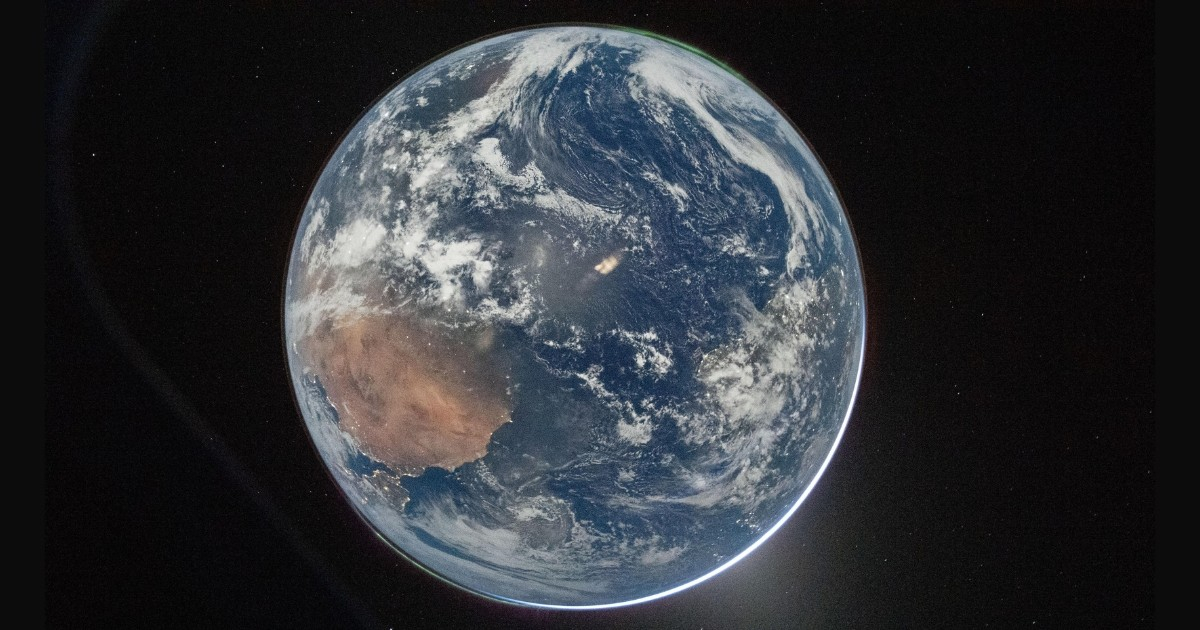
This past Friday, NASA unveiled breathtaking high-resolution photographs of Earth, taken from the Orion capsule of the Artemis II mission. Accompanied by the cheerful message "Good morning, world," these images were released as the four astronauts continue their journey to the Moon.
The photos showcase our planet from deep space, highlighting vivid shades of blue and brown, intricate cloud formations, and a rare green aurora visible in Earth's atmosphere. Such clarity from this distance is seldom captured.
"We observe our planet as a whole, bathed in stunning blues and browns. A green aurora even illuminates the atmosphere. It’s us, united, watching as our astronauts embark on their lunar voyage," the space agency shared on its official account.
One of the images was captured from inside the capsule, framing Earth through the spacecraft's window, providing a genuine astronaut's view during their mission.
Launched last Wednesday at 6:35 PM Eastern Time from Kennedy Space Center’s launch pad 39B in Cape Canaveral, Florida, Artemis II took off aboard the Space Launch System rocket.
On Thursday, after about 25 hours in Earth orbit, the spacecraft performed a five-minute and 49-second translunar injection maneuver, marking its crew as the first humans beyond Earth orbit since Apollo 17 in December 1972.
The crew is led by Commander Reid Wiseman, with Pilot Victor Glover—recognized as the first African American to travel near the Moon—and Mission Specialist Christina Koch—celebrated as the first woman on a manned lunar mission—alongside Canadian Jeremy Hansen, the first Canadian citizen to join such a mission.
The spacecraft, aptly named "Integrity" by its crew, is equipped with over 28 cameras, including Redwire 12-megapixel cameras, 4K video capabilities, and modified GoPro cameras mounted on its solar panels.
These stunning images are also made possible by the Optical Communications System O2O, which uses infrared lasers to transmit 4K video from deep space at speeds of up to 260 Mbps, far surpassing the radio communications of the Apollo era.
While Artemis II will not land on the Moon, its primary goal is to validate Orion’s systems with a human crew before the Artemis III mission, which aims to achieve the first lunar landing since Apollo 17.
The lunar flyby is scheduled for April 6, at over 4,700 miles from the Moon's far side, with a splashdown planned for April 10 in the Pacific Ocean off the coast of San Diego.
Key Insights on Artemis II and NASA's Lunar Missions
What is the mission objective of Artemis II?
Artemis II's mission objective is to test and validate the Orion spacecraft's systems with a human crew, paving the way for the Artemis III mission, which aims to achieve a lunar landing.
Who are the crew members on the Artemis II mission?
The Artemis II crew consists of Commander Reid Wiseman, Pilot Victor Glover, Mission Specialist Christina Koch, and Canadian astronaut Jeremy Hansen.
How are the images from Artemis II transmitted to Earth?
The images from Artemis II are transmitted using the Optical Communications System O2O, which employs infrared lasers to deliver 4K video from deep space at high speeds.