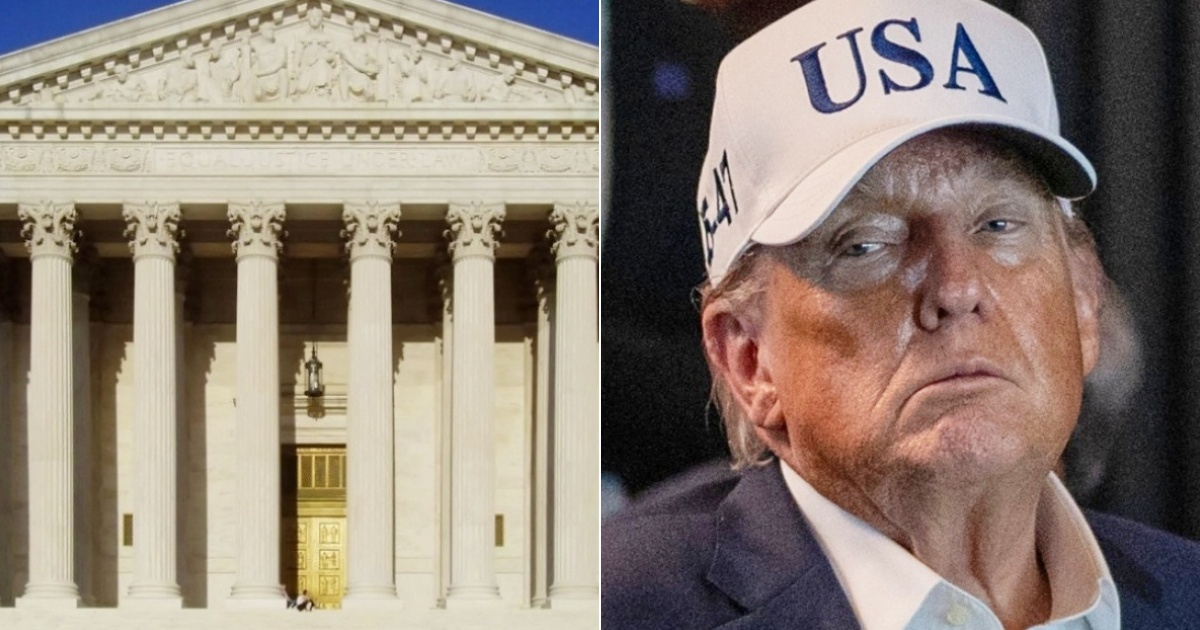
The United States Supreme Court expressed skepticism on Wednesday regarding President Donald Trump's effort to limit birthright citizenship. The session was notable not only for the critical questioning by the justices but also for the unprecedented presence of Trump himself in the courtroom.
During the proceedings, justices from across the ideological spectrum questioned the legal basis of the executive order, signaling significant doubts about its constitutionality.
Judicial Skepticism Over Birthright Citizenship Order
At the heart of the discussion is the executive order titled “Protecting the Meaning and Value of American Citizenship.” The administration argues that children born in the U.S. to parents who are undocumented or on temporary visas should not automatically be granted citizenship. However, the justices were notably skeptical of this interpretation.
For over two hours, the Supreme Court's conservative and liberal judges scrutinized the policy aimed at denying automatic citizenship to children born in the United States to parents without permanent residency.
Trump's attendance, lasting over an hour, broke traditional protocol and heightened the political stakes of a case viewed as pivotal.
Solicitor General D. John Sauer faced a barrage of skeptical questions as the justices delved into both the legal and practical implications of the order.
The case reached the Supreme Court after being deemed illegal by all lower courts, which have prevented its enforcement.
In New Hampshire, Federal Judge Joseph N. LaPlante ruled that the policy “likely violates” both the Constitution and federal law.
Trump's Continued Rhetoric
Following the hearing, President Trump promptly voiced his opinion through a post on Truth Social, criticizing the current policy: “We are the only country in the world DUMB enough to allow ‘birthright citizenship’!”
However, data from the Pew Research Center contradicts this claim, showing that at least 32 other countries have similar policies, while around 50 nations employ more restrictive versions.
The 14th Amendment's Citizenship Clause in Question
The legal battle centers on the interpretation of the Citizenship Clause of the 14th Amendment, which declares that all people born or naturalized in the U.S., and under its jurisdiction, are citizens.
The Trump administration argues that individuals in the country illegally or temporarily are not “subject to the jurisdiction” of the United States, and thus their children should not receive automatic citizenship. This view, supported by some conservative factions, seeks to reinterpret a century-old principle.
Sauer urged the court to address what he described as “long-standing misconceptions about the Constitution’s meaning,” likening this case to landmark decisions such as Brown v. Board of Education (1954) and District of Columbia v. Heller (2008).
Nevertheless, opposition within the court has been strong. Justice Sonia Sotomayor previously called the attempt “an impossible task in light of the Constitution's text, its history, this court's precedents, federal law, and Executive practice.”
Potential Impact on Hundreds of Thousands of Children
Beyond the legal debate, the case has immediate human ramifications. According to estimates from the Migration Policy Institute and Pennsylvania State University, over a quarter of a million babies born each year in the U.S. could be affected by the executive order.
Civil rights advocates and critics of the measure claim it represents a radical reinterpretation of the concept of citizenship.
“We have the President of the United States attempting to radically redefine the notion of American citizenship,” said Cecillia Wang, legal director of the American Civil Liberties Union.
Furthermore, the order would not only impact undocumented immigrants but also individuals with temporary legal status, such as students or those applying for permanent residency.
Part of a Broader Immigration Agenda
The attempt to curtail birthright citizenship is part of a broader immigration policy under Trump, which has included increased deportations, reduced refugee admissions, suspended asylum at the border, and removed temporary protections for migrants.
This case is yet another challenge for a Supreme Court that has, in recent times, allowed some restrictive immigration policies to proceed, even after being halted by lower courts.
The Supreme Court will not issue an immediate decision. A ruling is expected by late June, but its impact could be profound and lasting.
At stake is not only an executive order but also the interpretation of a fundamental aspect of American legal identity. The decision could either reaffirm a historical principle or pave the way for an unprecedented redefinition of who is entitled to U.S. citizenship.
Exploring the Supreme Court's Deliberations on Birthright Citizenship
What is the central issue in the Supreme Court case regarding birthright citizenship?
The case revolves around the legality and constitutionality of an executive order aiming to restrict birthright citizenship for children born in the U.S. to parents who are undocumented or hold temporary visas.
How has the Supreme Court responded to Trump's executive order?
The justices have expressed skepticism about the executive order's legal basis and its alignment with constitutional principles, particularly focusing on the 14th Amendment's Citizenship Clause.