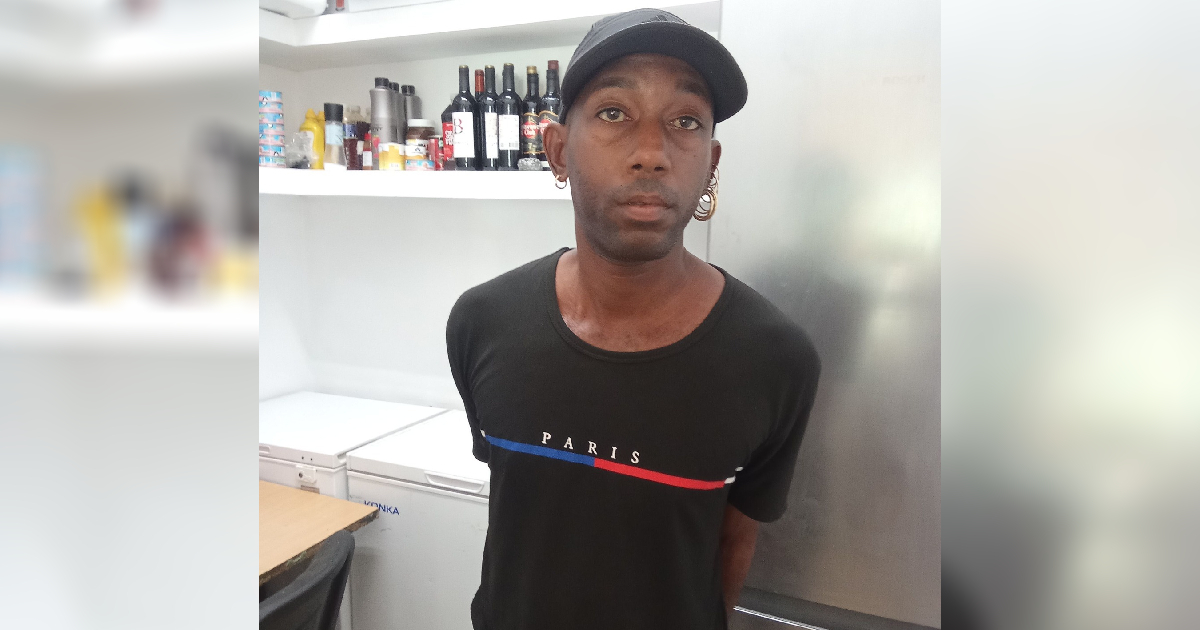
A man was apprehended in the Plaza de la Revolución district of Havana after being caught impersonating the municipal director of Hygiene and Epidemiology to defraud private businesses.
His capture was made possible due to the proactive intervention of local residents, later aided by officers from the National Revolutionary Police (PNR), as reported by Pedro Lizardo Garcés Escalona, president of the “Rampa” Popular Council in Vedado, on Facebook.
"The individual shown in the photo was apprehended by the community with the assistance of PNR agents. He had been scamming various private ventures in our municipality, falsely claiming to be the municipal director of Hygiene and Epidemiology for Plaza de la Revolución," the statement read.
The post included an image of the alleged scammer—wearing a black t-shirt emblazoned with "PARIS" and a matching cap—likely taken inside one of the affected businesses, with shelves of bottles and refrigeration equipment visible. The identity of the detained man was not disclosed.
Fraud Tactics in Private Sector
To fraudulently obtain money, the suspect targeted non-state businesses, exploiting the fear that entrepreneurs and owners of small and medium enterprises have towards inspections and penalties from authorities.
Victims were urged to report their cases at the PNR unit located at Zapata and C in Vedado.
A Widespread Issue
This scam method is not unfamiliar in Cuba. In October 2023, another person was arrested in Havana for using false documentation to impersonate an inspector from the Provincial Directorate of Comprehensive Supervision and Control (DISC) to defraud individuals. This incident came to light following a victim's complaint in late September of that year.
Similar incidents have occurred in other provinces. In Holguín, a man was detained for pretending to be a Transport inspector and illegally charging for rides on the street.
Exploiting a Climate of Fear
This type of fraud thrives in an environment where government inspections of private businesses are common and legitimate. Between February 11 and 17, inspectors from the Plaza de la Revolución Municipal Administration Council visited 11 non-state management forms, nine self-employed workers, three small and medium enterprises, and one state entity, issuing 12 fines ranging from 1,500 to 8,000 Cuban pesos for violations such as undisclosed prices, overpricing, and hygiene issues.
Such real oversight pressures lend credibility to those posing as officials to private business owners, creating fertile ground for scammers to exploit entrepreneurs' fear of fines and other sanctions.
Economic Instability and Digital Scams
The non-state sector in Cuba has expanded significantly in recent years, with new regulations in 2026 decentralizing the approval of non-state economic actors to municipalities, further broadening the scope of businesses vulnerable to this type of fraud.
Other scam methods, such as those executed through digital platforms, have also seen a rapid increase amid the country's severe economic crisis.
Earlier this month, a Cuban woman reported being victimized by a scam involving a bank transfer, using one of the island's most widespread forms of fraud: digital identity theft.
Understanding Fraud in Cuba's Private Sector
How are scammers exploiting private businesses in Cuba?
Scammers impersonate government officials to prey on the fear of inspections and fines, tricking business owners into paying them under false pretenses.
What measures can business owners take to protect themselves from scams?
Business owners should verify the identity of any inspector by checking official identification and contacting the relevant authorities before complying with any demands.
What is the impact of these scams on Cuba's economy?
These scams undermine trust in both the private sector and government oversight, potentially stunting economic growth and discouraging private enterprise.