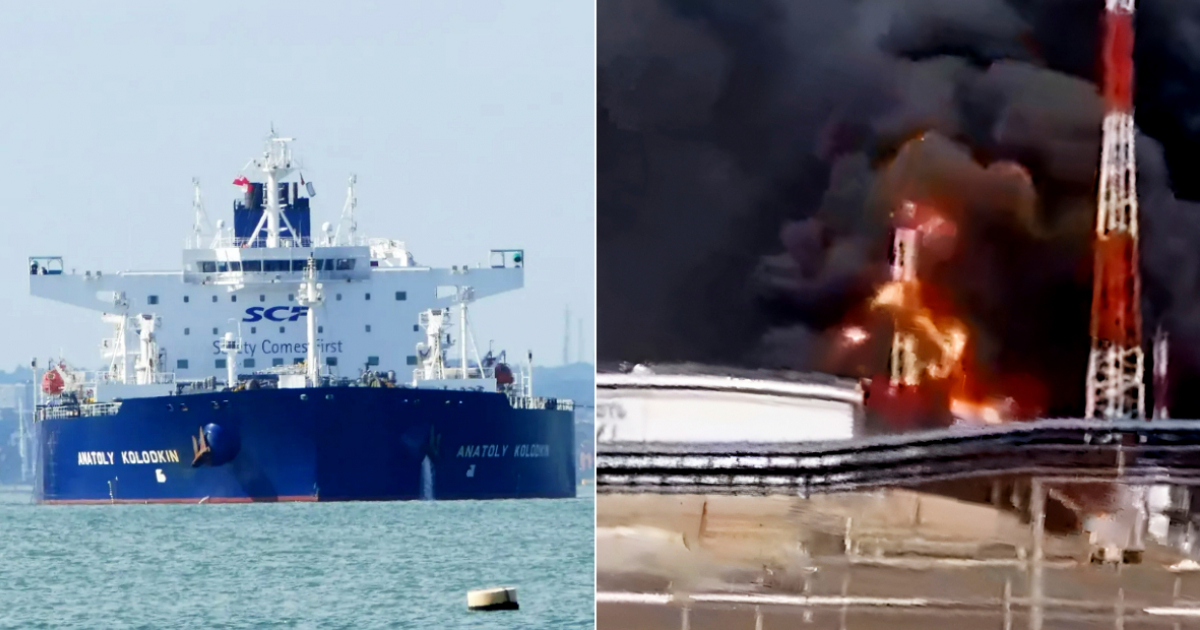
The arrival of the Russian tanker Anatoli Kolodkin in Cuba is part of a more intricate scenario than it initially appears. The crude oil loaded at Primorsk, one of Russia's prominent energy ports, has recently become a target of Ukrainian drone strikes.
Ukraine has ramped up its attacks on the Baltic oil corridor, hitting facilities in both Primorsk and Ust-Luga, two vital hubs for Russian crude exports. These assaults have resulted in fires, damage to storage tanks, and partial shutdowns, directly impacting Moscow's ability to maintain its international oil shipments.
The intention behind these strikes is evident: to cut the Kremlin's revenues amidst ongoing conflict. As the world's second-largest oil exporter, Russia heavily relies on these sales, while Ukraine aims to weaken this financial lifeline. Various analyses suggest that these operations are likely supported by Western intelligence agencies.
Within this context, the shipment of 730,000 barrels to Cuba takes on a different significance. Although the Trump administration allowed the tanker to dock—purportedly as a humanitarian gesture—the U.S. continues to exert effective control over the energy flow to the island. Washington authorizes specific shipments while restricting the Cuban regime's stable access to fuel.
This creates a strategic paradox: the United States permits the oil's arrival but simultaneously contributes—directly or indirectly—to undermining the infrastructure enabling these deliveries. Russia succeeds in sending shipments like that of the Anatoli Kolodkin, yet faces mounting pressure on its export capacity.
For Cuba, this translates into even more precarious dependence. The cargo covers only about a week's consumption in a nation that requires around 100,000 barrels daily to sustain its electrical grid and economy. Each shipment serves as a temporary reprieve within an increasingly uncertain supply chain.
In essence, this situation reinforces an emergent trend: the United States not only pressures the Cuban regime but is also beginning to position itself as the entity that, directly or indirectly, determines which oil reaches the island.
Rather than an energy relief, the case of the Anatoli Kolodkin illustrates how Cuba's crisis is ensnared in a geopolitical chess game, where Havana's survival hinges on external decisions.
Key Questions About Russia's Oil Shipments to Cuba
Why is Ukraine targeting Russian oil ports like Primorsk and Ust-Luga?
Ukraine aims to diminish Russia's revenue streams by attacking key oil export facilities, thereby weakening the Kremlin's financial resources amid ongoing conflict.
How does the U.S. influence oil shipments to Cuba?
The United States controls the flow of oil to Cuba by authorizing specific shipments while restricting stable access, thus exerting significant influence over the island's energy supply.
What impact do these oil shipments have on Cuba's energy needs?
The shipments provide only temporary relief, as they cover a week's worth of consumption in a country that needs around 100,000 barrels daily to maintain its economy and electrical grid.