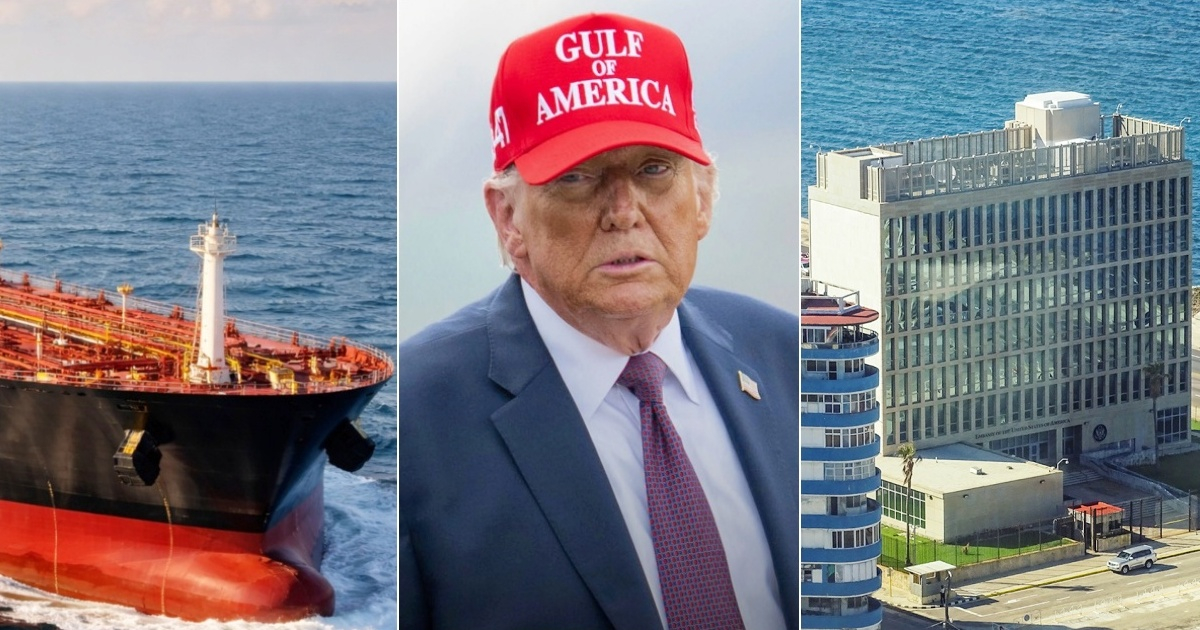
In a surprising turn of events, the U.S. administration under Donald Trump reportedly allowed a Russian oil tanker to dock in Cuba amidst ongoing energy restrictions on the island. The decision, as revealed by journalist Eric Martin, seemingly followed a strategic move by the Cuban regime regarding the U.S. Embassy in Havana.
Martin, who specializes in State Department affairs, disclosed on social media platform X that Washington approved the delivery of the Russian crude only after Havana granted a crucial concession to the American diplomatic mission.
"Indeed, the U.S. intends to permit Cuba to receive this incoming Russian tanker," Martin noted, elaborating on the circumstances surrounding the decision.
"However, this comes AFTER the Cuban regime sanctioned the importation of fuel for the U.S. Embassy," he added, citing information from informed sources.
A Shift in U.S. Policy
This apparent policy reversal from the White House contrasts sharply with the hardline stance taken just weeks earlier, when the Trump administration had threatened sanctions and tariffs on nations supplying oil to Cuba.
Martin highlighted another revealing aspect, stating, "Trump just mentioned having 'no problem' if a country wants to send oil to Cuba now."
He warned that this stance might catch off guard governments that were recently pressured by Washington. "This could be a big surprise for Mexico and several other nations," he commented, recalling that they had been "threatened with tariffs only two months ago for doing exactly that."
Confirmation from the Air Force One
Martin's remarks align with comments made by President Trump himself during a press interaction aboard Air Force One. Trump confirmed the arrival of the Russian tanker Anatoly Kolodkin, loaded with between 700,000 and 730,000 barrels of crude oil destined for Cuba.
"If a country wants to send some oil to Cuba, I have no issue with it," the president stated unequivocally.
When questioned about any potential advantage for Russia, Trump dismissed it: "It doesn't help. They lose a ship of oil. That's all," he remarked, referring to Moscow.
The president defended his decision on humanitarian grounds, saying, "I'd rather let it through... because people need heating, cooling, and all the other necessities."
Despite this, he maintained a critical stance towards the Cuban regime. "Cuba is finished. They have a bad regime... very bad and corrupt leadership," he asserted, emphasizing that the oil arrival "won't make a difference."
The Oil Shipment Amidst Cuba's Energy Crisis
The Russian tanker, sanctioned by the United States, the European Union, and the United Kingdom, departed from Primorsk in early March and arrived in Cuba on Monday, as confirmed by Russian authorities.
The vessel carries approximately 100,000 tons of crude—equivalent to over 700,000 barrels—in what marks the first significant fuel supply for the island in more than three months.
Despite the immediate impact, experts like Jorge Piñón from the University of Texas estimate that the shipment will only suffice for about two weeks of consumption in a nation battered by prolonged power outages and a deep energy crisis.
The Embassy's Role Amidst Blackouts
The alleged "action" by the Cuban regime, cited by Martin as a catalyst for the U.S.'s favorable response to the oil delivery, follows weeks of tension over fuel supply to the U.S. Embassy in Havana.
As previously reported by The Washington Post, the Cuban government initially rejected a request from the diplomatic mission to import fuel for its generators amidst constant blackouts.
This refusal forced the embassy to scale back operations, consolidate staff into shared housing, and limit generator usage, all while facing mounting challenges to maintain basic functions.
That situation reportedly changed, allowing fuel importation, in what now appears to be a concession that, according to sources cited by Martin, could have played a role in Washington's decision.
Political Implications of the Exchange
This episode suggests a possible tacit exchange between the two governments amid an unprecedented energy crisis in Cuba and a U.S. policy that, until recently, aimed to severely restrict oil flow to the island.
While Havana grapples with widespread blackouts and a near-paralyzed economy, Washington's temporary easing—despite being framed as a humanitarian decision—hints at more complex dynamics in the bilateral relationship.
And, based on Eric Martin's revelations, it seems that access to fuel for the U.S. Embassy may have been a crucial element in this shift.
Understanding the U.S.-Cuba Oil Policy Shift
What prompted the U.S. to allow Russian oil to reach Cuba?
The U.S. approved the delivery after the Cuban regime permitted fuel importation for the U.S. Embassy in Havana, suggesting a strategic concession.
How does this decision align with recent U.S. policies?
This decision marks a shift from the previous hardline approach, where the Trump administration threatened sanctions against countries supplying oil to Cuba.