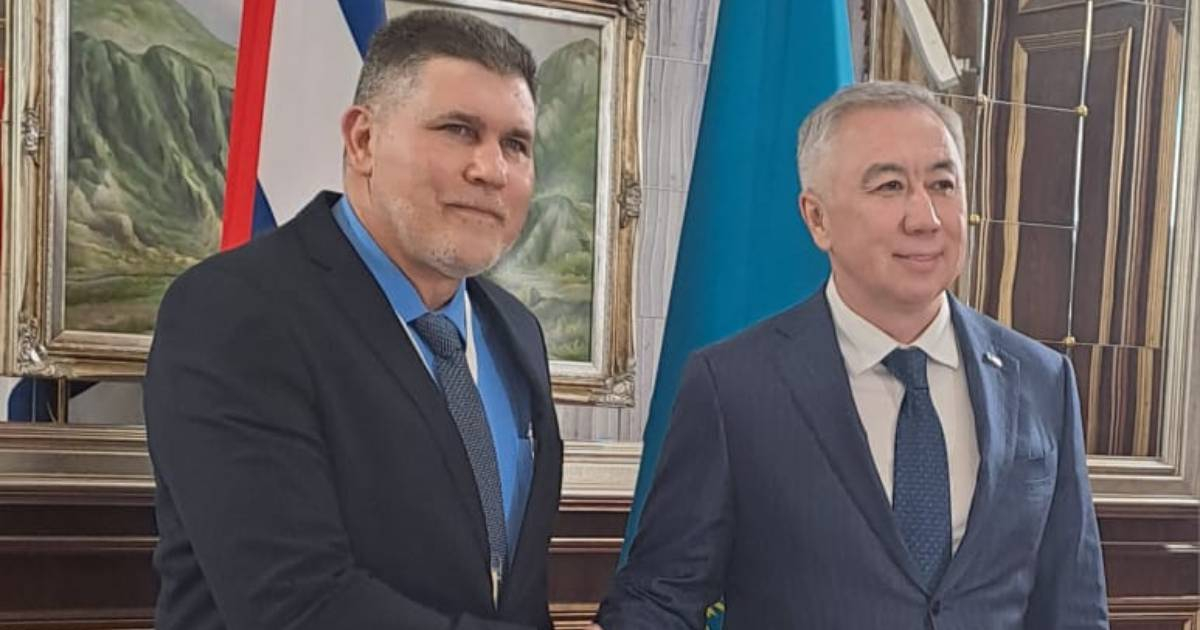
On Thursday and Friday, Cuban Deputy Prime Minister Óscar Pérez-Oliva Fraga attended the Eurasian Intergovernmental Council meeting in Shymkent, Kazakhstan, where he once again expressed the regime's ambition to make Cuba a regional logistics hub centered around the Mariel Special Development Zone.
Addressing leaders and delegations from the five member states of the Eurasian Economic Union (EEU)—Russia, Belarus, Kazakhstan, Kyrgyzstan, and Armenia—Pérez-Oliva called for action beyond rhetoric: "It is essential to move into a new phase of realization and implementation of joint projects."
The deputy prime minister highlighted potential areas of cooperation such as health tourism, the biopharmaceutical industry, food and energy security, the chemical industry, and digital transformation. He announced that the Mariel logistics hub project will be officially presented at the upcoming Eurasian Economic Forum.
"We need to adopt a more comprehensive and strategic vision of the role Cuba can play as an extraregional partner to expand the activities and presence of the Eurasian Economic Union in our economy and throughout Latin America and the Caribbean," Pérez-Oliva stated.
This year marks five years since Cuba became an Observer State of the EEU. Cuba has submitted a proposed Joint Collaboration Plan for 2026-2030, aiming for its approval and signing in the first half of this year.
Recurrent Promises and Uncertain Outcomes
The proposal for a logistics hub is not new and has yet to yield tangible results. In June 2025, Díaz-Canel introduced it at the IV Eurasian Economic Forum in Minsk. In August of the same year, Prime Minister Manuel Marrero Cruz reiterated it virtually before the Intergovernmental Council in Kyrgyzstan. In December, Marrero delivered the same message from Moscow.
Since its opening in 2013, the Mariel Special Development Zone, constructed with a loan of approximately $862 million from the Brazilian bank BNDES, has been operating at 40% capacity. It is managed by GAESA, the military conglomerate that controls about 40% of the Cuban economy.
Political Implications of Pérez-Oliva's Role
Pérez-Oliva's participation also carries political significance. As a grandnephew of Fidel and Raúl Castro, he was promoted to Deputy Prime Minister in October 2025 while retaining his position as Minister of Foreign Trade. His rising international presence contrasts with Miguel Díaz-Canel's focus on domestic management.
In his speech, Pérez-Oliva also condemned the Executive Order signed by Trump on January 29, which imposed tariffs on countries exporting oil to Cuba, describing the U.S. policy as an "illegal and arbitrary" pressure on the island.
Despite the rhetoric of sovereignty, the underlying message underscores the regime's urgent need to attract investment and economic relief from its Eurasian allies amid an energy and economic crisis that Pérez-Oliva himself acknowledged, mentioning "a difficult situation with fuel availability."
The upcoming Astana Forum, scheduled for May 28 and 29 under the theme "Digital Transformation and the Economy of Trust," will be the next venue where the regime will attempt to turn its repeated promises about Mariel into concrete agreements.
Frequently Asked Questions About Cuba's Logistics Ambitions
What is the Mariel Special Development Zone?
The Mariel Special Development Zone is a key Cuban initiative intended to boost economic growth by attracting foreign investment and fostering a logistics hub. It is located west of Havana and is operated by the military conglomerate GAESA.
Why is Cuba seeking to become a logistics hub?
Cuba aims to leverage its strategic geographical location to become a central logistics hub for the Americas. This ambition is part of a broader strategy to attract foreign investment, boost economic growth, and enhance its regional influence.
What challenges does the Mariel project face?
The Mariel project faces several challenges, including insufficient infrastructure, limited capacity utilization, and the need to secure sustained foreign investment and international partnerships.