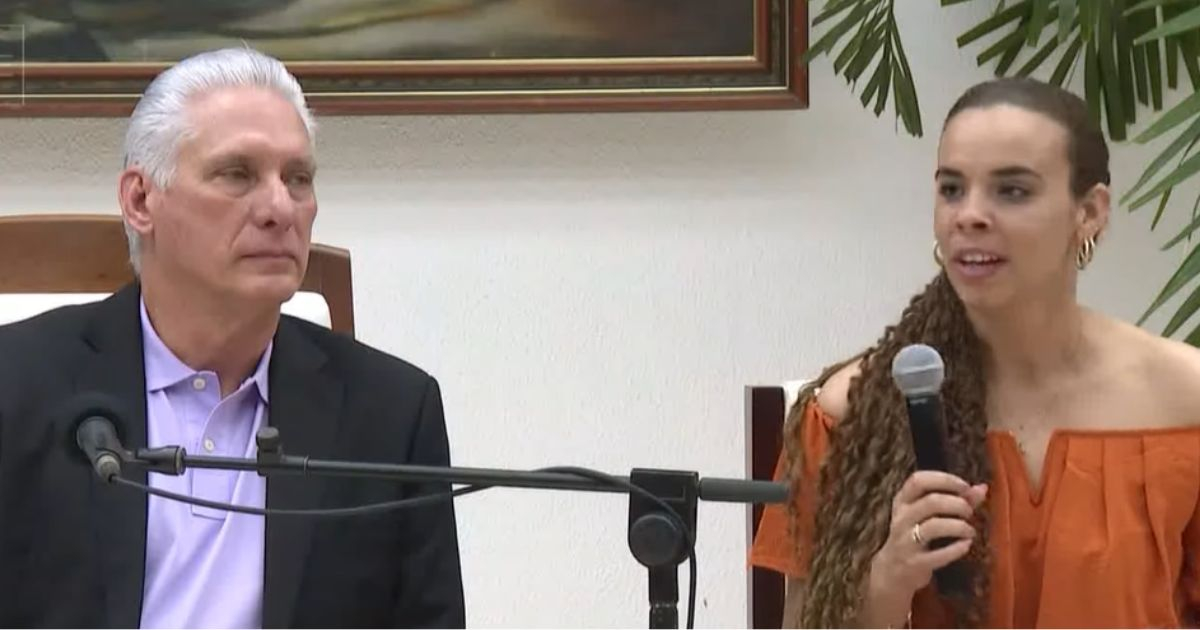
Just when it seems the saccharine rhetoric and over-the-top affection in the speeches from Cuban bureaucrats couldn't get any more excessive, Meyvis Estévez, the national first secretary of the Union of Young Communists (UJC), manages to surpass herself.
In a recent Facebook post, Estévez described a gathering that she claims "stirred our souls," where President Miguel Díaz-Canel met with young people who, "overwhelmed with emotion," assured him that "history marches on," as inevitably as Tuesday follows Monday.
With almost surgical detail, Estévez recounted that "every word, every story of sacrifice and dedication, pulsed with the same heart that knows how to defend the sacred." She did not, however, specify what exactly is considered sacred—perhaps the air conditioning at the Palace of the Revolution or the full fuel tanks of top-level bureaucrats.
The Emotional and the Pragmatic
Her post skillfully transitions from a formal tone to a more sentimental one, claiming that "it was an intimate dialogue, where sensitivity and firmness joined hands to show us that the continuity of the Revolution is not a given; it is built daily with sweat, science, and love."
Continuing her introspective narrative, Estévez described how, in response to Díaz-Canel's calls, the youth's deep-seated feeling of commitment emerges. She emphasized that the first secretary of the PCC "spoke to us with the closeness of a guide, a father, and with the passion of just another Cuban."
Commitment and Honor
Unsurprisingly, the "trust placed in us" had to be mentioned as "the greatest of honors," tying it immediately to the "commitment not to falter, to rise to every challenge, to be that young force the Revolution can always count on."
During the meeting, which also served as an official ceremony to bestow state honors on those with "exceptional merits," Díaz-Canel emphasized the necessity for young people to "continue the legacy" and expressed his belief that "we will overcome these times, and for you, they will be experiences of strengthening convictions and growing as revolutionaries."
Reality vs. Rhetoric
Such "growth" seems disconnected from the economic and social realities in Cuba, where most indicators are declining, except for inflation, poverty, youth emigration, and widespread dissatisfaction with the oppressive system.
Díaz-Canel also addressed "the battle for communication, popular mobilization, ideological formation, cultural creativity, and the battle of symbols," as reported by the official press, echoing the repetitive jargon of Cuban propaganda.
Nearing the end of her "chronicle" of the event, Estévez claimed they left with "nostalgia for the current times but immense joy in feeling part of something bigger than ourselves."
Finally, in a gentle and tender manner, the "youth leader" encapsulated the country's structural crisis in a soft note of "nostalgia." There's no mention of the sadness, frustration, or desperation felt by young people demanding change in the streets. Nor is there irony or parody from those highlighting the nation's primitive conditions. Certainly not the exhaustion and agony of mothers pleading for their imprisoned children...
No, none of these are part of the approved emotional repertoire of a young Cuban communist. "Immense joy," and nothing more.
Understanding the Sentiment in Cuban Political Discourse
What did Meyvis Estévez emphasize in her Facebook post?
Meyvis Estévez highlighted the emotional impact of a meeting with President Miguel Díaz-Canel, emphasizing the themes of commitment, continuity of the Revolution, and the deep connection between youth and the ideals of Cuban socialism.
How does Estévez's narrative contrast with the realities in Cuba?
While Estévez's narrative is filled with optimism and commitment to revolutionary ideals, it contrasts sharply with the harsh economic and social realities in Cuba, where indicators like inflation, poverty, and youth emigration are on the rise.