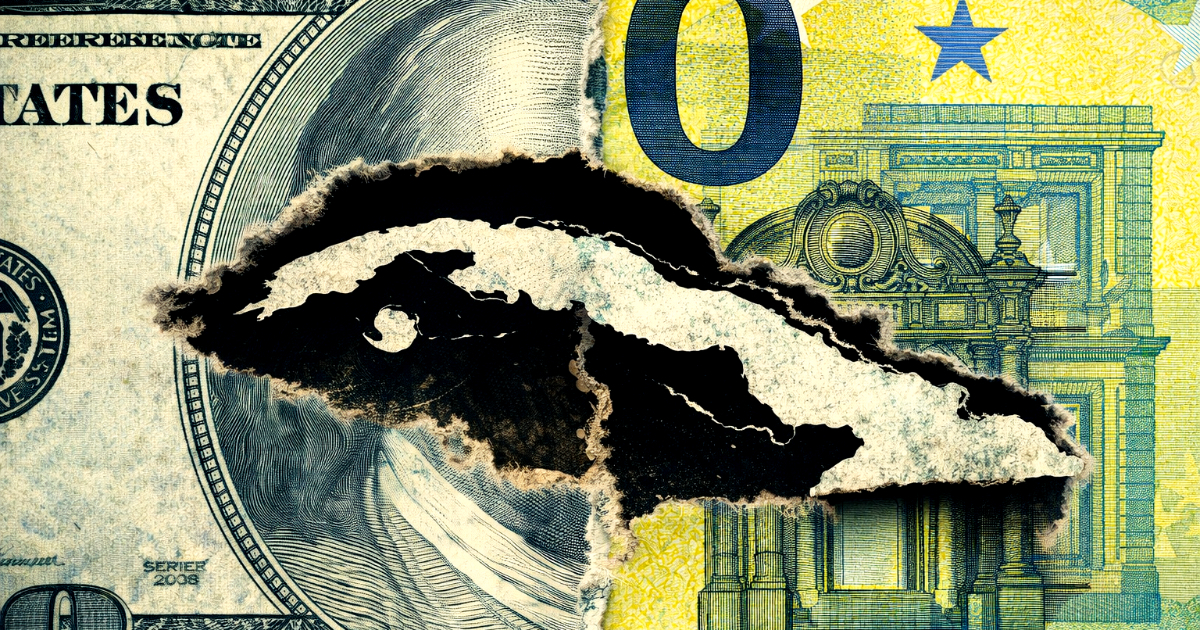
The informal currency market in Cuba is experiencing a period of apparent stability, which, rather than indicating economic improvement, highlights a precarious balance at historically high levels.
Recently, the dollar has remained steady at 515 CUP and the euro at 580 CUP, while the MLC continues to be the only currency showing visible movement.
This steadiness creates what analysts refer to as a "high plateau": a point where supply and demand are balanced, but under crisis conditions.
The Cuban peso is unable to recover, yet there is little room for further sustained increases due to the population's limited purchasing power.
A key factor is the lack of liquidity in pesos. With low wages and persistent inflation, many Cubans cannot acquire foreign currency at increasingly high prices, which reduces upward pressure on the market.
However, the current market behavior cannot be explained solely by economic factors. Contributing to this apparent stability is a significant element: political and geopolitical uncertainty.
The recent capture of Nicolás Maduro and the new scenario in Venezuela have directly impacted the perception of stability of the Cuban regime, a traditional ally of Chavismo.
Adding to this are statements from U.S. Secretary of State Marco Rubio, suggesting a possible transition in Cuba amid Washington's more aggressive policy toward Havana.
This context creates a dual effect on the currency market. On one hand, it increases demand for foreign currency as a refuge amid uncertainty. On the other, it halts transactions due to the expectation of possible political or economic changes, contributing to the current paralysis.
In this scenario, the MLC acts as a more dynamic indicator, with fluctuations linked to internal consumption and the availability of products in state-run stores, unlike the dollar and euro, which are more associated with savings and value protection.
Overall, the current stability is not a sign of improvement, but rather exhaustion. The market doesn't decline because the peso remains weak, but it doesn't rise either because the population has reached its limit in purchasing capacity, amid uncertainty that is no longer just economic, but also political.
Understanding Cuba's Economic and Political Landscape
What is causing the stability in Cuba's informal currency market?
The apparent stability in Cuba's informal currency market is due to a balance between supply and demand under crisis conditions, influenced by a lack of peso liquidity and political uncertainty.
How has the capture of Nicolás Maduro affected Cuba's economy?
The capture of Nicolás Maduro has impacted Cuba's economy by affecting the perception of stability of the Cuban regime, which has traditionally been allied with Chavismo, leading to increased political uncertainty.
Why is the MLC more dynamic than the dollar or euro in Cuba?
The MLC is more dynamic because its value fluctuates based on internal consumption and product availability in state-run stores, unlike the dollar and euro, which are mainly tied to savings and value protection.