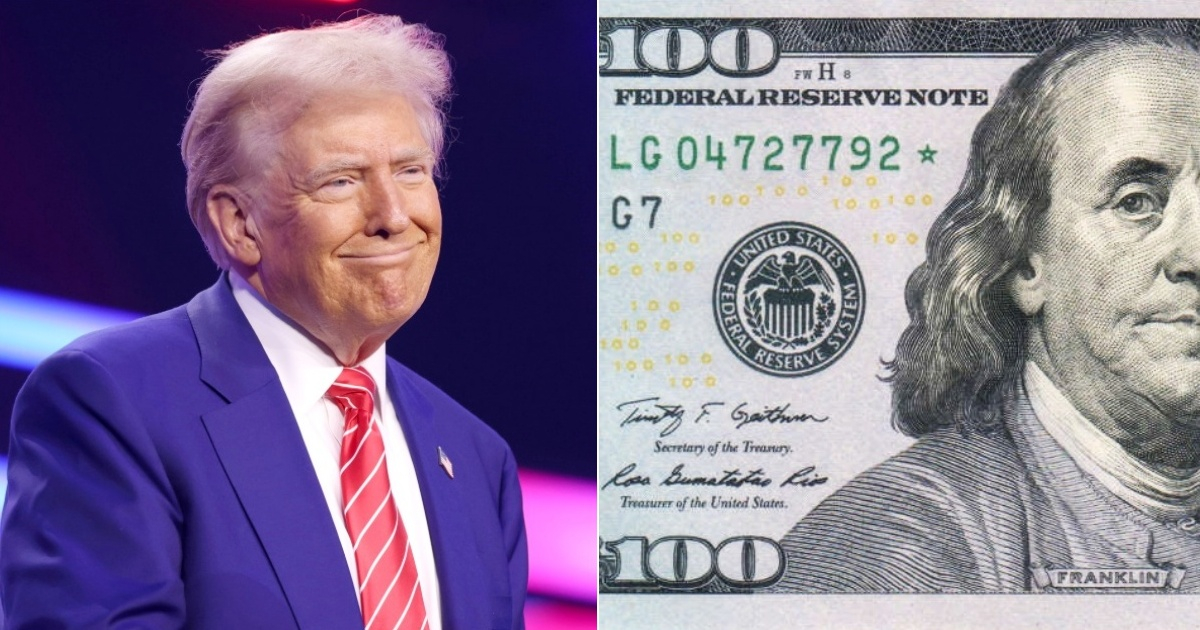
The United States government has unveiled an unprecedented change to its currency: the signature of President Donald Trump will be featured on the newly issued dollar bills.
This groundbreaking move, announced by the Treasury Department, sets a historical precedent by including, for the first time, the autograph of a sitting president on U.S. currency.
According to the Associated Press, this will mark "the first instance of a sitting president's signature" on U.S. bills, a departure from the tradition since 1861 where only the signatures of the Treasury Secretary and the Treasurer have appeared.
This decision is officially framed as part of the celebrations for America's 250th anniversary. It envisions Trump's signature appearing alongside that of the current Treasury Secretary, Scott Bessent, on all newly printed bills.
The Bureau of Engraving and Printing will be responsible for implementing this change.
A Politically Charged Symbolic Gesture
The Treasury has presented this measure as a historic acknowledgment. Bessent stated in a release that "there is no more powerful way to recognize the historic achievements of our great country and President Donald J. Trump than with U.S. dollar bills bearing his name."
Similarly, Treasurer Brandon Beach emphasized that including Trump's signature "is not only fitting but also well-deserved."
However, this announcement has not gone unnoticed or been seen merely as a ceremonial gesture. Analysts and critics perceive this decision as part of the president's broader strategy to imprint his name and image across various national institutions and symbols.
Reports from CNN suggest this initiative is "one of the latest moves by the president to leave his mark on the entire federal government."
In recent months, the administration has pushed for projects and changes ranging from government platforms with his brand to alterations in cultural institutions.
Gradual Changes in Circulation
The plan envisions the first bills featuring Trump's signature entering circulation this year, likely starting with the $100 denomination before expanding to others.
The overall design of the bills will remain unchanged; the modification will be limited to the signature.
Currently, many circulating bills still bear the signature of former Treasury Secretary Janet Yellen, meaning the transition will be gradual.
Commemorative Coins and Legal Boundaries
The addition of the presidential signature coincides with other symbolic projects related to the nation's 250th anniversary.
These include the approval of a 24-karat gold commemorative coin bearing Trump's image and proposals to feature his likeness on common currency coins.
These initiatives have sparked legal debates. U.S. law prohibits depicting sitting presidents or living figures on regular circulation coins, prompting discussions in Congress.
Indeed, Democratic lawmakers have proposed measures to strengthen these restrictions and prevent similar precedents.
The criticisms have been explicit. Congresswoman Shontel Brown described the Treasury's plan as "disgusting and contrary to American values," highlighting the polarization the measure has caused.
An Open Precedent
Apart from its official justification, the inclusion of Trump's signature on the bills represents a significant change in U.S. monetary tradition.
While experts suggest that the Treasury Secretary may have the authority to decide who signs the currency, the move opens a debate on the boundaries between institutional commemoration and personal power personalization.
In a country where national symbols are typically kept separate from active political figures, the decision to feature the signature of a sitting president on everyday currency sets a precedent likely to continue stirring controversy.
Exploring the Impact of Trump's Signature on Dollar Bills
Why is the inclusion of Trump's signature on dollar bills historic?
This marks the first time in U.S. history that a sitting president's signature is featured on currency, breaking a tradition dating back to 1861.
What are the legal challenges associated with this decision?
U.S. law prohibits depicting sitting presidents or living figures on coins, leading to debates in Congress and proposals to reinforce these restrictions.
How will the transition to bills with Trump's signature occur?
The transition will be gradual, starting with the $100 bills and eventually expanding to other denominations. Current bills with former Secretary Janet Yellen's signature will remain in circulation during this time.