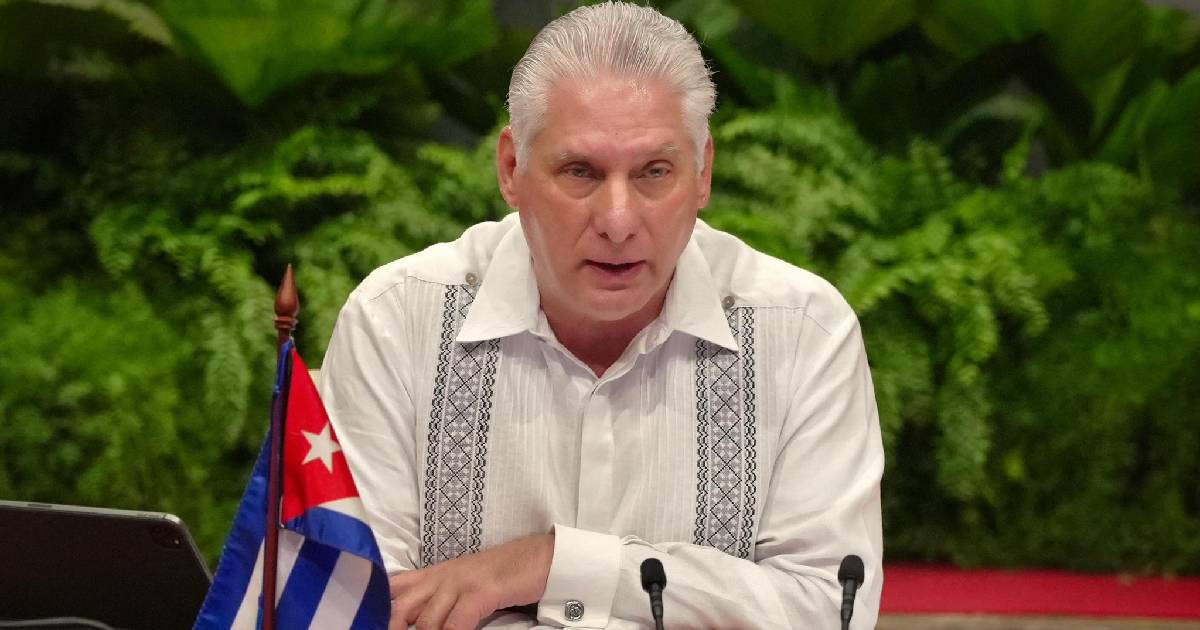
In a recent interview with La Jornada, Cuban leader Miguel Díaz-Canel stated that the country is progressing towards developing its own economic model. Inspired by the experiences of China and Vietnam, Díaz-Canel claims this model will have "unique features" that make it superior.
"It's not about copying," he emphasized, advocating for a system that integrates centralized planning, Communist Party oversight, and certain market mechanisms.
This initiative, positioned as an evolution of Cuba's socialist framework, suggests a model able to compete with—and even surpass—economies that have achieved sustained growth by embracing capital and loosening their structures.
However, the internal conditions in Cuba cast doubt on the feasibility of Díaz-Canel's vision.
New Economic Plan: Ambitions and Realities
In his remarks to La Jornada, Díaz-Canel elaborated: "We are updating our economic and social model, a process that began or deepened during the sixth party congress. We've achieved several transformations that we aim to accelerate, with distinct Cuban characteristics," he explained.
He described the new government plan as "a Cuban system that shares elements with Chinese and Vietnamese models. For instance, the Communist Party's leadership, as outlined in our Constitution, a strong state, an efficient government, and a streamlined public administration free of bureaucracy."
Díaz-Canel also assured that there would be "a proper balance between centralized planning and market forces. Necessary market regulations will prevent speculation, ensuring harmony between state and non-state sectors." He emphasized that "all economic actors will contribute to the country's economic and social development."
Economic Challenges Amid Lofty Promises
While Díaz-Canel speaks of sustainable development, innovation, and growth, the everyday reality for Cubans tells a different story.
Energy shortages lead to blackouts lasting up to 40 hours, and shortages of food and fuel persist. Cuban workers' wages are insufficient to meet basic needs, leaving families hungry and without adequate shelter.
A stark example highlights the severity of the situation: the pension of an elderly Cuban barely covers the cost of a liter of sunflower oil on the informal market.
This gap between rhetoric and reality underscores the fragility of the government's model, which it aims to showcase internationally amidst Cuba's humanitarian crisis.
Comparisons with China and Vietnam: A Rhetorical Exercise
Unlike Cuba, China and Vietnam implemented substantial reforms, including opening up to foreign investment, expanding the private sector, and relaxing economic controls.
These changes revitalized their economies and improved growth indicators, all while maintaining control under communist governments.
In contrast, Díaz-Canel's model retains state and political control as its central pillars, limiting the market's real role. The lack of concrete structural reforms makes this comparison more rhetorical than practical.
The Double Discourse with the United States
This narrative of opening up to investments from Cubans abroad and economic change in Cuba coincides with a significant development in the regime's foreign policy.
On March 13, 2026, Díaz-Canel confirmed that Cuban officials have engaged in talks with U.S. government representatives to "seek solutions through dialogue for bilateral differences."
The leader acknowledged these high-level discussions, involving Raúl Castro, and stated his participation in the negotiations. However, the regime had long denied these conversations, both domestically and internationally.
The simultaneous promotion of a supposed new economic model and the admission of talks with Washington reveal a strategy of double discourse. On one hand, there's an attempt to project self-sufficiency and ideological strength; on the other, there's an acknowledgment of the need to negotiate amidst a deep crisis.
The dissonance in Díaz-Canel's declarations about sovereignty, resilience, and the success of the new Cuban economic model clashes with a reality marked by shortages, blackouts, external dependence, and growing social unrest. The incoherence in the official narrative only amplifies doubts about the credibility of these proposals.
An Unbacked Vision
The idea of a Cuban economic model surpassing those of China and Vietnam lacks substance. Díaz-Canel's claims appear to be delusions without tangible support.
Without deep reforms, genuine openness, and amidst a prolonged crisis, the project becomes more of a political construct than a feasible roadmap.
For millions of Cubans, the priority remains addressing immediate needs: food, electricity, and transportation. In this context, promises of a "superior" economic model contrast starkly with a reality that daily refutes the government's rhetoric.
Cuba's Economic Model: Key Questions Answered
What is Díaz-Canel's proposed economic model for Cuba?
Díaz-Canel's proposed economic model is a Cuban system inspired by China and Vietnam, integrating centralized planning, Communist Party oversight, and market mechanisms, aiming to be superior to those countries' models.
How do current conditions in Cuba challenge Díaz-Canel's vision?
Cuba faces severe challenges like energy shortages, food and fuel scarcity, and inadequate worker incomes, which contradict the promises of sustainable development and growth in Díaz-Canel's vision.
How do China and Vietnam's economic reforms differ from Cuba's approach?
China and Vietnam implemented deep reforms, opening up to foreign investment and expanding the private sector, whereas Cuba's approach under Díaz-Canel retains strong state and political control, limiting market freedoms.