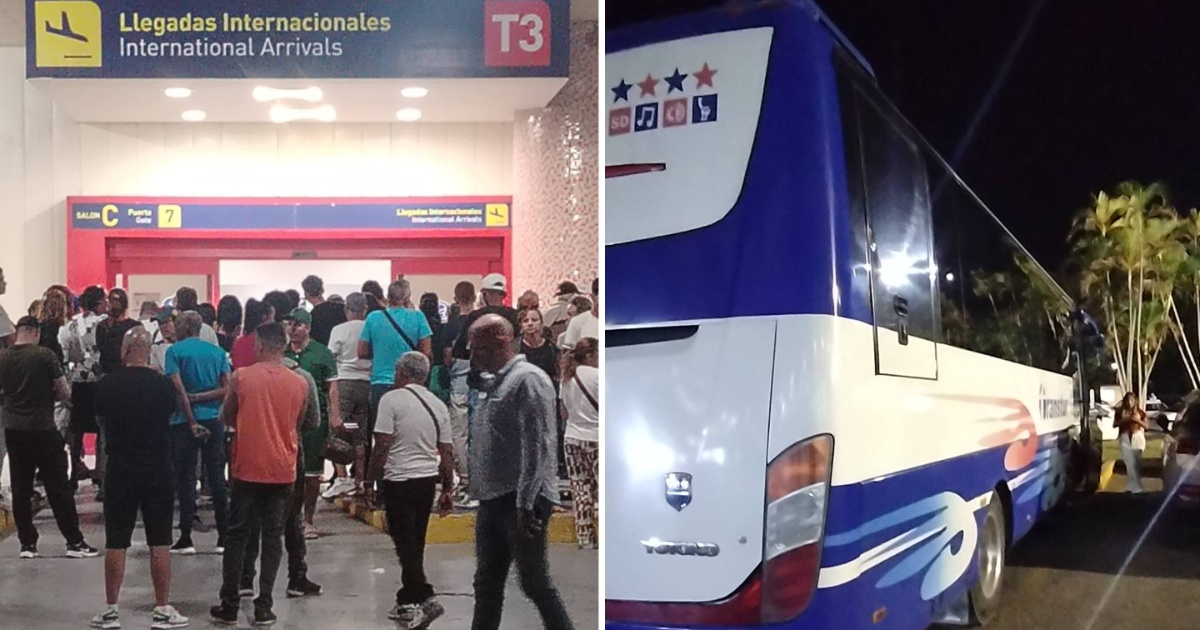
While Cuba's public transport system is enduring one of its most severe breakdowns in decades, marked by suspended routes, minimal train services, and a dire fuel shortage that has immobilized much of the nation, the José Martí International Airport in Havana offers at least one transportation alternative for international travelers.
According to a Facebook post, a bus service charges five dollars to transport passengers to central areas of the capital city.
However, this service is neither a stable solution nor widely publicized, sparking debate among users who claim it is not always available or operates only from a specific terminal.
Unequal Access to Transportation Services
This situation highlights a growing inequality in Cuba: there is insufficient transport for residents commuting daily for work, education, or necessities, yet relatively organized options emerge for those arriving in Havana with foreign currency.
This perception intensified following a post by internet user Rick Reyna. Upon arriving from Monterrey on a Vivaaerobús flight at 8:30 PM, Reyna discovered a bus parked near Gate 7. He paid five dollars and reached Central Park in 42 minutes, while other passengers continued to the Habana Libre.
Reyna then took a pedicab for 500 Cuban pesos, roughly one dollar, bringing his total travel cost to six dollars. He noted that private taxi drivers were charging between 50 and 70 dollars.
Challenges and Inconsistencies
However, social media discussions reveal that this service does not solve the issue or guarantee access for all arriving at the airport. Comments from users indicate that the bus is "not always there," and that there is insufficient information within the airport or from official sources to guide passengers.
One commenter summarized the situation: "For those who need it, it's a mystery." Another specified that the option is available at Terminal 3, but not Terminal 2. A third person dismissed the notion of normalcy, stating it is "extremely difficult to find transportation" and, if available, it is "excessively expensive."
The Broader Transportation Crisis
This episode is particularly significant when viewed against the backdrop of Cuba's broader transportation woes. Transport Minister Eduardo Rodríguez Dávila acknowledged on the official program Mesa Redonda the sector's severe decline, attributing much of the crisis to the U.S.'s so-called "energy blockade."
However, even within this official narrative, internal structural issues were exposed: low technical availability, lack of lubricants, deteriorating infrastructure, and a system unable to maintain basic services.
The practical outcome has been a drastic reduction in services nationwide. Rodríguez Dávila stated that national buses operate only once a day, trains run once every eight days, and the ferry to the Isla de la Juventud is down to two weekly trips.
Government Promises Amid Structural Failures
The government has accompanied acknowledgment of the crisis with new promises. By 2026, the minister announced plans to assemble 50 minibuses and 50 hearses, distribute 150 electric tricycles to municipalities, introduce the first urban electric buses with renewable energy charging stations, deploy 400 electric cars for dialysis services, and install solar panel charging stations on the national highway and other high-demand areas.
These promises starkly contrast with a reality marked by years of deterioration without visible structural solutions.
Despite the official narrative, the transport collapse is not a recent phenomenon nor solely attributable to external factors. Decades of neglect, aging vehicles, a shortage of spare parts, and poor planning have gradually weakened the system to its current state.
Statistics are telling: state-run passenger transport in Cuba plummeted by 93% between January and September 2025, illustrating the scale of the collapse.
Practically, moving within the country has become a daily ordeal. In many cities, services have nearly vanished. In Havana, there were recent moments when all urban routes were suspended due to a lack of fuel.
In Ciego de Ávila, only two of 135 bus routes are operational, while trains have been completely halted due to diesel shortages. Nationwide, interprovincial travel has been similarly affected: in Las Tunas, nearly all bus departures have been canceled, leaving only a night service to Havana.
The consequences for the population are severe. Long waits have become routine, and in many cases, finding transport is impossible even if one is willing to pay.
The rising cost of fares, which can multiply in mere days, has turned mobility into an unaffordable luxury for many Cubans. In the absence of real solutions, people often resort to walking long distances, using bicycles, or relying on an informal market where prices can consume a large portion of monthly wages.
Understanding Cuba's Transportation Dilemma
What is causing the transportation crisis in Cuba?
The crisis is attributed to decades of neglect, outdated vehicles, a shortage of spare parts, poor planning, and external factors like the U.S. "energy blockade."
How are travelers at Havana Airport affected?
Travelers may find an inconsistent bus service charging five dollars to central Havana, but it is not always available, and guidance is lacking.
What measures is the Cuban government taking?
The government promises to assemble minibuses, introduce electric buses, and install solar-powered charging stations by 2026, though these plans contrast with current realities.