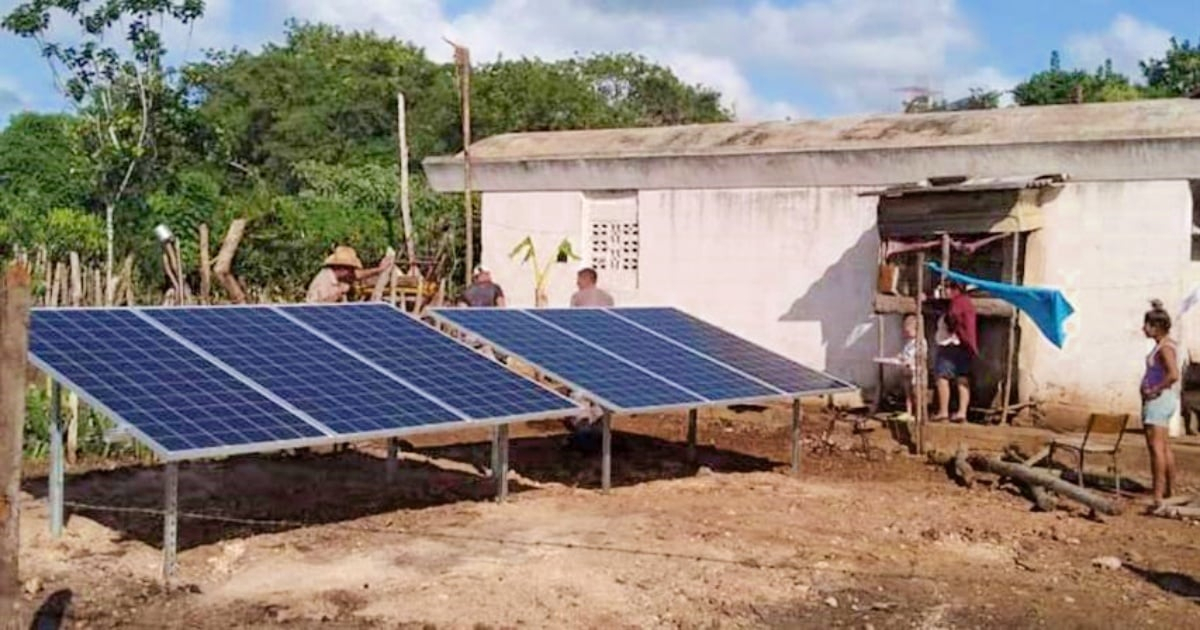
The Cuban government has announced a new policy requiring solar energy contracts to be paid in U.S. dollars, reshaping access to renewable sources amid the nation's ongoing energy crisis.
Outlined in the Official Gazette through a resolution by the Ministry of Energy and Mines, this policy introduces a model where individuals and businesses can "purchase" solar power capacity from the state system, instead of independently installing their own systems.
This framework allows for contracts starting from 0.5 kilowatts with no upper limit, and payments are set in dollars based on the contract's duration.
For instance, a 1 kW contract costs $600 for 20 years, $312 for 10 years, $168 for 5 years, and $90 for 2 years, while a 5 kW deal reaches $3,000 under the longest term.
Rather than acquiring solar panels or directly generating electricity at home, individuals pay for a capacity within the system managed by the state-run Unión Eléctrica.
In return, customers receive a monthly credit of 125 kWh for each kW contracted, effectively acting as an energy credit against their consumption.
The resolution also allows for selling surplus energy back to the national grid, though at rates dictated by the state, which retains full control over the process.
Payments must be made through bank accounts designated by Unión Eléctrica, with these funds earmarked for investments in power generation and distribution, prioritizing renewable sources.
Customers are also issued a renewable energy generation certificate, which is more symbolic than practical within the scheme.
The new regulation overrides the previous 2021 resolution, indicating a shift in model rather than a mere technical adjustment.
In reality, this measure does not liberalize the energy sector but rather enforces a centralized system where the state maintains control while partially transferring the financial burden of power generation to citizens.
Access to this scheme is contingent on the availability of foreign currency, introducing an element of inequality in a context where many lack stable access to U.S. dollars.
Rather than facilitating the spread of solar energy, the new model effectively turns citizens into financiers of state-run power generation in exchange for consumption discounts, against a backdrop of frequent blackouts and structural limitations.
Recently, the government has promoted the installation of photovoltaic modules as one potential solution to the energy crisis.
However, the high cost of these systems underscores the real accessibility challenges for the majority of the population.
According to a Unión Eléctrica publication, an 800-watt module installed in Héroes and Heroínas del Trabajo homes is priced at 75,200 Cuban pesos.
The package includes a solar panel, wiring, connectors, and a battery with a 1,200-watt output, sufficient to power basic appliances such as a refrigerator, rice cooker, or TV.
Despite being promoted as a solution, the steep price of these kits and their limited availability widen the gap between those who can access alternative energy options and those who continue to rely on the national grid.
Understanding Cuba's Solar Energy Policy
What does the new Cuban solar energy policy entail?
The policy requires solar energy contracts to be paid in U.S. dollars and allows individuals and businesses to buy solar power capacity from the state, rather than installing independent systems.
How does this policy affect energy access in Cuba?
The policy creates inequality in energy access due to its reliance on foreign currency, potentially limiting availability to those without stable access to U.S. dollars.
What are the costs associated with the solar energy contracts?
Costs vary by contract length, with 1 kW priced at $600 for 20 years, $312 for 10 years, $168 for 5 years, and $90 for 2 years. A 5 kW contract can cost up to $3,000 for the longest term.