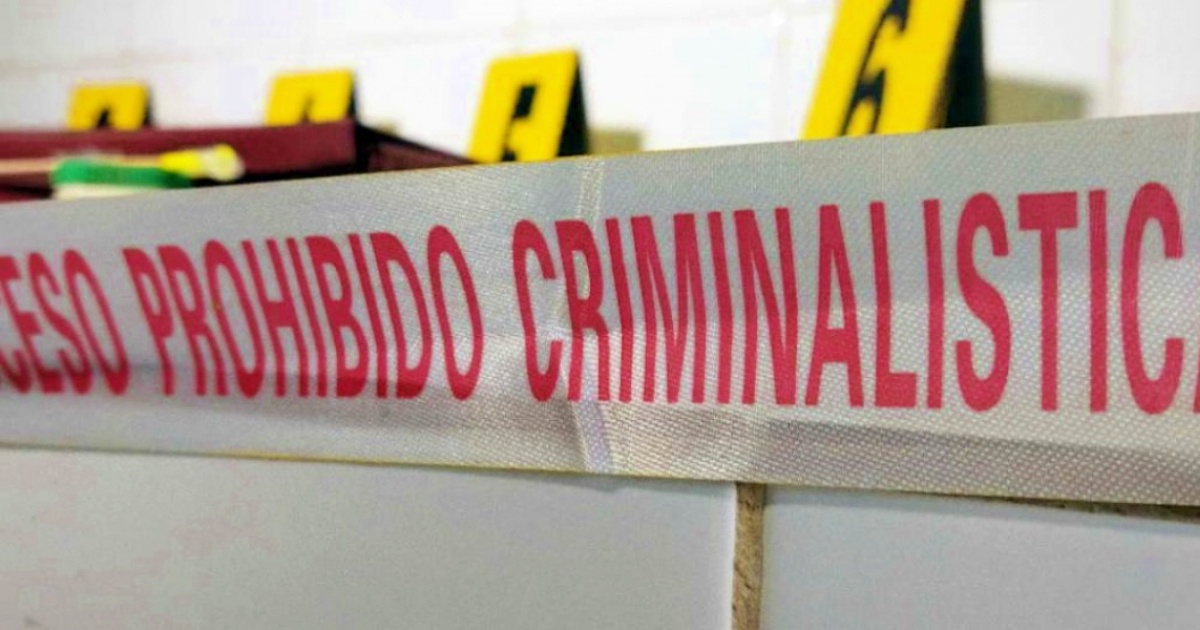
A seven-year-old girl was tragically killed last weekend in Havana, as confirmed in recent reports by independent organizations Alas Tensas (OGAT) and Yo Sí Te Creo en Cuba (YSTCC). These groups have classified the case as a child femicide.
The victim, Gabriela Herrera Rodríguez, was found dead on March 21 in the Chibás neighborhood, Guanabacoa municipality. Initially circulating as unverified reports on social media, the incident was later confirmed by the feminist organizations.
The Disappearance and Discovery
According to verified information, the young girl left her home in the afternoon and did not return. Her disappearance prompted a search by her mother, family, and local residents.
As night fell, her body was discovered near the neighborhood, close to the home of the alleged perpetrator. The body showed "signs of extreme violence and possible indications of other assaults," highlighting the severity of the crime.
The suspected assailant, a neighbor from the same area, was apprehended following the discovery.
From Social Media Rumors to Independent Confirmation
Before confirmation, the case stirred emotions on social media where numerous, sometimes conflicting, versions were shared. Initial posts mentioned the girl's disappearance and her subsequent discovery, but included unverified details about the crime's circumstances, the suspect's identity, and other specifics.
Discrepancies in comments about whether the girl was alone or with someone at the time of her disappearance added to the confusion. Only after OGAT and YSTCC's confirmation did the fundamental elements of the case become clearer.
Alternative Accounts and Allegations
Activist Lara Crofs shared additional insights based on local testimonies and independent platform reports, suggesting variations in location and details of the event. Her account places the incident in the Bahía neighborhood of Habana del Este, where the girl allegedly left home on March 22 and was later found dead behind a residence.
Crofs claimed the suspected individual, Alexander Fernández Méndez, aged between 50-51, had recently moved into the area and had a history of theft. Suspicion arose when his wife noticed him exhibiting unusual behavior, such as washing a sheet, which led to his capture in Guanabacoa.
These elements, however, remain unconfirmed by official or independent sources.
Demand for Institutional Transparency
In her statement, Crofs demanded greater transparency from the authorities: "I urge the regime to address this matter seriously and give it the importance it deserves. We need to live in a country where social justice and the rule of law protect citizens."
A Disturbing Pattern of Violence
Gabriela's murder occurs shortly after a similar case: the femicide of 14-year-old Katherine Cruz Aguilera in Las Tunas. Ileana Álvarez, director of Alas Tensas, emphasized the alarming situation:
"In Cuba, we are witnessing extreme violence against girls, taking lives and occurring in a context of total vulnerability. In just one week, two heinous crimes have shaken the nation."
Understanding Child Femicide
The observatories explain that child femicide refers to the murder of a girl in a context of misogynistic violence, abuse, power dynamics, or extreme vulnerability. Álvarez elaborated on the elements in Gabriela's case:
"This involved a young girl, only 7 years old, who disappeared, prompting a desperate search by her family and community, culminating in the discovery of her body showing signs of extreme violence, possibly other injuries, near the aggressor's and victim's residences."
Katherine's case also showed patterns of vulnerability, brutality, and suspected abuse.
Institutional Failures and Lack of Protection
Beyond the crime, the observatories argue that these incidents are symptomatic of a structural issue. "These crimes occur amid Cuba's humanitarian crisis, leaving children increasingly exposed and defenseless," they state.
They also criticize the absence of effective policies: "We denounce the lack of preventive and protective measures, and the negligence of an authority focused on repression while abandoning the most vulnerable."
They conclude by stressing the urgency: "Naming and denouncing these acts is crucial. Yes, child femicide exists in Cuba, and silence would also be a form of violence."
Documented Phenomenon Lacks Official Statistics
Femicide, defined by UN Women as the intentional killing of a woman because of her gender, lacks systematic public statistics in Cuba. Therefore, its documentation falls to independent observatories.
With Gabriela's case, OGAT and YSTCC's records show 12 verified femicides in 2026, alongside seven attempted femicides and one gender-based murder of a man.
In 2025, these observatories documented 48 femicides, compared to 56 in 2024, but warn that the apparent decrease might result from underreporting and lack of institutional transparency.
The 2025 analysis reveals troubling patterns: in over 90% of cases, the aggressor knew the victim; crimes occurred at home in 62.5% of incidents; knives predominated in 64.6%, and two-thirds of cases involved high levels of cruelty.
A Renewed Call for Action
The murder of Gabriela Herrera Rodríguez not only mourns a family and community but also highlights the extreme vulnerability of many girls in Cuba. As summarized by Alas Tensas:
"This is not an isolated case. Recent incidents show alarming patterns: the perpetrator's proximity, extreme violence, and a crisis context where victims lack protection."
Observatories stress the importance of identifying, documenting, and demanding justice for these crimes as an urgent response to a reality that cannot be normalized or ignored.
Understanding Child Femicide in Cuba
What defines a child femicide?
Child femicide is defined as the murder of a girl in a context of misogynistic violence, power abuse, or extreme vulnerability.
Why is the murder of Gabriela Herrera Rodríguez significant?
Gabriela's murder underscores the extreme vulnerability and lack of protection for girls in Cuba, highlighting systemic issues in addressing gender-based violence.
How are femicides documented in Cuba?
Femicides in Cuba are documented by independent observatories like Alas Tensas and Yo Sí Te Creo en Cuba, as there are no systematic public statistics available.