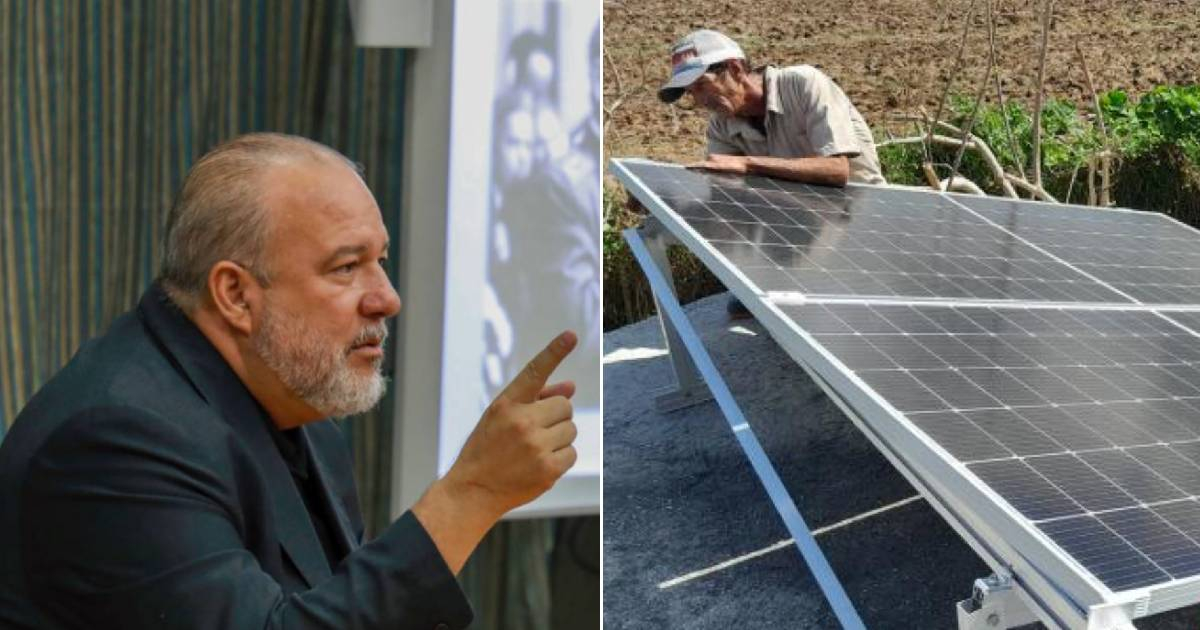
Cuban Prime Minister Manuel Marrero Cruz revealed on his X account that by March, the installation of over 10,250 photovoltaic solar systems for teachers, doctors, and "Heroes of Labor" will be complete. Additionally, this month marks the completion of 5,000 more modules in isolated communities and essential centers across the nation.
In two posts tagged with #GovernmentProgram and #CubaWillPrevail, Marrero framed these announcements as proof of the regime's strength amidst Cuba's most severe energy crisis in recent history. "Pursuing the energy transition under adverse circumstances showcases not only our resilience but also our ability to develop," expressed the Prime Minister.
Concerning the primary initiative, Marrero noted progress "towards the recovery of the National Electric System, enhancing its sovereignty." By February 2026, of the planned 10,200 systems for this beneficiary group, 7,719 had been installed, achieving 87.4% completion. Copextel is responsible for the installations, with each kit comprising an 800 W panel, connections, and a 1,200 W battery. The cost per system stands at 75,200 Cuban pesos, equivalent to more than 20 average state salaries, with payment plans available.
Efforts in Isolated Areas
Regarding the 5,000 modules for remote areas, provincial reports indicate 686 installations in Santiago de Cuba—171 in vital centers and 515 in homes within 31 communities under the Plan Turquino—and over 1,100 systems in isolated zones of Granma. The panels are part of a Chinese donation valued at over 114 million dollars.
Marrero's announcements starkly contrast with the severity of Cuba’s ongoing crisis. The electricity deficit nears 1,800 megawatts, blackouts impact up to 64% of the country and can last between 20 to 25 hours a day. Approximately 102 power plants remain idle due to fuel shortages, a situation worsened since December 2025 with the halt of Venezuelan oil supply, on which Cuba relies for 25,000 to 30,000 barrels daily.
Solar Energy as a Strategic Focus
The government has made solar energy the cornerstone of its so-called energy transition. Cuba currently has 49 solar parks connected to the National Electric System, with a capacity ranging from 900 to 1,000 megawatts, aiming to reach 92 parks—or about 2,000 megawatts—by 2028, largely with Chinese support.
However, independent experts caution that solar panels do not address the underlying issue. Without nighttime storage batteries, photovoltaic parks cannot meet demand during peak consumption hours.
Energy expert Jorge Piñón has warned that Cuba would need between 3 to 5 years and investments of $8 billion to $10 billion to initiate a genuine recovery. Meanwhile, Energy Minister Vicente de la O Levy admitted in December 2025 that "2026 will be difficult, although slightly better than 2025."
Understanding Cuba's Energy Challenges
How many solar systems are being installed in Cuba?
Cuba is installing over 15,250 photovoltaic solar systems, with 10,250 for specific professionals and 5,000 in isolated communities.
What are the challenges facing Cuba's energy sector?
Cuba is experiencing a significant electricity deficit of 1,800 megawatts, with frequent blackouts and a dependency on Venezuelan oil, compounded by a lack of fuel and idle power plants.
What role does solar energy play in Cuba's energy strategy?
Solar energy is central to Cuba's energy transition strategy, with plans to expand from 49 to 92 solar parks by 2028, thanks to significant Chinese support.