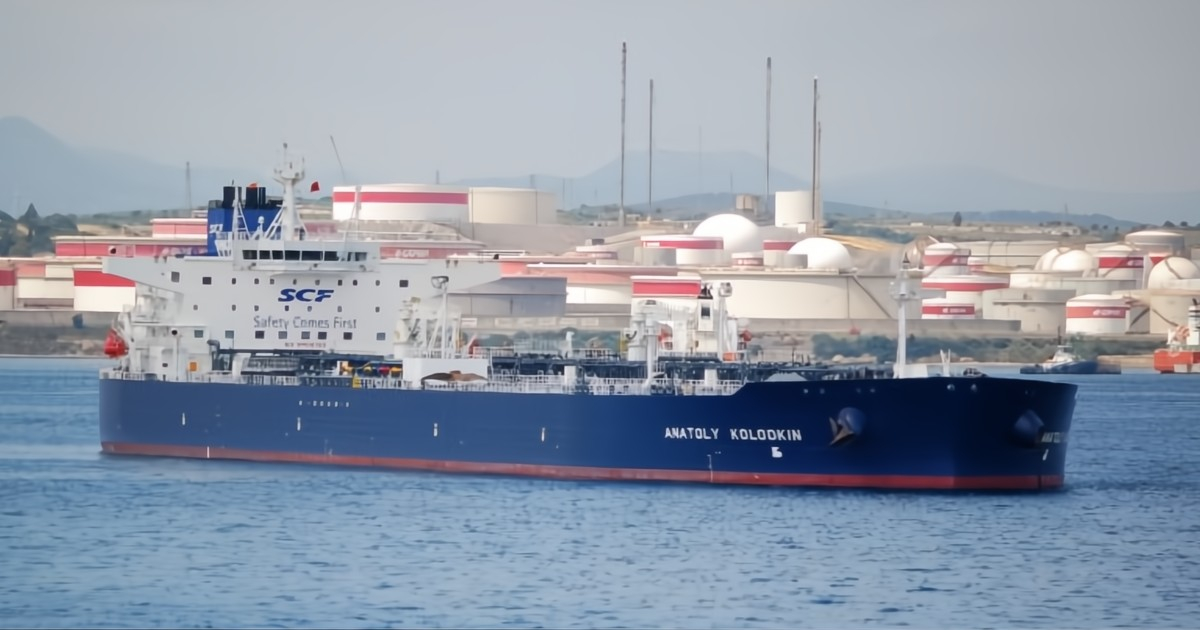
A Russian oil tanker carrying over 700,000 barrels of crude has thrust Cuba into the spotlight of a geopolitical standoff between Moscow and Washington. As millions of Cubans continue to endure blackouts, shortages, and an unrelenting energy crisis, the situation has become increasingly tense.
The tanker, Anatoly Kolodkin, sanctioned by the United States, the European Union, and the United Kingdom, is making its way through the Caribbean under the watchful eyes of the U.S. Coast Guard. Its destination remains uncertain, as its course has shifted from its initial trajectory towards Matanzas, sparking speculation about whether it will reach the island or face interception.
According to reports cited by Politico, the tanker is carrying approximately 730,000 barrels of crude and was even escorted by a Russian warship through Europe. Experts interpret this as more of a provocation than a mere commercial operation.
Analysts consulted by the media outlet believe the shipment's primary aim is not to aid Cuba, but to send a direct message to the United States during a time of heightened international tension. "This move is not about Cuba; it's about pressuring Washington," agree experts and former officials cited by Politico, who view this maneuver as a test of how far the U.S. government is willing to go in its own sphere of influence.
Dire Energy Situation in Cuba
On the island, the situation is dire. The potential Russian oil shipment would provide only a brief respite—mere weeks or even days—for a nation where power outages last over 30 hours and the energy deficit has reached critical levels. The fuel shortage has drastically cut electricity generation, leading to protests and growing social unrest.
Strategic Implications Beyond Oil
The implications extend far beyond oil. As noted by The New York Times, the shipment has reignited alarms in Washington about Cuba's role as a strategic platform for Russia and China just 90 miles from the United States. The island reportedly hosts intelligence facilities linked to the Kremlin, such as the Lourdes base, and other alleged Chinese stations, enhancing its geopolitical significance in global rivalries.
Former President Donald Trump had already declared a national emergency to halt oil imports to Cuba, arguing that Havana allows foreign military and intelligence capabilities that threaten U.S. security. In this context, the Russian tanker's movements appear as a direct challenge to that policy.
U.S. Energy Blockade Intensifies
Simultaneously, Washington has tightened its energy blockade on the island. By pressuring key suppliers like Mexico and Venezuela, the U.S. government has left Cuba with virtually no stable supply since January. The recent decision by the Treasury Department to explicitly exclude the island from any relaxation of sanctions on Russian oil reinforces this strategy.
The Cuban populace finds itself caught between hope and frustration. Initially, the tanker's arrival was seen as a potential relief amidst the energy collapse. Now, with its altered course and the presence of U.S. military assets in the area, that relief is once again in doubt.
On the global chessboard, Cuba is once more a pawn in play. For Russia, it's an opportunity to apply pressure on the United States. For Washington, it's a red line in its hemisphere. For Cubans, it's another day marked by uncertainty, darkness, and the feeling that their fate is being decided far from their shores.
Key Questions Surrounding the Russian Tanker and Cuba
What is the significance of the Russian oil tanker heading to Cuba?
The Russian oil tanker is significant because it places Cuba at the center of a geopolitical confrontation between Russia and the United States. The shipment is seen as a provocation and a message to the U.S. amidst global tensions.
How does this affect the energy situation in Cuba?
If the tanker reaches Cuba, it could provide temporary relief to the nation suffering from severe power outages and an energy crisis. However, this relief would be short-lived, lasting only weeks or days.
Why is the United States concerned about this shipment?
The U.S. is concerned because the shipment underscores Cuba's strategic role for Russia and China, potentially threatening U.S. security. The presence of foreign military and intelligence capabilities in Cuba is considered a significant risk to Washington.