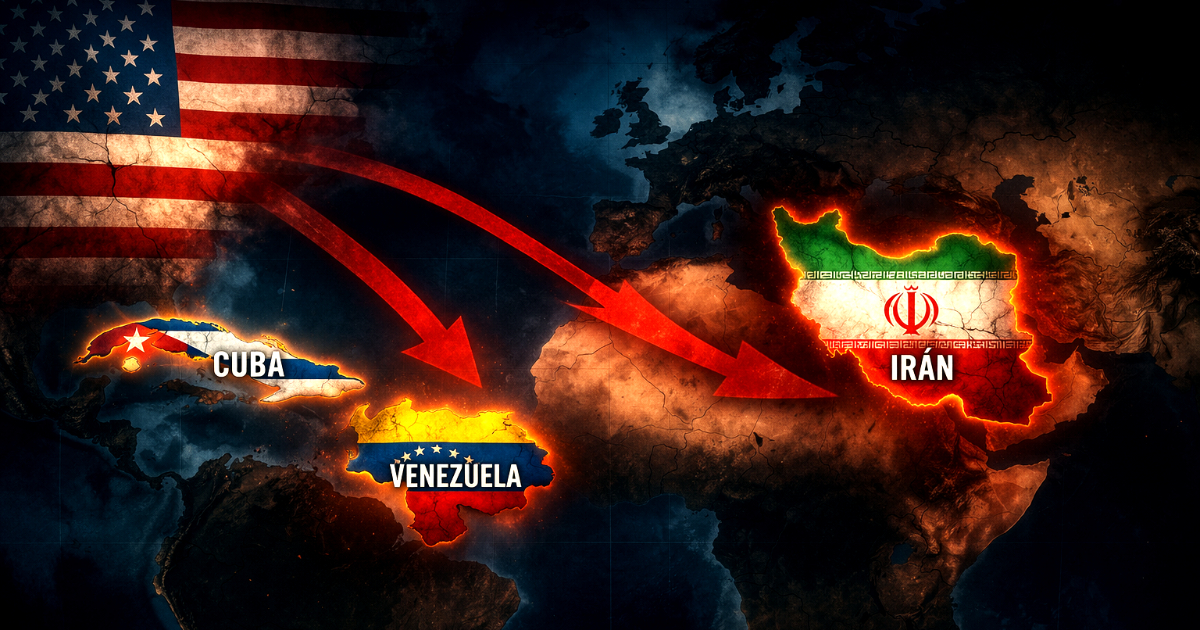
For years, the notion of regime change in Washington was synonymous with the failures in Iraq and Afghanistan. The term vanished from official rhetoric, becoming almost taboo in U.S. foreign policy discussions.
However, recent developments in Cuba, Venezuela, and Iran suggest that this concept not only persists but has been redefined through a strategy that is more subtle yet equally ambitious in its aims.
New Tactics for Old Goals
The primary shift lies not in the objective but in the approach. In the early 2000s, regime change meant direct military intervention, prolonged occupations, and state reconstruction efforts. Today, the Trump administration favors a more pragmatic and cost-effective strategy: a combination of economic pressure, international isolation, and leveraging internal crises to drive political changes without deploying large military forces.
Venezuela: A Pivotal Role
In this updated approach, Venezuela is central. For years, the U.S. attempted to weaken the Chavista regime through sanctions and diplomatic pressure. Recent events, however, marked a turning point. The ousting of Nicolás Maduro through U.S.-led intervention transformed a strategic goal into an accomplished fact. Venezuela now faces an uncertain phase where the question is no longer if the regime will fall, but what kind of system will emerge and whether it can stabilize.
Cuba: Navigating a Key Crisis
Cuba presents a different yet crucial scenario for understanding this strategy. The island is experiencing one of its deepest crises, a result of decades of economic mismanagement, state control, and lack of freedoms amid increasing international pressure. Washington has intensified its isolation of the regime, particularly in the energy sector, while exploring contacts within the Cuban system to open potential negotiation pathways.
The strategy seems clear: increase the pressure to force changes but avoid a chaotic collapse that could lead to greater instability. Instead of a sudden downfall, the aim is for a gradual transformation from within, with openings for exile participation and international investment.
Iran: A Different Dimension
Iran introduces a strategic nuance. Unlike Cuba and Venezuela, the U.S. does not explicitly call for immediate regime change. The focus remains on containing Iran's nuclear program and limiting its influence in the Middle East. Nonetheless, the intensity of economic pressure and indirect confrontations suggest that weakening the system is part of the agenda. In this context, a political shift is not the stated goal but remains a potential outcome.
These cases are not isolated scenarios but rather reflect a unified vision of the international landscape.
The Trump administration appears to operate under the assumption that the world is now in an era of open competition among powers, where stability is no longer paramount, and geopolitical influence regains prominence. In this paradigm, adversarial regimes are not managed; they are pressured, weakened, and, if circumstances allow, transformed.
What is emerging is not a return to classic interventionism but an adaptation of an old strategy to new circumstances. Regime change remains a tool of U.S. foreign policy but now employs more indirect, selective, and seemingly effective methods. Fewer invasions, more pressure; less ideological rhetoric, more strategic calculation.
Cuba, Venezuela, and Iran are not merely distinct crises. Together, they represent a consistent trend: the quiet return of a policy that never truly disappeared but now reclaims a central role with a different face.
Understanding Washington's Regime Change Strategy
How has the U.S. strategy for regime change evolved?
The U.S. strategy for regime change has shifted from direct military interventions to a more pragmatic approach involving economic pressure, international isolation, and leveraging internal crises to drive political change.
What role does Venezuela play in the new U.S. strategy?
Venezuela is central to the new U.S. strategy, serving as a pivotal case where the removal of Nicolás Maduro transformed a strategic aim into reality, marking a shift in how regime change is pursued.
Why is Cuba significant in this strategy?
Cuba is significant as it represents a scenario where increased pressure is used to encourage internal change without causing a chaotic collapse, aiming for gradual transformation from within.