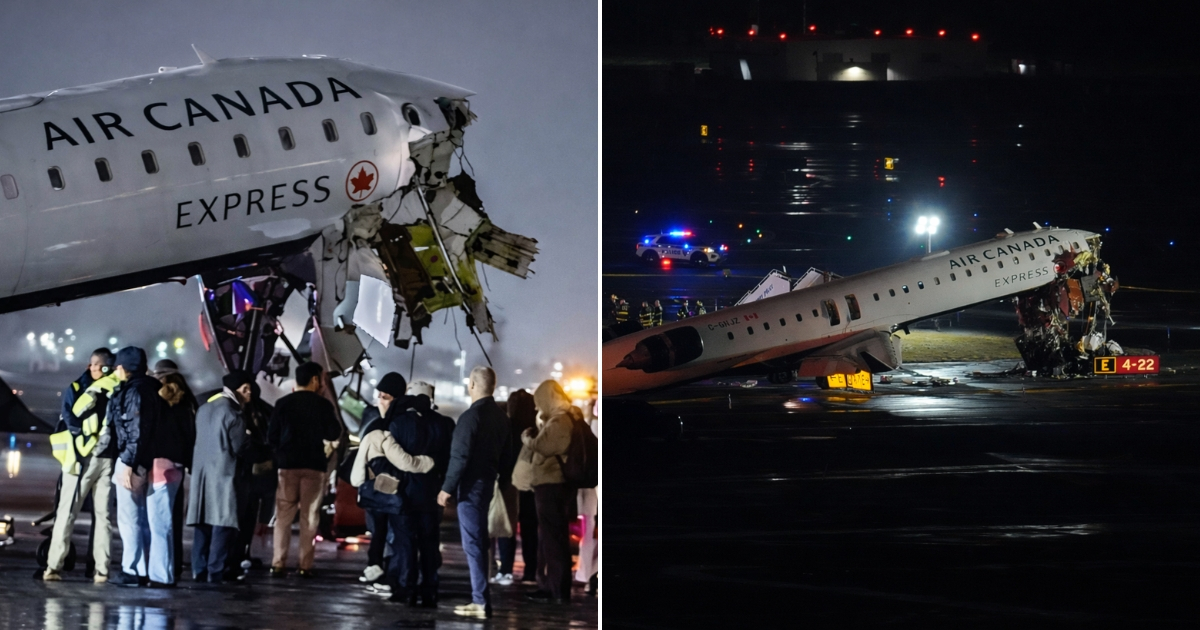
An Air Canada Express flight was involved in a tragic collision with a fire truck on Runway 4 at New York's LaGuardia Airport on Sunday night, resulting in at least two fatalities and injuring around 70 people, according to preliminary reports from AP News, which have yet to be officially confirmed.
The flight, identified as AC 8646, was operated by Jazz Aviation on a Bombardier CRJ-900. It departed from Montréal-Trudeau International Airport at 10:12 p.m. Eastern Time and was in the process of landing when the crash occurred at approximately 11:38 p.m. The weather conditions were challenging, with rain and low clouds present at the time.
Sequence of Events Leading to the Collision
The airport's firefighting vehicle, ARFF Truck 1, had received clearance from air traffic control to cross the active runway via taxiway D as the aircraft approached. The truck was responding to an emergency involving a United Airlines flight that had reported an unusual odor onboard. Preliminary records indicate the air traffic controller instructed the truck to halt several times before the accident happened.
Impact and Immediate Aftermath
The collision occurred with the aircraft traveling at roughly 21 knots (about 39 kilometers per hour), leading to severe damage to the plane's nose, cockpit, and front galley, causing the fuselage to tilt. All four crew members sustained serious injuries. At least eight individuals, including four firefighters, are in critical condition, while over 60 passengers suffered less severe injuries.
The Federal Aviation Administration (FAA) promptly issued a complete stop on operations, resulting in the full closure of LaGuardia Airport, with flights being redirected to other airports in the region. The New York Police Department (NYPD) confirmed the incident, and the Fire Department of New York (FDNY) responded to the scene. Investigations by both the FAA and the National Transportation Safety Board (NTSB) are underway.
Historical Context and Safety Concerns
According to the Associated Press, "New York's LaGuardia Airport shuts down after an Air Canada flight collides with a Port Authority vehicle on the runway." This tragic event marks the first fatal accident for Air Canada in over four decades, as well as the first such incident for the CRJ-900 model. The involved aircraft, registered as C-GNJZ, is 20 years old and was delivered to Jazz Aviation in 2005.
LaGuardia Airport has a troubling history of runway incidents. In October 2025, two Delta regional planes collided at low speed on a taxiway, and in May of the same year, a Republic Airways flight aborted takeoff to avoid a collision with a crossing United plane. The FAA reports about 30 runway incursions per million operations at LaGuardia, with 22 serious incidents in 2023 and seven in 2024. The NTSB has not yet released preliminary findings as of this report.
Key Questions About LaGuardia Collision
What caused the collision at LaGuardia Airport?
The collision occurred when a fire truck was crossing the runway as the Air Canada plane was landing. The truck had clearance but was ordered to stop by air traffic control multiple times before the crash.
How many people were affected by the accident?
At least two people were killed and around 70 were injured, including four crew members and several firefighters in critical condition.
What actions were taken following the collision?
The FAA issued a total halt of operations, closing LaGuardia Airport, while investigations were launched by the FAA and NTSB. Flights were diverted to other regional airports.