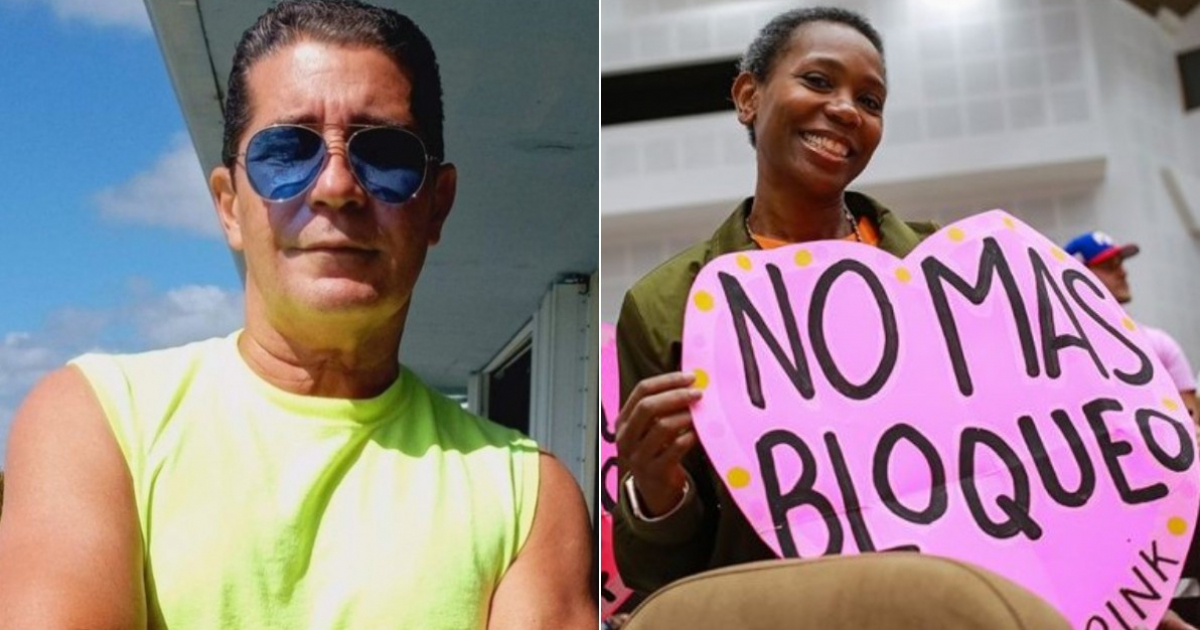
Cuban actor Erdwin Fernández Collado has issued a sharp critique against the members of the so-called Convoy Nuestra América to Cuba, and more broadly, against foreigners who visit the island with an idealized view of the system, ignoring the real conditions faced by the population.
Through a Facebook post, Fernández Collado lambasted these organized visits, asserting that the guests are shown a carefully curated version of the country that is far removed from the everyday lives of Cubans.
"I 'love' these visits from foreigners who are completely detached from the Cuban reality on the island," he wrote, emphasizing his sarcastic tone from the outset.
While not holding the visitors entirely accountable, Fernández Collado questions the image they receive. He points out that these groups are transported in privileged conditions, far from any scene that would reflect the deterioration and shortages experienced by locals.
"They are picked up in air-conditioned buses or open-air vehicles and taken to meet and support 'that' in a climate-controlled, pristine setting," he describes, referring to the official meetings and organized tours.
Exposing the Carefully Crafted Narrative
These itineraries, he explains, are designed to hide the most glaring problems of the country: "They are taken through those 'assigned' places on the best streets and avenues... where the garbage on the streets, the long queues, and the dirty, time-worn buildings are not visible."
The actor extends his critique by echoing a metaphor used by his friend, actress María Teresa Pina Cabrera, who likened Cuba to "a zoo."
Erdwin fully grasps this metaphor and elaborates on it with stark imagery: "Many foreigners come to Cuba to see that destruction, that neglect, the old cars, and dilapidated buildings... and they enjoy it (not all of them)."
According to him, many visitors consume this reality as an exotic experience and would prefer it not to change. "To them, we are 'their Zoo,' the time machine, but in reverse, and it's sad but true."
A Sarcastic Proposal for a Genuine Experience
As a counter to this viewpoint, the actor sarcastically suggests a way to show these visitors the real Cuba. "How beautiful those 'enthusiastic and supportive' foreigners would look in the neighborhoods with two buckets trying to fill them with water," he writes, portraying scenes that are part of everyday life for millions of Cubans.
He further mentions other daily hardships that are completely absent from the official foreign tour of regime supporters but should be known: "Endless blackouts, buying in local currency, and connecting to ETECSA."
He even takes the idea to an extreme to highlight the contrast: "I’d give them three days without nerve-calming pills, without sleep, with the affectionate mosquitoes caressing their white skins on nights without a fan."
Through these examples, Erdwin aims to highlight the gap between the international solidarity narrative that many of these groups promote and the authentic reality of the country. "The reality of Cuba and its people is different, not what they have in their heads, not what 'those' export," he asserts.
He concludes his message with a warning about the limits of such narratives: "I believe that lies and mockery have their limits, and those limits are about to be reached."
The actor's statements add to other critical voices, both inside and outside the island, questioning these organized visits, pointing out that rather than reflecting the real situation, they contribute to reinforcing a distorted image of the country while much of the population faces growing difficulties in their daily lives.
Understanding the Critique of Foreign Visits to Cuba
What is Erdwin Fernández's main criticism regarding foreign visitors to Cuba?
Erdwin Fernández criticizes the idealized view that foreign visitors often have of Cuba, facilitated by carefully organized tours that hide the country's real challenges and hardships faced by its people.
How does Erdwin propose to give foreigners a real experience of Cuba?
Erdwin sarcastically suggests that foreigners should experience everyday Cuban life by participating in activities like fetching water with buckets, enduring blackouts, and dealing with the local economic conditions.