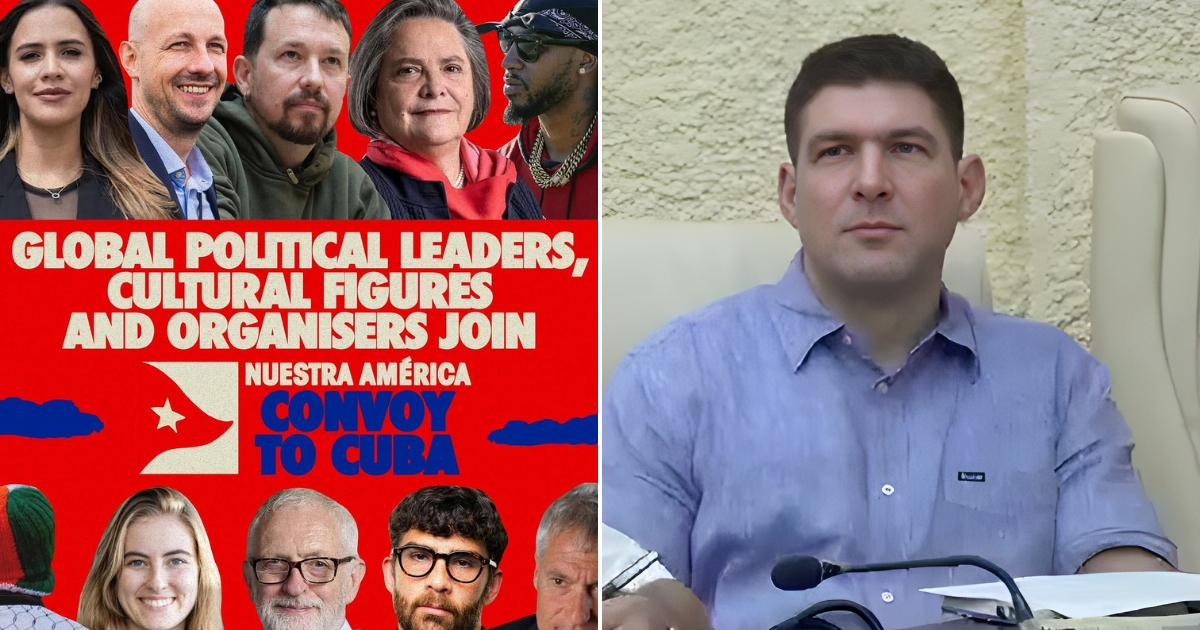
Recently, the so-called "Nuestra América Convoy" has once again highlighted a curious phenomenon: activists, politicians, and international leftist figures—including notable European personalities like Pablo Iglesias—strolling through Havana, meeting with the regime’s top brass, and echoing the same old rhetoric.
They speak of “resistance,” “blockade,” and “dignity.” Yet, they fail to mention the most glaring detail: in Cuba, power is not with the people; it rests with a single family.
This fact is no longer hidden. Take the example of "El Cangrejo," Raúl Castro’s grandson, who is frequently seen at crucial meetings, operating within the circles of true power, making high-level decisions and connections without ever being elected. It’s a dynastic succession in full display.
Contradictory Stances of the Left
Is this really the model they endorse?
In their own countries, these are the same individuals who rally against any form of privilege, shout “no kings,” proclaim themselves anti-monarchists, and criticize the elites. Yet, in Cuba, they applaud a system where power is inherited by blood, and institutions serve merely as a façade.
The Harsh Reality for Ordinary Cubans
Meanwhile, as they engage in ideological tourism, the everyday reality for the average Cuban is starkly different: constant blackouts, shortages, inadequate wages, and no ability to determine their future.
But apparently, none of this seems to matter to them.
This begs the inevitable question: how can such blindness be explained?
There are only two possibilities: either they don’t understand what they’re witnessing, or they choose not to speak the truth.
Understanding Support for Cuba's Political System
Why do international leftist figures support Cuba's ruling family?
They often admire the ideals of resistance and anti-imperialism that the Cuban regime claims to uphold, despite the apparent contradictions with their own anti-privilege stances.
What are the consequences for ordinary Cubans under this system?
Ordinary Cubans face daily challenges such as frequent power outages, scarcity of basic goods, insufficient wages, and a lack of autonomy over their lives and futures.
What is the role of "El Cangrejo" in Cuba's political landscape?
"El Cangrejo," Raúl Castro's grandson, is seen as a key player in the power dynamics, participating in critical meetings and decisions without holding an elected position, signifying a dynastic transition of power.