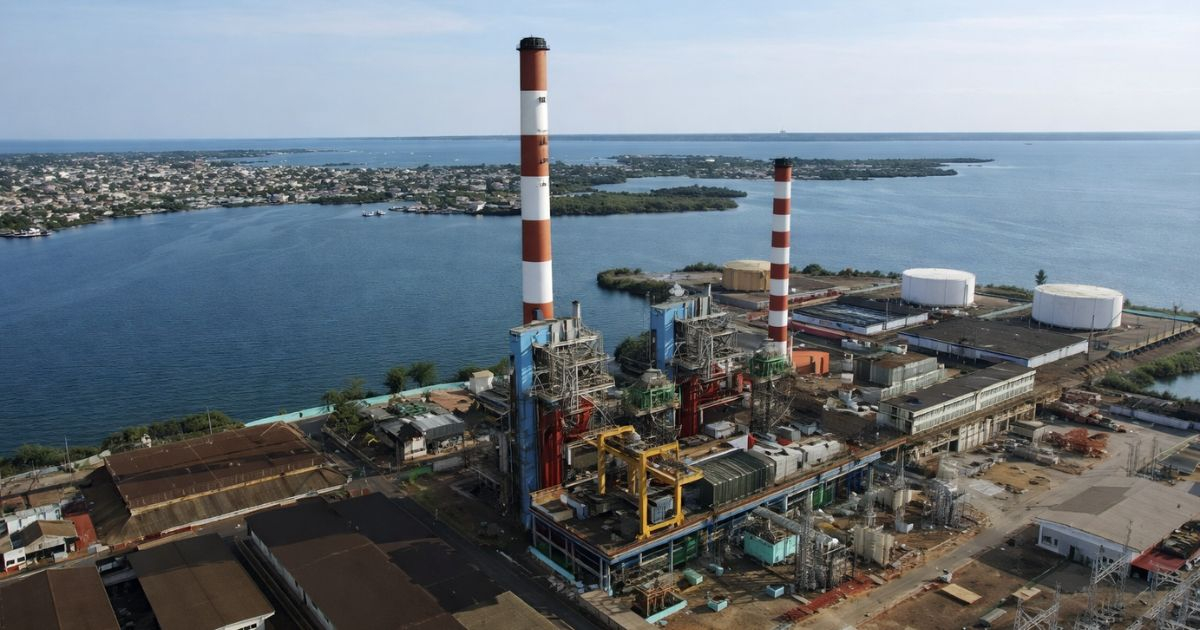
The Cuban Electric Union (UNE) has reported tangible progress in restoring the National Electrical System (SEN) as of Sunday, following Cuba's second complete blackout in a week. This latest collapse occurred at 6:38 PM on Saturday after Unit No. 6 at the 10 de Octubre thermoelectric plant in Nuevitas, Camagüey, went offline. The UNE provided updates on the recovery process through their social media channels.
Initial recovery steps involved reactivating Energas Varadero and Energas Boca de Jaruco, both gas-powered plants operated by the Cuban-Canadian joint venture Energas S.A., which together can supply up to 506 megawatts to the SEN. The organization announced, "Energas Varadero and Energas Boca de Jaruco are now in service. Energy has reached the Ernesto Guevara Thermoelectric Plant in Santa Cruz del Norte."
Additionally, the Unit 3 at the Carlos Manuel de Céspedes Thermoelectric Plant in Cienfuegos was brought online, linking it to the central region's microsystem. This unit, with a capacity of 158 megawatts, is crucial for the gradual reconnection of the national grid.
The Ernesto Guevara plant in Santa Cruz del Norte, Mayabeque, running on domestic crude oil, can produce up to 107 megawatts. Its operation is essential not only for its energy contribution but also because it uses Cuban oil, preventing import costs that could reach $400,000 daily.
Saturday's blackout was triggered by a cascading failure of the operational machines, as described by official reports, following the shutdown of the Unit 6 in Nuevitas. It marked the seventh total system collapse in the past 18 months and the second one this week, after a general blackout last Monday, March 16th, which left the island in darkness for 29 hours and 29 minutes.
Restoring the SEN after a complete system failure is a "highly complex" process that may take days, according to Lázaro Guerra, the director-general of Electricity at the Ministry. The recovery begins with easily restartable power sources, forming regional microsystems that are then progressively interconnected, prioritizing hospitals without generators and potable water sources.
This is set against an unprecedented structural energy crisis. Argelio Jesús Abad Vigoa, the Deputy Minister of Energy and Mines, acknowledged that Cuba has gone three months without fuel, halting distributed generation entirely. Venezuelan oil shipments ceased in early January 2026 due to political changes in that country, and on January 29, the Trump administration signed an executive order prohibiting oil sales to Cuba.
Last Thursday, the generation deficit exceeded 1,847 megawatts, compared to a peak demand of 2,000 to 3,000 megawatts, resulting in blackouts in Havana lasting up to 20 hours a day. During Saturday's outage, residents of El Vedado protested by banging pots and pans.
Understanding Cuba's Electrical Challenges
What caused the recent blackout in Cuba?
The blackout was caused by a cascading failure of machines following the shutdown of Unit No. 6 at the 10 de Octubre thermoelectric plant in Nuevitas, Camagüey.
How is the recovery of the National Electrical System being managed?
Recovery involves reactivating key power plants and forming regional microsystems that are progressively interconnected, prioritizing essential services like hospitals and water supplies.
What are the impacts of the energy crisis in Cuba?
The crisis has resulted in frequent and prolonged blackouts, with Havana experiencing outages up to 20 hours daily. The lack of fuel has halted distributed generation, exacerbating the situation.