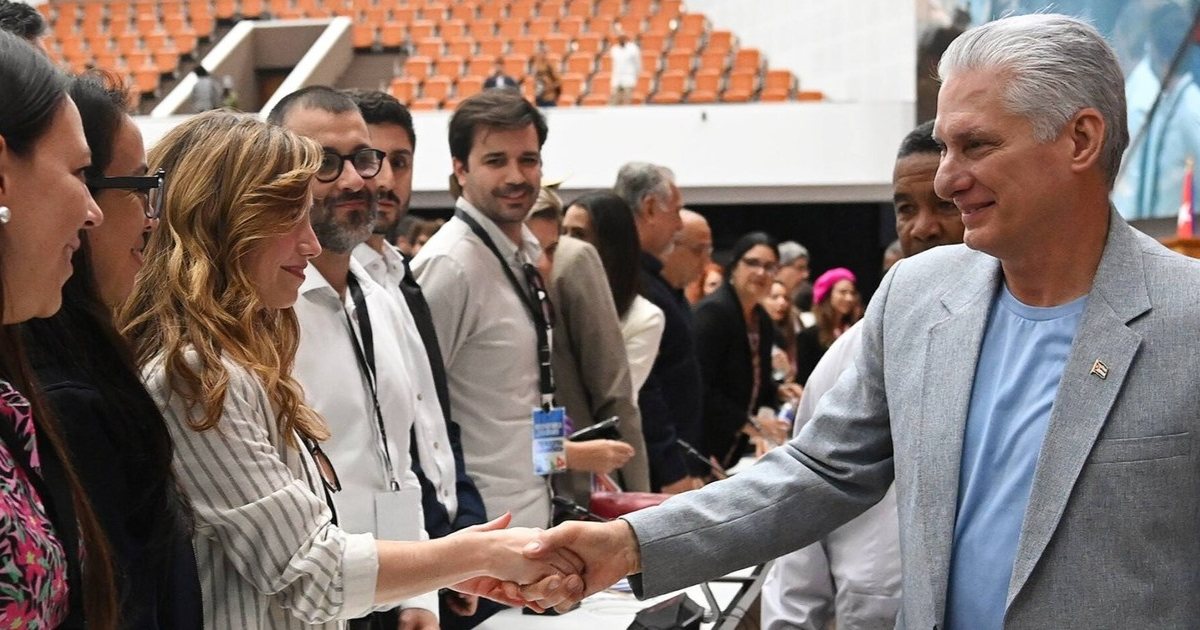
Cuban leader Miguel Díaz-Canel once again defended the regime's official narrative during a meeting with foreign delegations who traveled to Havana to express their support for the Cuban government, amid the island's deep economic and social crisis.
Addressing approximately 650 visitors from around 140 organizations that are part of the so-called Convoy Nuestra América to Cuba, Díaz-Canel expressed gratitude for their presence, describing them as bearers of a solidarity that, according to him, "energizes us" and strengthens the system's convictions.
"We understand what it means to come to Cuba," he stated, highlighting what he considered an act of bravery by those visiting the island amidst international tensions.
Díaz-Canel persisted in portraying Cuba as an inspiring model, asserting that "what we are discussing is not only Cuba's cause but also the cause of all the world's peoples."
The dictator could not resist citing Cuba's "solidarity" actions globally, such as medical missions in other countries—which international organizations have likened to "modern slavery"—and, with marked cynicism, he asked the audience: "Is that why we're a threat, or are we a threat because of the example we set?"
This remark, made while defending Cuba's international role, starkly contrasts with the everyday reality faced by Cubans, including power outages exceeding 20 hours daily, chronic food shortages, rampant inflation, and wages and pensions insufficient to cover basic needs.
In addition to this, essential services—from hospitals to transportation—are deteriorating, creating an environment where daily survival is a constant struggle.
Contrasting Realities: Political Rhetoric vs. Everyday Life
Despite these challenges, the leader reiterated familiar official slogans like revolutionaries never surrender, adding, "We are in difficult times, but also times of definitions, and here is a people who prefer to live standing than to die on their knees."
He also reaffirmed the regime's stance against the United States, stating that Cuba is open to dialogue but will not abandon its political model: "We continue to stand by the motto of Patria o Muerte, and we will prevail."
Meanwhile, outside the island, numerous supporters of the dictatorship continue to travel and show their backing, only to return to their countries where they enjoy economic and political freedoms absent in Cuba.
This disconnect between ideological discourse and the reality of life in the country is becoming increasingly apparent, especially when these statements are contrasted with the hardships faced by the population.
The event, filled with political rhetoric and calls for international solidarity, once again highlights a central contradiction: while the government insists on projecting an image of resistance and dignity, the daily reality for Cubans reflects a profound crisis that remains unresolved.
Understanding Cuba's Political and Economic Challenges
What are the main issues facing Cubans today?
Cubans are dealing with significant challenges such as extended power outages, severe food shortages, uncontrolled inflation, and inadequate wages and pensions, which make it difficult to meet basic needs.
How does Díaz-Canel view Cuba's role internationally?
Díaz-Canel portrays Cuba as a model that inspires other nations, highlighting the island's international solidarity efforts, including medical missions, despite criticism from international organizations.
What is the Cuban government's stance towards the United States?
The Cuban government remains open to dialogue with the United States but firmly stands by its political model, refusing to make concessions on its principles.