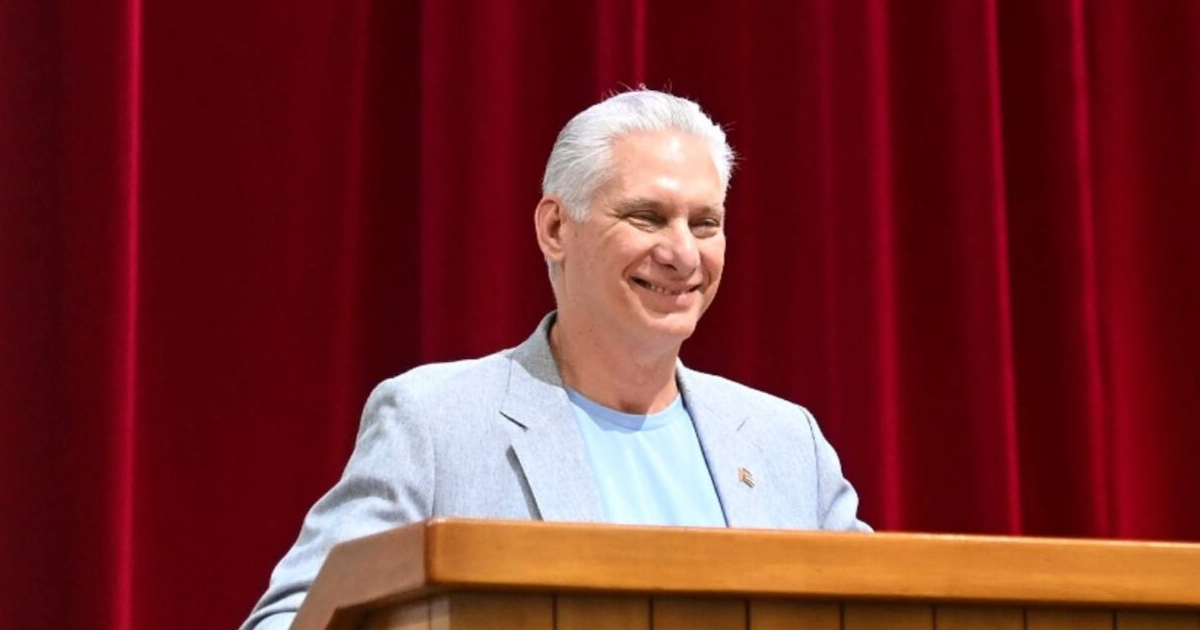
Miguel Díaz-Canel, the Cuban leader, presided over a gathering in Havana with foreign activists and supporters who traveled to the island to back the regime amidst one of the most severe crises Cuba has faced in decades.
The meeting took place at the Palacio de las Convenciones, where approximately 650 individuals from 33 countries participated in the event known as the Convoy Nuestra América to Cuba.
The event was characterized by speeches supporting Cuba's political system and repeated criticisms of the U.S. embargo, a narrative the government continues to assert as central to the national situation.
During his speech, Díaz-Canel expressed gratitude to the visitors, describing their presence as a courageous act: "We understand the significance of coming to Cuba," he stated.
The president emphasized that international support strengthens the system's legitimacy, asserting that such initiatives provide "spiritual energy" during challenging times.
He also argued that Cuba's cause goes beyond its borders: "What we are discussing is not just Cuba's cause, but the cause of all peoples around the world."
In his address, the leader reverted to the usual rhetoric of power on the island, portraying Cuba as a solidary nation and a victim of external campaigns. "This revolution will continue to triumph," he assured, reiterating that the country poses no threat, but rather serves as an example.
However, it was towards the end of his speech that he made one of the most striking statements of the gathering: "We are in difficult times, but also times of definitions, and here is a people who prefer to die standing than living on their knees." This declaration sharply contrasts with the everyday reality faced by millions of Cubans.
While the official discourse emphasizes resistance and dignity, the country experiences a situation marked by power outages exceeding 20 hours a day in many areas, chronic food shortages, skyrocketing inflation, and wages that have completely lost purchasing power. Additionally, hospitals lack resources, medicines are scarce, and living conditions have deteriorated significantly.
In this context, the sacrifice rhetoric promoted by the leadership is especially questioned.
The leaders of the country do not endure the same shortages as the population, making calls to "resist" or even "die standing" seem disconnected from the reality of those who must survive with the bare minimum daily.
The activities of such foreign delegations also draw increasing criticism.
Many question why foreign activists, who live in open societies with functional economies, travel to Cuba to support a system that restricts basic freedoms. For Cubans, this external support overlooks—or chooses to ignore—the real precariousness in which the population lives.
Meanwhile, the regime continues to attribute the crisis almost exclusively to external factors, avoiding accountability for decades of failed economic decisions, structural inefficiency, and lack of profound reforms.
In this narrative, the United States and figures like Donald Trump remain blamed as the main culprits.
Díaz-Canel, for his part, reiterated that Cuba is open to dialogue with Washington but without abandoning the system's principles: "We remain committed to Homeland or Death, and we shall overcome," he concluded.
The contrast between this message and daily life on the island continues to highlight an increasingly evident gap between official discourse and the reality of a country facing sustained deterioration in virtually all areas.
Understanding Cuba's Crisis and International Support
What was the purpose of the Convoy Nuestra América to Cuba?
The Convoy Nuestra América to Cuba aimed to show international support for the Cuban regime during a deep national crisis, with participants expressing solidarity against the U.S. embargo.
How does the Cuban leadership justify their current stance?
Cuban leadership justifies their stance by framing Cuba as a victim of external campaigns, emphasizing resilience and solidarity while deflecting blame for internal issues onto factors like the U.S. embargo.
Why do foreign delegations supporting Cuba face criticism?
Foreign delegations face criticism for backing a regime that restricts freedoms, as their support seems to ignore the harsh realities and shortages faced by the Cuban population.