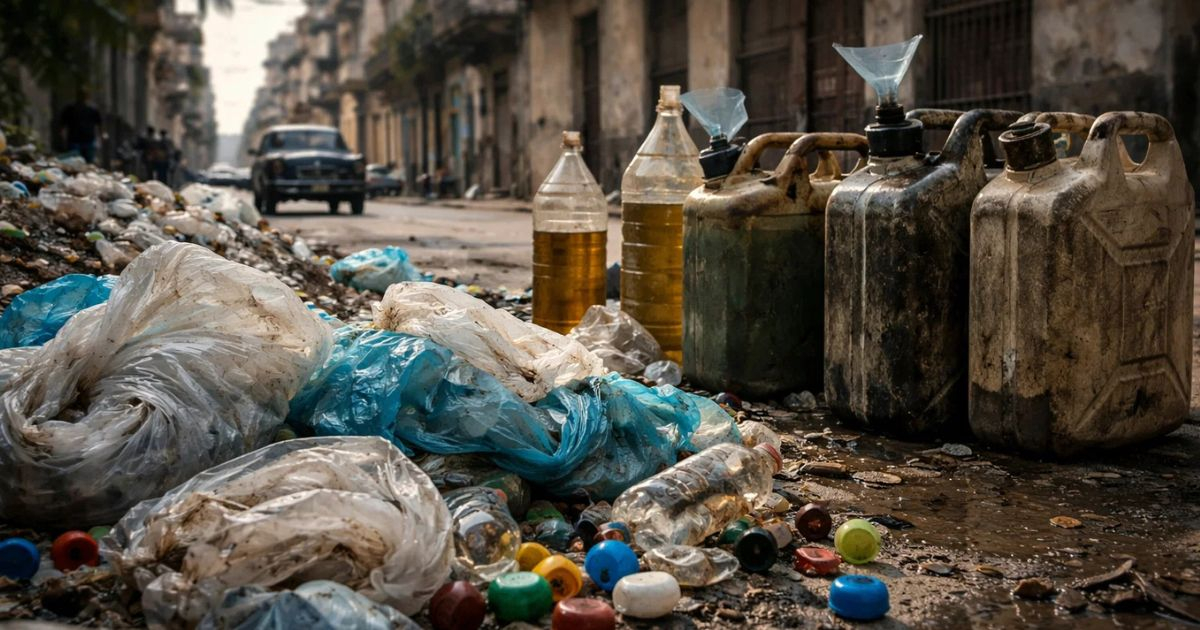
An innovative project backed by the Cuban government in Holguín is aiming to transform plastic waste into fuel, as the communist regime continues to seek solutions amidst one of the most severe energy crises in its history.
According to reports from Prensa Latina and Radio Angulo, the initiative called Pyralis is being developed at the province's Science and Technology Park. It employs a pyrolysis process to convert nylon bags and plastic caps into oils used for producing gasoline and diesel, at a time when many vehicles are immobilized due to fuel shortages.
Specialist Alejandro Ortiz spearheads the project, which claims to yield up to 100 liters of pyrolytic oils from every 100 kilograms of plastic waste. However, official reports lack details on the additional processing required to turn these derivatives into usable fuels, as well as the technical resources this would entail.
The plant is currently under construction at the Héroes del 26 de Julio Mechanical Company, and efforts are underway to set up waste collection points in communities to supply the system.
Proponents of the project suggest that the generated fuel could initially be used for essential services like ambulances, amidst the ongoing scarcity of diesel and gasoline affecting the nation. Yet, the reports fail to address crucial aspects, such as the environmental impact of the process, including the management of pyrolysis byproducts or the emissions associated with this technology.
There are also no specifics on the costs of implementation, maintenance, or the project's scalability—key factors in assessing its feasibility within an already strained and structurally limited energy system.
The initiative also proposes community incentives, offering benefits to neighborhoods with higher levels of waste collection, as a means to engage the public in the process.
While the project’s proponents hope to expand the model nationwide, questions remain about its actual capacity to provide sustainable solutions to Cuba's ongoing energy crisis.
Understanding the Pyralis Initiative and Its Implications
What is the objective of the Pyralis project in Cuba?
The Pyralis project aims to convert plastic waste into fuel to help alleviate Cuba's severe energy crisis by producing gasoline and diesel from materials like nylon bags and plastic caps.
How does the Pyralis project intend to produce fuel?
The project utilizes a pyrolysis process to transform plastic waste into oils, which can be further processed to produce gasoline and diesel.
What are some concerns about the Pyralis initiative?
Concerns include the lack of detailed information on environmental impacts, such as emissions from the pyrolysis process, and the costs and scalability of the project.