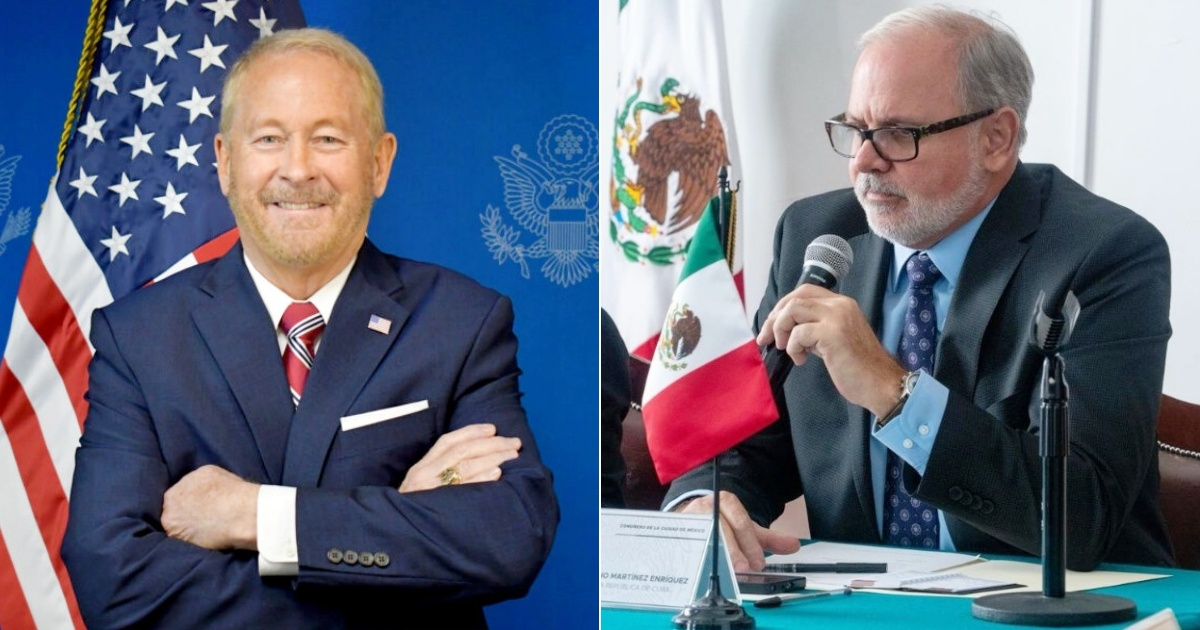
A recent diplomatic spat involving Cuba erupted in Mexico following a public confrontation between U.S. Ambassador Ronald Johnson and Cuban regime representative Eugenio Martínez Enríquez amidst discussions on international aid to the island.
The controversy ignited when Johnson took to social media platform X, quoting Secretary of State Marco Rubio, stating, "The best way to help the Cuban people is to empower them," rather than empowering the regime that has "oppressed them for decades."
His remarks were perceived as a direct criticism of Mexico's aid initiatives towards Cuba, prompting a swift reaction from Cuban diplomats.
The Cuban ambassador sharply countered the U.S. representative's message.
"Disrespectful comment by the U.S. mission chief in Mexico likely stems from annoyance at the solidarity and brotherhood shown by Mexicans towards the Cuban people. These are what truly empower the people," he wrote, employing a controversial syntax.
He added, "What he advocates is to make a people like the Cubans, who are already free, suffer."
The exchange intensified with the intervention of Johana Tablada de la Torre, the island's Foreign Service ambassador in Mexico, who expanded the criticisms against Washington.
"Helping Cuba respects the rights of our peoples. The U.S. can stop persecuting commerce, fuel, travel, investment, transfers, remittances, and the population's livelihood sources. It opts to intensify the siege and suffocation to make suffer, destabilize, and dominate. They will fail!" Tablada de la Torre wrote, again using controversial language.
The clash extended beyond the diplomatic sphere.
Mexican Senator Lilly Téllez supported the U.S. stance with a succinct "Exactly," while social media users joined the debate with critical messages regarding the Mexican government's support for Havana.
Among them, a user commented, "What López Obrador and Claudia Sheinbaum have done is exactly that, empower the regime that has oppressed [Cubans] for decades."
The confrontation unfolds amid escalating regional tensions over Cuban policy, with divergent stances between the U.S.—which maintains a pressure strategy on the regime—and Latin American governments advocating for cooperation and humanitarian aid.
Controversy Over Mexican Aid to Cuba
The discussion has intensified following former President Andrés Manuel López Obrador's call to organize a collection to support the "brotherly Cuban people," an initiative that has reignited the debate over whether such aid benefits the populace directly or ends up strengthening the Cuban state apparatus.
This call has already translated into donations from Mexican politicians linked to the ruling party, who have contributed funds to an account set up to channel resources towards the island amid the Caribbean nation's economic crisis.
The campaign has garnered both support and criticism, including warnings about potential legal risks for those maintaining financial ties with the United States due to the current sanctions regime against Cuba.
In parallel, Mexican President Claudia Sheinbaum announced she would also make a personal donation, defending the aid as an act of historical solidarity and reiterating her government's stance of support for the Caribbean nation.
Meanwhile, from Havana, Miguel Díaz-Canel publicly expressed gratitude for Mexico's support.
Impact of International Aid on Cuba
How did the diplomatic tension between the U.S. and Cuba arise in Mexico?
The tension arose after U.S. Ambassador Ronald Johnson criticized support initiatives for Cuba, prompting a strong response from Cuban diplomats.
What was the response from the Cuban ambassador to the U.S. comments?
The Cuban ambassador accused the U.S. mission chief of disrespect and defended Mexico's solidarity with Cuba, claiming it genuinely empowers the Cuban people.
How did Mexican politicians react to the U.S. stance on aid to Cuba?
Mexican Senator Lilly Téllez supported the U.S. position, while other officials and social media users criticized the Mexican government's support for Cuba.
What risks are associated with financial aid to Cuba?
There are potential legal risks for those maintaining financial ties with the U.S. due to the sanctions regime against Cuba.