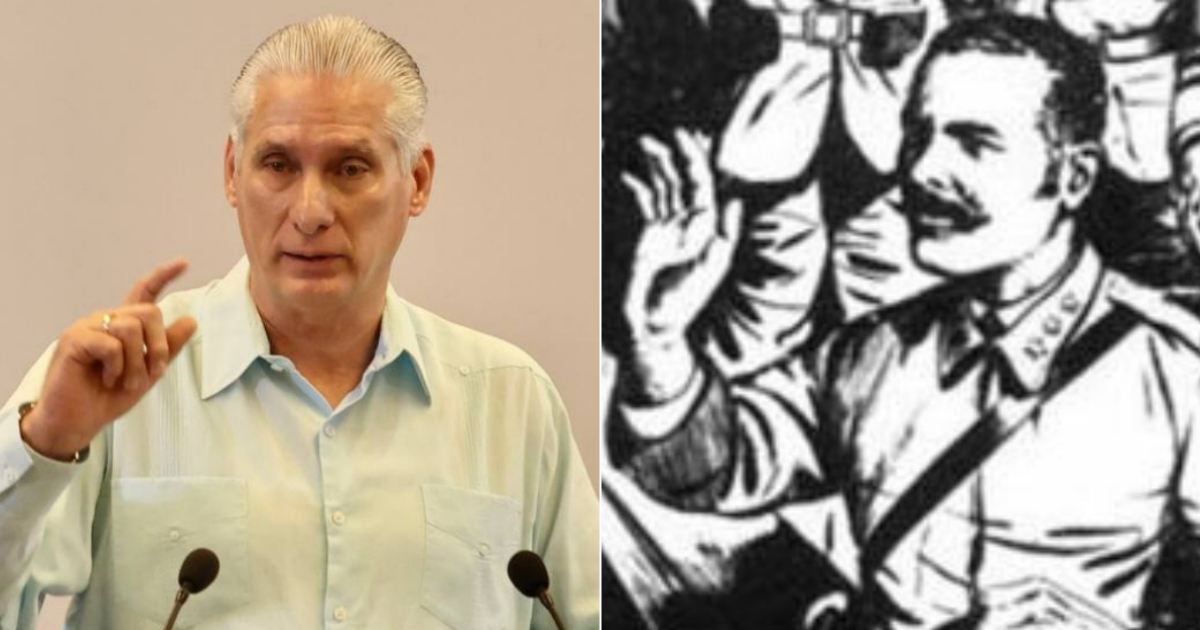
On Sunday, Cuban leader Miguel Díaz-Canel invoked the historic Baraguá Protest in a social media post that has drawn attention due to its timing amid acknowledged talks between Havana and Washington. This development was recently confirmed by the regime itself.
“When you say Baraguá, Antonio Maceo’s unwavering stance against the pact without independence comes to mind: ‘We don't understand each other,’ he tells the Spanish counterpart, rallying his troops to 'break the corojo' soon after. We will always owe ourselves to that legacy of dignity," Díaz-Canel expressed on his Facebook page.
The post, tagged with #CubaViveEnSuHistoria, harks back to one of Cuba's most renowned independence episodes: the Baraguá Protest on March 15, 1878. During this event, General Antonio Maceo rejected the Pact of Zanjón, a settlement between Spain and some independence leaders aimed at ending the Ten Years' War without granting the island's independence.
During his meeting with Spanish General Arsenio Martínez Campos, Maceo uttered the famous phrase “No, no nos entendemos,” symbolizing the refusal to accept an agreement deemed inadequate for independence goals and representing the "moral salvation of the revolution."
For decades, the Cuban regime's propaganda has transformed the Baraguá Protest into a symbol of political intransigence and principle defense, presenting it as a historical precedent for the government's confrontational stance against external pressures.
Political Implications of Díaz-Canel's Remarks
Díaz-Canel's reference comes at a politically sensitive time. On March 13, during a special broadcast on state television, the leader admitted for the first time that there are ongoing discussions with the United States, following weeks of official denials.
He clarified that these are preliminary and exploratory contacts. Díaz-Canel also mentioned that General Raúl Castro is involved in the process, along with international mediators.
The acknowledgment of these talks occurs against a complex geopolitical backdrop for Havana, following the capture of Nicolás Maduro in Venezuela on January 3, a development that weakened a key ally of the Cuban regime and exacerbated the island's energy crisis.
Baraguá's Historical Relevance in Cuban Discourse
In this context, Díaz-Canel’s allusion to Baraguá has been interpreted by some as an attempt to bolster the narrative of political firmness, even as the Cuban regime admits to having contacts with Washington.
Since 1959, the official discourse has frequently used the Baraguá Protest as a national resistance symbol and a rejection of agreements seen as contrary to the country's interests. In the regime's narrative, Antonio Maceo's figure is often portrayed as a historical precursor to the so-called “revolutionary intransigence.”
However, the phrase cited by Díaz-Canel—“No nos entendemos”—takes on a particular nuance amid the regime's own acknowledgment of exploring dialogue channels with the United States.
Understanding the Baraguá Protest and U.S.-Cuba Relations
What was the Baraguá Protest?
The Baraguá Protest was an event on March 15, 1878, where General Antonio Maceo rejected the Pact of Zanjón, which aimed to end the Ten Years' War without granting Cuba independence from Spain.
Why is Díaz-Canel's reference to Baraguá significant?
Díaz-Canel's reference to Baraguá is significant because it coincides with admissions of exploratory talks between Cuba and the United States, raising questions about the regime's stance and intentions.
How has the Cuban regime used the Baraguá Protest historically?
The Cuban regime has historically used the Baraguá Protest as a symbol of national resistance and political intransigence, portraying it as a historical foundation for resisting external pressures.