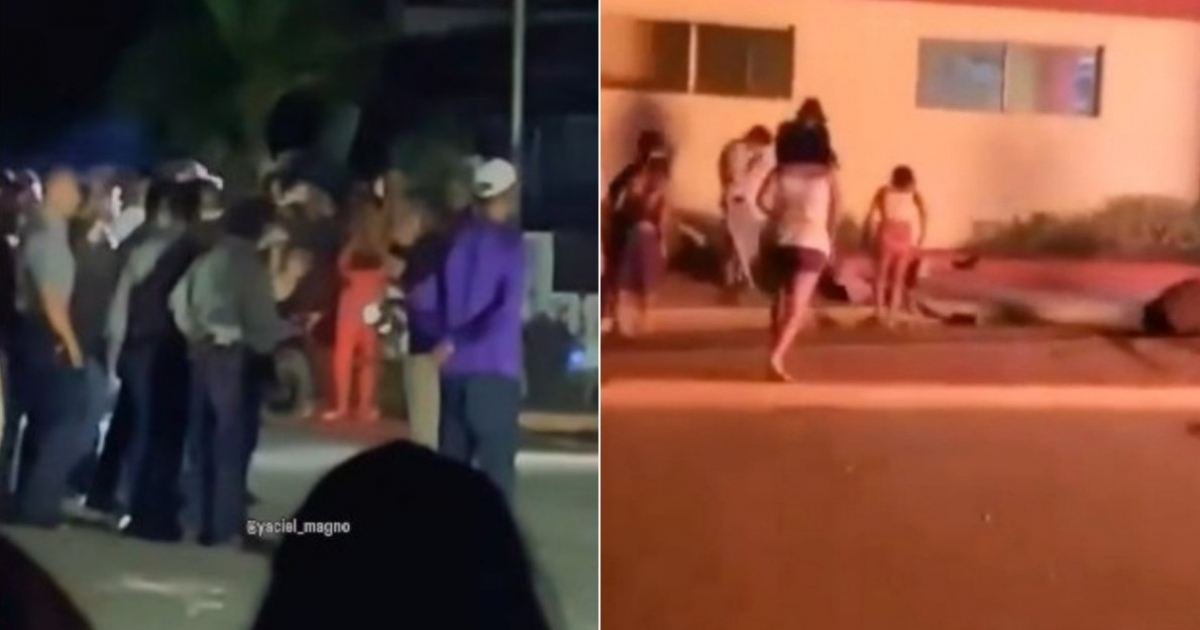
The demonstrations that erupted in the city of Morón last Friday continue to stir reactions, even among those linked to the country's state apparatus.
Aris Arias Batalla, a rescue operations official from the Ministry of Public Health in Santiago de Cuba, issued a warning about the dangers of firing shots into the air. This police tactic, as acknowledged by state media, was reportedly used during the crackdown on the protests.
On Facebook, Arias described such actions as a potential threat to the public.
"Firing into the air is neither a 'joke' nor a harmless tradition. It is an act of criminal negligence that turns the shooter into a public hazard, capable of killing someone miles away without seeing them or controlling the impact," he stated.
Although Arias refrained from directly naming the police, his remarks are clearly supported by government media reports claiming that officers fired shots into the air to disperse the crowd.
This aspect is noteworthy.
While the official narrative has attempted to portray these shots as a legitimate measure to "restore order," Arias himself warns that it is an extremely dangerous action that could result in innocent lives being lost.
Indirect Criticism from Within
In a subsequent post, Arias elaborated on why shooting into the air poses a severe risk.
He emphasized that bullets do not vanish after being fired skyward. They ascend due to the explosion, reach their peak, and then descend under the influence of gravity, accelerating as they fall.
When they return to the ground, they do so at potentially deadly speeds—between 90 and 150 meters per second—enough to penetrate a person's skull.
"A falling bullet is not like a coin or a stone," he highlighted.
Arias detailed the unpredictable nature of such shots, pointing out that the bullet could travel several kilometers before landing, potentially striking anywhere: a street, a home...
In other words, an action supposedly aimed at quelling disturbances could end up endangering any citizen, even those not participating in the protest.
Controversy Over the Use of Gunfire
The official's statements come amid heated debate regarding the events during Friday's protests in Morón.
In front of the municipal headquarters of the Communist Party, a young man fell to the ground following the sound of a gunshot. Videos circulated online show others rushing to assist him and quickly taking him away on a scooter.
Eyewitnesses claim the young man was struck by a bullet, a version the authorities deny.
The official newspaper Vanguardia asserted on social media that "there were no gunshot injuries. The shots were fired into the air to disperse the unrest."
Official journalist Francisnet Díaz Rondón echoed this explanation, denying that shots were fired directly at protesters, though admitting shots were indeed fired.
An Uncomfortable Acknowledgment
Arias's intervention introduces an inconvenient element for the official narrative.
By referencing the same government publications, he acknowledges that shots were indeed fired into the air.
From that point, he issues his warning: such actions are neither harmless nor acceptable from a public safety perspective.
Though he avoids direct confrontation with the authorities, his analysis ultimately questions the practice that state media had presented as an appropriate response to the protests.
Protests Amid a Deepening Crisis
The events in Morón reflect the rising tension across the country.
The combination of prolonged blackouts, food shortages, inflation, and deteriorating basic services has fueled social discontent in various regions of the island.
In response, the state apparatus has reinforced surveillance and deployed police forces to suppress any public demonstrations.
However, incidents like the one in Morón highlight the risks of this strategy, especially when firearms—purportedly discharged "into the air"—are used in populated areas.
Arias's warning, coming from someone close to official structures, underscores an uncomfortable reality: even within circles tied to the system, there is concern about the methods used to quell the growing social unrest.
FAQs on Police Tactics and Public Safety in Cuba
What are the dangers of firing shots into the air?
Firing shots into the air is extremely dangerous as bullets eventually return to the ground at high speeds, potentially causing fatal injuries to unsuspecting individuals miles away from the original shot.
What was the official response to the allegations of gunfire during the Morón protests?
The official response was that no injuries were caused by gunfire, as shots were fired into the air to disperse the protesters. However, this explanation has been met with skepticism from eyewitnesses and critics.
How has the social situation in Cuba contributed to recent protests?
Prolonged power outages, food shortages, inflation, and the deterioration of basic services have led to increased social discontent and protests in various parts of Cuba.