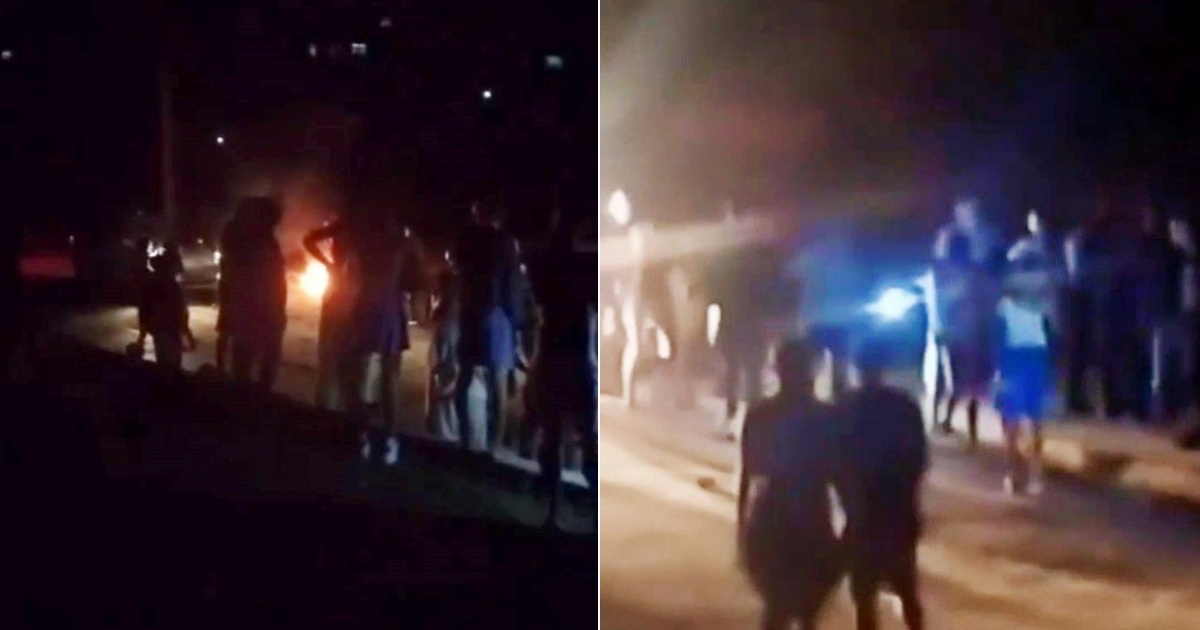
The Cuban government dismissed claims on Sunday about protests against the regime in Santiago de Cuba’s Micro 9 district, despite numerous reports and eyewitness accounts circulating of demonstrations and a significant police presence in the area during the early hours.
An official narrative, shared by the pro-government Facebook page Héroes del Moncada, accused social media users of distorting events, stating that the situation was merely a minor grievance over power outages.
According to this account, "various profiles and pages on social networks, primarily from users residing abroad, have circulated news of protests occurring in Micro 9, Santiago de Cuba, where the truth was deliberately twisted and manipulated."
The post also refuted reports of disturbances and political slogans against the government.
It claimed that rumors of alleged fires in garbage dumps, attacks on a pregnant woman and a minor, and anti-revolutionary chants by locals were entirely false.
The official stance maintained that the situation involved a small group of individuals expressing dissatisfaction due to prolonged power cuts.
The post further stated, “It was simply a small number of people who gathered outside their homes after 10 p.m. to voice their grievances about electrical service issues.” The incident, they claimed, “did not escalate into significant events nor negatively affect other residents in the neighborhood.”
The publication justified the police presence, explaining, “Authorities arrived at the scene, as is normal not only in Cuba but worldwide when incidents like these occur, to engage in dialogue with the residents and resolve the situation.”
Furthermore, the pro-government page warned that disobedience to authorities could lead to repercussions: “Some chose the path of disobedience, which those ensuring public order cannot tolerate.”
The statement concluded by accusing opponents and critics of exploiting the situation to sow distrust towards the government: “Individuals opposed to Cuban society’s values and principles use incidents like these to spread confusion and hatred through lies and manipulation.”
Conflicting Accounts from the Neighborhood
However, reports from within the neighborhood portrayed a vastly different scene.
Residents of the Micro 9 area, particularly around the 300 buildings known as "Vicoa" in the José Martí district of Santiago de Cuba, took to the streets early Sunday morning to protest amid a long-lasting blackout.
The tension in the neighborhood was captured in audio recordings and messages sent from within the district, as reported by independent journalist Yosmany Mayeta Labrada, who monitored the events overnight.
According to testimonies cited by the journalist, several protesters chanted slogans like “Down with the dictatorship!” and “Freedom!” while some trash bins were set ablaze in the streets.
Mayeta emphasized that the dissatisfaction expressed in the streets extended beyond the energy crisis.
“They weren’t demanding electricity, although they lacked it; they weren’t asking for water or food. They were shouting down with the dictatorship and calling for freedom for the Cuban people,” Mayeta explained in reference to the messages he received from the scene.
Heavy Police Presence
Reports from the early morning indicated a substantial police deployment in response to the protests.
Descriptions from within the neighborhood mentioned patrol cars, transport vehicles, personnel from the so-called “black berets,” and plainclothes State Security agents accompanied by dogs, blocking access to the area.
Audio messages from inside described the situation: “People, security between Marial and Cohabita stopping people, checking, civilian beast and patrolling with dogs,” recounted one of the messages from the scene.
Several arrests were reported, including a man known locally as "Rasta" or "Rastafari."
At 12:35 a.m., according to Mayeta, a message reported that a minor was assaulted while trying to defend her father during his arrest, and a pregnant woman was also allegedly beaten during the police intervention.
Fears of Protests Spreading
As concerns grew that the situation might spread to other city neighborhoods, authorities reportedly implemented control measures across Santiago de Cuba.
Mayeta reported that the Provincial Communist Party headquarters in Plaza de Marte was urgently militarized, while Beatriz Johnson Urrutia, the province’s first secretary of the PCC, summoned top Ministry of the Interior officials.
The journalist noted fears that protests might move to this location, similar to recent events in Morón, Ciego de Ávila.
Reports also indicated that long guns were distributed at police stations in Santiago de Cuba, including the one nearest to Micro 9.
According to testimonies, authorities even ordered music to be turned off in the Chicharrones park and Ferreiro district to prevent gatherings of young people during the night.
A Wave of Protests Amid Energy Collapse
The events in Santiago de Cuba unfold amid a new wave of protests on the island, sparked by the worsening electrical crisis following the Antonio Guiteras power plant’s collapse in early March.
The most recent precedent occurred in Morón, Ciego de Ávila, where protesters attacked and damaged the municipal Communist Party headquarters, burned furniture and police bicycles, and clashed with police from Friday night to Saturday.
In response, President Miguel Díaz-Canel issued a public warning: “There will be no impunity for vandalism.”
While the government downplays the events in Santiago de Cuba, the reports circulating from the early morning depict a growing tension in several Cuban cities, marked by social unrest amid the island’s prolonged economic and energy crises.
Frequently Asked Questions about the Santiago de Cuba Protests
What sparked the protests in Santiago de Cuba?
The protests were initially sparked by prolonged power outages amid the worsening energy crisis in Cuba. However, protesters also expressed broader discontent with the government, chanting slogans for freedom and against the dictatorship.
How did the Cuban government respond to the protests?
The Cuban government deployed a significant police presence, including patrol cars, security forces, and plainclothes agents, to block access to the protest area and control the situation. Several arrests were reported.
What was the official narrative regarding the protests?
The official narrative dismissed the events as a minor grievance over power outages and accused social media users of manipulating the truth. The government denied reports of disturbances and anti-government slogans.