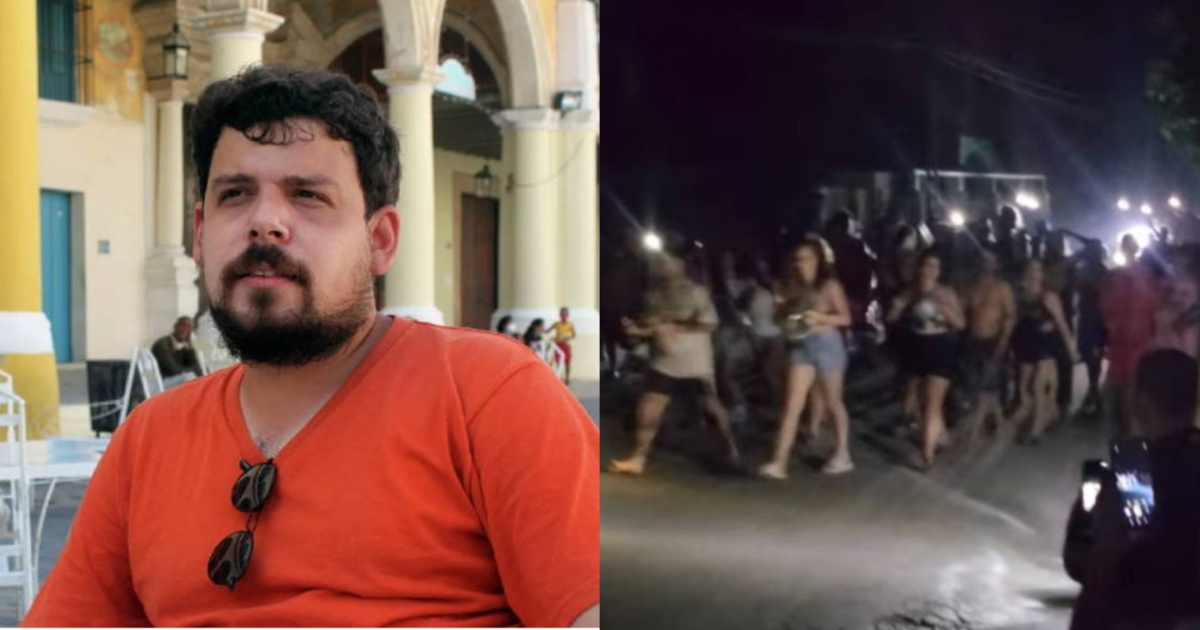
Michel Torres Corona, spokesperson for the state-run program Con Filo, referred to the Cubans who protested on Friday in Morón, Ciego de Ávila, as "beasts that insult and destroy."
Torres Corona, who is also the director of the state publishing house Nuevo Milenio, shared on Facebook, "The best response to the beasts that insult and destroy is culture. Today, like every week, we had Saturday of the Book, and Editorial José Martí presented the title ‘Renée Potts: casi nada en la memoria,’ a literary evocation of this writer and journalist by her daughter Valentina Porras."
He further commented, "The Cuban Institute of the Book and its president, Juan Rodríguez Cabrera — the group to which I belong — remain steadfast in this trench of ideas, convinced that in such a critical moment for the nation, we cannot abandon our memory or our identity. As Martí said, being cultured is the only way to be free, and those who attack and set fires, driven by desperation or petty intentions, are the ones who stray from that thought, that history, that essence," alluding to the protests from the previous night.
This Saturday, the ruling leader Miguel Díaz-Canel described the protest in Morón as "vandalism" and "violence," warning protesters that there will be no impunity.
"There will be no impunity for vandalism and violence," the leader declared on X.
He also stated that demands are legitimate as long as they are made with "civility."
"It is understandable the discontent caused in our people by the prolonged blackouts, as a result of the U.S. energy blockade, cruelly intensified in recent months," wrote the leader, typically blaming the U.S. for the situation in Cuba, as is common in the regime's propaganda.
"Complaints and demands are legitimate, provided they are made with civility and respect for public order. What will never be understandable, justified, or accepted is the violence and vandalism that jeopardizes citizen tranquility and the security of our institutions," he added.
The protests in Morón occurred amidst blackouts that in some areas of the country exceed 20 hours a day, compounded by a severe economic crisis marked by food shortages, inflation, and the deterioration of basic services.
During the demonstrations, there were confrontations in front of the municipal Party headquarters, where a fire was set on the street, and the building suffered damages.
One of the most striking moments of the protest was captured in a widely circulated video online, showing the instant a young man is injured after a gunshot is heard while he was near the PCC headquarters.
In the footage, the young man falls to the ground and is assisted by several protesters, who carry him and transport him on a motorcycle to take him to a hospital.
Although various social media reports claim that the young man was shot by a police officer — and some even suggest he might be a minor — official media have denied any shots were fired at the protesters, asserting that the young man was injured in a fall.
The official narrative has also attempted to portray the events as isolated disturbances led by a small group of individuals manipulated from abroad, with state media reporting that five people have been detained.
Key Events and Reactions to Morón's Protests
What was the response of the Cuban government to the Morón protests?
The Cuban government, led by Miguel Díaz-Canel, labeled the protests as "vandalism" and "violence," warning that there would be no impunity for such actions.
How did the protesters in Morón express their discontent?
Protesters in Morón expressed their discontent through demonstrations in front of the municipal Party headquarters, where they set a fire on the street and caused damage to the building.
What triggered the protests in Morón?
The protests were triggered by prolonged blackouts exceeding 20 hours a day in some areas, along with a deep economic crisis characterized by food shortages, inflation, and deteriorating basic services.