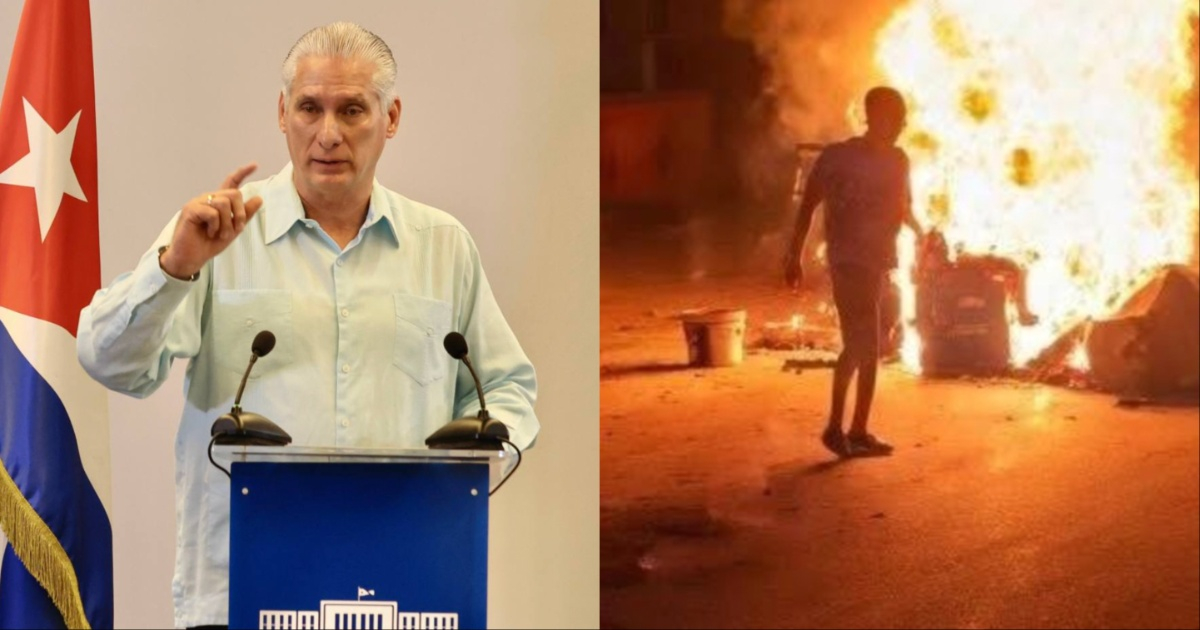
Cuban leader Miguel Díaz-Canel stated on Saturday that while grievances are legitimate, they must be expressed with "civility" following the early morning protest in Morón.
"The frustration caused by the prolonged blackouts is understandable as they result from the U.S. energy blockade, which has been ruthlessly intensified in recent months," Díaz-Canel wrote on X, predictably blaming the United States for Cuba's current situation, a common narrative in the regime’s propaganda.
"Complaints and demands are valid as long as they are made with civility and respect for public order. Violence and vandalism, which threaten citizen tranquility and the security of our institutions, will never be comprehensible, justified, or tolerated," he added.
Díaz-Canel issued a warning to the protesters: "There will be no impunity for vandalism and violence."
These threats from Díaz-Canel emerged just hours after a tense night in Morón, where numerous videos circulated on social media showing groups of residents marching through the streets, chanting anti-government slogans, and banging pots and pans.
During the protests, clashes occurred near the municipal headquarters of the Party, where a fire broke out on the street and damage was inflicted on the building.
One of the most striking moments of the protest was captured in a widely shared video, showing a young man getting injured after a shot was heard near the PCC building.
In the footage, the young man collapses to the ground and is assisted by several demonstrators, who carry him on a motorbike to a hospital.
Although various reports on social media claim that the young man was shot by a police officer—and some even suggest he might be a minor—official media have denied that any shots were fired at protesters, maintaining that the youth was injured in a fall.
The official narrative has also attempted to portray the events as isolated disturbances orchestrated by a small group of people manipulated from abroad, with state media reporting the detention of five individuals.
Meanwhile, profiles linked to government institutions have circulated videos recorded in the early hours showing empty streets in Morón, accompanied by messages asserting that the city is "entirely calm."
The protests occurred amidst a growing social unrest on the island, fueled by extended power outages, food shortages, and worsening living conditions.
Understanding the Morón Protests and Regime Response
What triggered the protests in Morón?
The protests were primarily triggered by prolonged power outages, which have exacerbated existing frustrations over food shortages and deteriorating living conditions in Cuba.
How did Díaz-Canel respond to the protests?
Díaz-Canel acknowledged the legitimacy of complaints but emphasized they should be made civilly. He condemned violence and vandalism, warning that such actions would not go unpunished.
What was the official response to reports of police violence?
Official media denied that police fired on protesters, claiming the young man captured in the video was injured by a fall rather than by a gunshot.