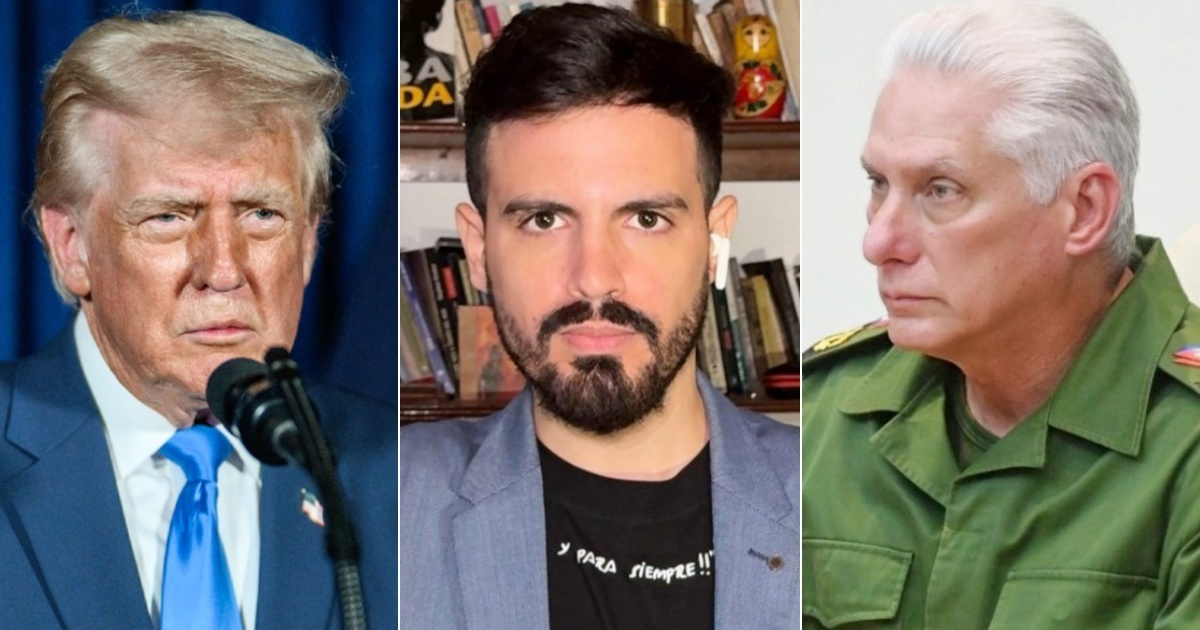
Official Cuban spokesperson Pedro Jorge Velázquez, widely known on social media as El Necio, has publicly acknowledged that the government in Havana concealed information regarding its communications with the United States. This revelation has ignited a substantial debate on social media concerning the transparency of the Cuban authorities.
Velázquez, a blogger and staunch defender of the Cuban regime on digital platforms, recently took to Facebook to justify the newly revealed discussions between the two nations. In his detailed post, he admitted the government's opaque handling of information, which he conceded undermines public trust.
"Regardless of the reasons for Cuba’s secrecy, which—I've said before—does not benefit public trust, many politicians and journalists claimed there were no talks. Meanwhile, the Cuban government was aware, but Miami wasn't," he wrote.
He admitted that several figures within Cuba's media and political spheres publicly denied the existence of U.S. contacts, despite reports from the U.S. suggesting otherwise. El Necio justified this contradiction by stating that the discussions occurred at a governmental level, excluding figures from the Cuban exile community in Miami.
"The exchange table is not with the mercenary and unpatriotic crowd of Miami's extreme ‘exile’... They are not part of the discussion," he asserted.
In his message, he specifically mentioned several Cuban-American congress members and exile media figures, claiming they hold no real sway in the negotiations. "Neither María Elvira, Mario Díaz-Balart, Carlos Giménez, nor others have any influence," he noted.
Contradictions and Political Disputes
El Necio also attempted to address the apparent contradiction between the denials by Cuban-American politicians and former President Donald Trump's assertion of dialogue. "People ask: how are Cuban-American congress members denying contact while Trump confirms it?" he questioned.
According to him, Cuban-origin congress members were sidelined in any rapprochement attempts between Washington and Havana because they hold no significant influence in U.S. policy toward Cuba. "These people are just the errand runners; they don't have respect or support from Trump or Congress," he argued.
He concluded by stating, "Miami claimed the Cuban government wasn't at the table; in reality, they weren't."
A Previous Controversy
The controversy didn't begin with this particular post. A day earlier, El Necio defended himself on Facebook after facing criticism from other government-aligned communicators for demanding explanations from the government about rumors of U.S. contacts.
In that post, he claimed he was attacked for publicly questioning the lack of official information on the matter. "Was it necessary to call me a ‘traitor,’ ‘coward,’ ‘egotist,’ or ‘confused’ for being the only one asking the government about contacts with the U.S., something that was indeed happening?" he wrote.
He added that some television hosts and colleagues joined in criticizing him for doubting the official version. "They campaigned against me: TV hosts and ‘colleagues’ attacked and dismissed my request. But El Necio wasn't so wrong," he maintained.
Debate on Transparency and Credibility
El Necio's admissions have sparked intense discussions among Facebook users, where the acknowledgment that the government was "hiding the ball" became a focal point of comments. Many questioned the credibility of officials after their denials of contact.
"You can't lie to the people. Why does the government lie, manipulate, and deceive? That's not right," one user commented. Another user pointed out that denying talks only to later confirm them damages trust in institutions.
Some recalled that government officials and media repeatedly denied any dealings with Washington. "The president, the foreign minister, and several journalists all claimed there was no contact, yet there were talks," another user noted.
Some comments went further, accusing the government of deliberate deceit. "It was a huge mistake not to inform the people. They lied indiscriminately, saying there were no talks," a participant in the debate wrote.
Defending Secrecy
However, some users defended the Cuban government's discretion, arguing that diplomatic negotiations often require confidentiality. "Some things must be done in secret to achieve them," one commenter cited a phrase often attributed to José Martí, used to justify the reserved handling of certain issues.
Another user stated, "Diplomatic matters aren't announced until tangible results are achieved." Along the same lines, some of the influencer's followers argued that premature disclosure of contacts could hinder negotiations.
"Prudence, intelligence, and discretion are essential for any dialogue between governments," another user remarked.
The post also drew criticism aimed directly at El Necio. Some commenters felt his explanation attempted to justify obvious contradictions between prior government statements and later admissions.
"This is about national deceit once again," one user asserted. Others criticized the term used by the influencer to describe the information handling. A supporter of the regime chastised him, saying "‘Hiding the ball’ isn't the appropriate term for Cuban diplomacy."
Some users even pointed out that official spokespersons found themselves in an awkward position after confirming contacts they had previously denied.
"Several journalists and officials ended up looking bad when what they denied was later confirmed," another participant opined.
Although El Necio intended to defend the Cuban government and discredit exile figures, his admission that Havana "hid the ball" fueled the discussion on informational transparency in Cuba.
U.S.-Cuba Talks: Questions and Answers
Why did El Necio's admission cause controversy?
El Necio's admission revealed that the Cuban government concealed information about U.S. talks, challenging the perceived transparency of the authorities and sparking debates on social media.
What was the reaction to the Cuban government's secrecy?
Many social media users criticized the government for lying and manipulating the people, leading to a decrease in trust and credibility of the authorities.
How did El Necio justify the government's actions?
El Necio claimed the discussions were governmental and excluded the Cuban exile community, arguing that transparency was not possible until results were tangible.