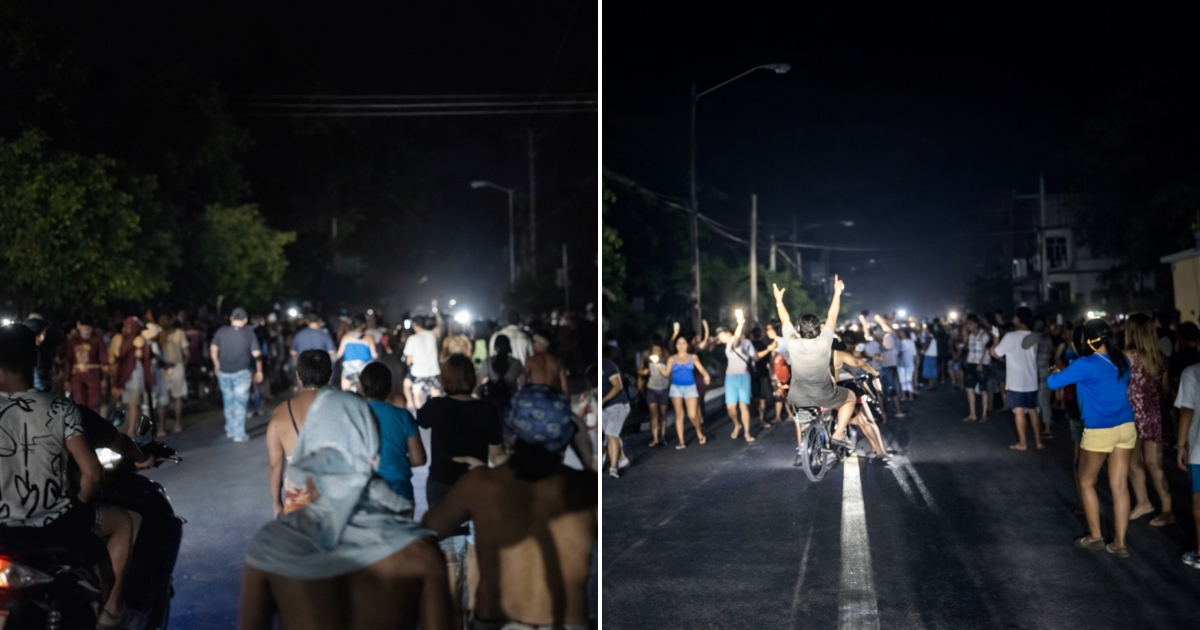
For decades, the Cuban regime has tirelessly promoted the notion that the people stand with the Revolution, that the Communist Party embodies the nation, and that the streets belong to them.
However, the night in Morón painted a different picture.
Amidst endless blackouts, mounting hunger, and dwindling patience, dozens of locals took to the streets, banging pots and pans, chanting “Freedom!” and reminding the powers that be of a simple truth: even fear can grow weary.
Morón, a modest municipality in Ciego de Ávila, accomplished what seemed impossible for years. It didn’t seek permission, wait for speeches, or hope for reforms that never materialize. Instead, the people simply took to the streets.
In the midst of this eruption of frustration, something deeply symbolic occurred: protesters pulled down Communist Party propaganda, furniture, and portraits of power and turned them into a bonfire right in the street.
If anyone sought a metaphor for Cuba’s current moment, they would struggle to find a better one.
For decades, the regime has constructed a country where almost everything is scarce: food, electricity, transportation, medicine. Yet, there is always an abundance of slogans, posters, and propaganda. Morón found a practical use for it: fuel for the fire.
Meanwhile, the regime’s response was predictable: gunfire, repression, internet blackouts, and official silence.
This is the playbook of a system that has forgotten how to govern but remembers how to cut the lights, block communications, and deploy police forces.
And still, the people came out.
Morón hasn't transformed the system overnight. No one is naive. However, it has demonstrated something far more dangerous to the regime: the people have lost their fear.
For this reason, despite the irony, many Cubans might say that Morón is—for a brief moment—the first municipality free of communism.
Free not because the local government changed, but because its citizens did something that felt forbidden for far too long: they said enough.
The problem for the regime is that ideas, much like fire, spread.
Today it was Morón.
Tomorrow, it could be any other municipality.
And when an entire nation begins to shed its fear, not even all the blackouts in the world can reignite obedience.
Change in Cuba won’t come from the Communist Party’s offices.
It will come from the streets.
Just like in Morón.
Understanding the Situation in Morón, Cuba
What sparked the protests in Morón?
The protests in Morón were triggered by prolonged blackouts, food shortages, and the general frustration with the regime's inability to address these issues effectively.
Why is Morón considered symbolically free from communism?
Morón is seen as symbolically free from communism because its residents openly defied the regime by protesting and destroying symbols of the Communist Party, showcasing a loss of fear and a desire for change.
How did the Cuban government respond to the protests?
The Cuban government responded to the protests with its usual tactics: repression, internet blackouts, and a lack of official communication, attempting to suppress the dissent.