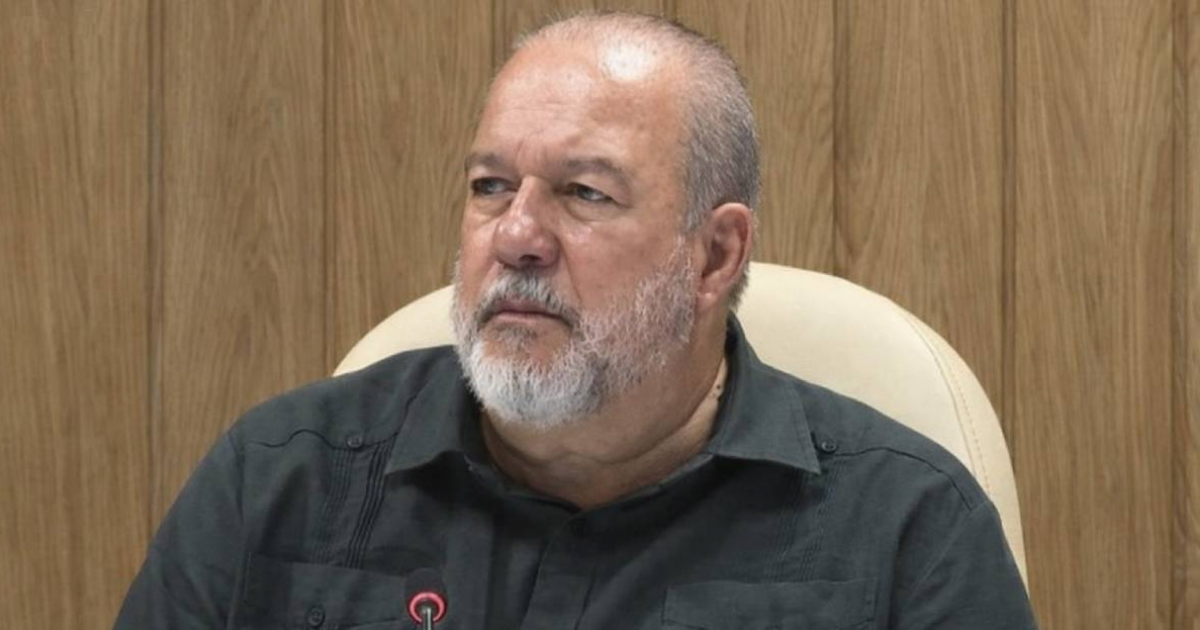
Cuba's Prime Minister, Manuel Marrero Cruz, has called on regime leaders to adopt the Government Program not merely as a document but as "a working tool that guides efforts at all levels."
This plea was made at the Higher School of State and Government Cadres, during a period of heightened suspicion over secret negotiations between Washington and Havana, which has resulted in uncertainty and a standstill in Cuba's bureaucratic machinery.
Marrero was unequivocal in his warning. "We stress a crucial idea: if we see the Government Program solely as a document, we've lost the fight," he stated.
This remark, shared on his X account, underscores the regime's fear that its own officials are not responding to the urgent historical moment Cuba is facing.
The program Marrero refers to was endorsed in late 2025 and revised in February 2026. Known for its bureaucratic language, it is a lengthy document that even regime officials find challenging to interpret, and it contains guidelines that have been altered over time.
The strategic plan's primary goals include prioritizing business autonomy, food production, changing the energy matrix, and achieving Cuba's macroeconomic stabilization.
The adjustments were not due to failures in the plan—common in Cuba's state development programs—but rather because of shifts in the international landscape.
In January, the U.S. capture of Nicolás Maduro cut off Venezuela's oil supply to Cuba. By the end of the month, Donald Trump signed Executive Order 14380, declaring a national emergency and threatening tariffs on countries supplying oil to the island.
Reports from the U.S. media subsequently disclosed that the Trump administration is secretly negotiating a deal with Havana that would include opening ports, energy, and tourism sectors.
Trump publicly confirmed these negotiations at the "Shield of the Americas" summit in Miami, saying, "Cuba is at the end of the road. They have no money or oil. They want to negotiate."
These talks are reportedly being led by Secretary of State Marco Rubio and involve Raúl Guillermo Rodríguez Castro, grandson of Raúl Castro, bypassing the official government channels of Miguel Díaz-Canel.
Political analysts believe this places Díaz-Canel, Marrero, and the officials of the Communist Party of Cuba (PCC) in a politically and psychologically untenable position before the Cuban people, and especially erodes their credibility with subordinates.
The Prime Minister demands discipline from state company leaders and PCC officials, urging commitment to an institutional roadmap that has borne no fruit for decades. Meanwhile, suspicions grow that the regime's future is being negotiated above their heads, between the Castro family and Washington.
The result is skepticism among leaders, a tacit wait for change that never arrives, and institutional paralysis justified by fuel shortages, a lack of various resources in the country, and daily power outages exceeding 20 hours.
Manuel Marrero's message is clear: the regime is "losing the fight," and the neglect of its Government Program is the most evident proof of this.
Key Questions About Cuba's Government Program and U.S. Negotiations
What are the main goals of Cuba's Government Program?
The program aims to prioritize business autonomy, enhance food production, shift the energy matrix, and achieve macroeconomic stabilization in Cuba.
Why is there skepticism about the program's effectiveness?
Skepticism stems from the program's failure to deliver tangible results over decades, compounded by ongoing suspicions of secret negotiations with the U.S. that sideline official government channels.
How are international shifts impacting Cuba's current situation?
The international context changed significantly with the U.S. capture of Nicolás Maduro, disrupting the oil supply from Venezuela, and Trump's executive order further isolating Cuba economically.