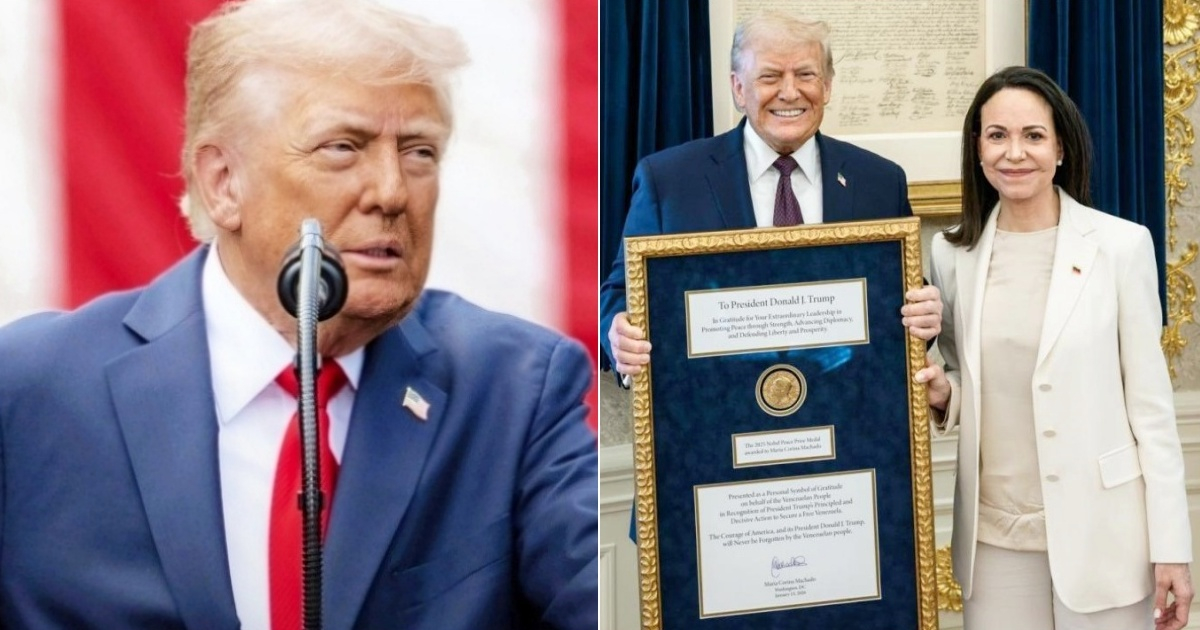
President of the United States, Donald Trump, has declared that he is no longer interested in winning the Nobel Peace Prize, a recognition he had previously sought while advocating for his foreign policy, which he described as “peace through strength.”
In a brief phone interview with the conservative newspaper The Washington Examiner, Trump asserted that he has "no idea" if the military offensive against Iran—dubbed Operation Epic Fury by the Pentagon—might bring him closer to receiving the prestigious international accolade.
When asked about the possibility of the military campaign affecting his Nobel aspirations, Trump's response was succinct: "I don't know." He swiftly concluded the conversation with a remark distancing himself from his previous ambitions: "I'm not interested."
Trump also dismissed the notion that the prize had been a topic of discussion during his recent interactions with foreign leaders. "No, I don't talk about the Nobel Prize," he stated.
Military Conflict Challenges Peaceful Narrative
These comments come nearly two weeks after the onset of the conflict involving the United States, Israel, and Iran, which erupted on February 28 with a joint offensive that quickly escalated in the Middle East.
Trump had repeatedly claimed that his diplomatic record and security approach made him a natural candidate for the Nobel Peace Prize. He even asserted that he had played a role in resolving eight international conflicts, using this argument to justify his pursuit of the award.
However, the war with Iran seems to have complicated that narrative. The conflict intensified following the assassination of Iran's supreme leader, Ayatollah Ali Khamenei, during the initial offensive. In response, the Islamic Republic has launched airstrikes against Israel and countries hosting U.S. military bases.
The war has already resulted in the deaths of seven U.S. soldiers, strained energy trade in the Persian Gulf, and driven up gasoline prices.
Investigation into School Bombing
Amid the rising military tensions, the U.S. government is investigating a Tomahawk missile attack on the Shajarah Tayyebeh elementary school in the Iranian city of Minab, which took place on the same day the war began. Initial reports indicate that the bombing may have killed approximately 175 schoolgirls.
While Trump has stated he will accept the findings of the official investigation, he has also suggested that Iran may have been responsible for the attack. Speaking in Doral, Florida, on Monday, he hinted that Tehran might have acquired Tomahawk missiles, despite the fact that only three other countries besides the U.S.—Australia, the UK, and Japan—possess such weapons.
Nevertheless, the New York Times has reported that preliminary findings from the Pentagon's investigation suggest the U.S. might be responsible for the attack.
The White House Defense
The Trump administration has defended the military operation as an effort to bolster U.S. security and curb Iran's regional influence. “For 47 years, the Iranian regime has actively and intentionally facilitated the murder of Americans while chanting ‘death to America’ and funding other bloodthirsty terrorists who seek to destroy the United States and all of Western civilization,” stated White House Press Secretary Karoline Leavitt in a statement.
Leavitt also argued that previous U.S. administrations were “too weak and cowardly to do anything about it,” and that Trump is “correcting decades of cowardice and holding those responsible for American deaths accountable.” According to the White House, the operation could also have positive economic effects once the fighting concludes, potentially leading to lower global energy prices.
A Prize Once Desired
The president’s current disinterest contrasts with his attitude in previous months. Trump had openly asserted that he deserved the Nobel Peace Prize and even publicly promoted his candidacy. At one point, he suggested that Venezuelan opposition leader María Corina Machado, who was awarded the Nobel, should share the prize with him.
During a meeting at the White House, Machado symbolically presented him with her medal. Now, in the midst of the war with Iran, it appears the president's tone has shifted.
Understanding Trump's Stance on the Nobel Peace Prize
Why has Trump distanced himself from the Nobel Peace Prize?
Trump has distanced himself from the Nobel Peace Prize amid escalating military actions against Iran, indicating a shift in focus away from the award he previously sought.
What was Operation Epic Fury?
Operation Epic Fury was the name given by the Pentagon to the U.S. military offensive against Iran, which sparked a broader conflict in the Middle East.
What are the potential consequences of the U.S. military operation in Iran?
The operation has resulted in casualties, strained energy trade in the Persian Gulf, increased gasoline prices, and may impact global energy markets.