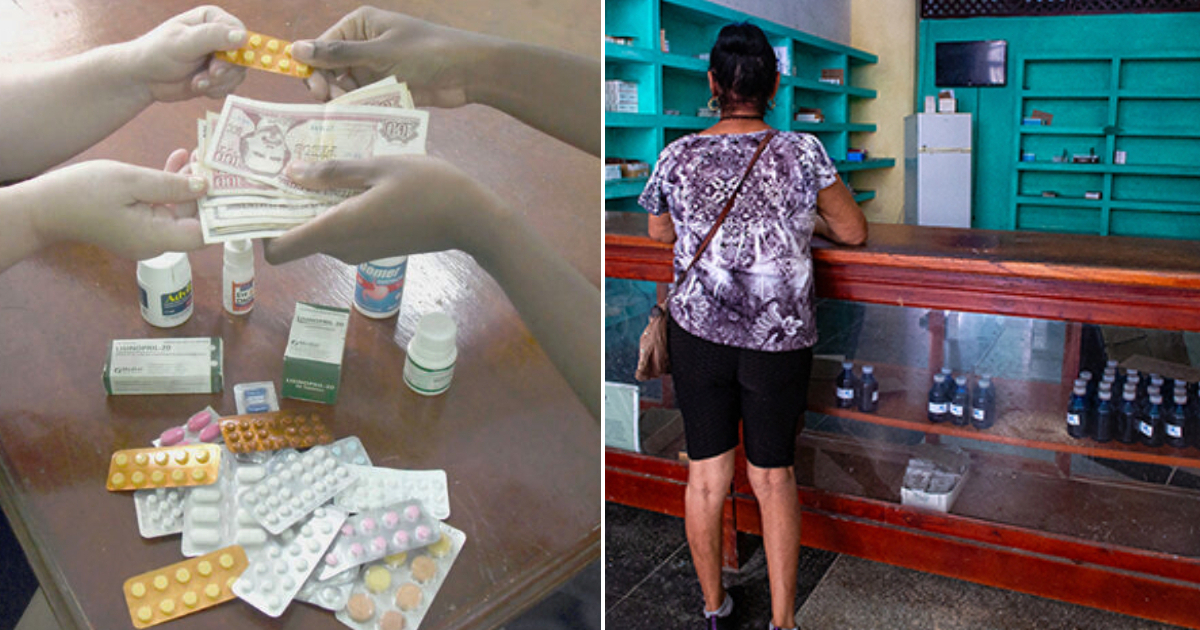
The Cuban state media has turned its attention to the unauthorized trade of medications thriving in the country, amidst a chronic shortage of pharmaceuticals in the government-run pharmacy network.
An article from the publication Trabajadores highlights how the buying and selling of drugs outside official channels have proliferated on social media, digital platforms, and public spaces while numerous state pharmacies remain devoid of essential treatments.
"Not long ago, acquiring an antibiotic simply required a trip to several pharmacies, and if it wasn't available, waiting for the next distribution cycle was the norm. Today, the scenario has changed: you only need to access a Telegram channel to find the medicine you're looking for being sold as a common commodity," the article points out.
The shortage of medicines in pharmacies has pushed many to seek treatments on this parallel market. "Many of these drugs lack proper storage or cold chain guarantees, yet they serve as a lifeline for those who, due to scarcity, have no other option," it adds.
The report includes accounts from citizens who admit to turning to these sellers due to the unavailability of medications through state-run outlets. Susana Iraola Fernández, a 71-year-old resident of Camagüey, disclosed that she resorted to informal purchases when pharmacy stocks dwindled.
"When medicines began to become scarce at the pharmacy, I was forced to buy on the street, especially antibiotics. I always opposed this because you never know their origin, but it's very tough to be sick and have nothing," she said.
Lázaro Marín, a medical student, is also quoted, noting that on several occasions he has had to purchase drugs for his mother outside official channels.
"People sell them and tell you what they're for, without really knowing. That's why you have to be careful. The necessity is driving people to these resellers without any guarantee or safety of what they're buying," he explained.
Health authorities mentioned in the publication acknowledge challenges in the production and supply of medications. Cristina Lara Bastanzuri, the Director of Medicines and Medical Technologies at the Ministry of Public Health (MINSAP), stated that "62% —equivalent to 403 products— are supposed to be manufactured by the national industry, while the remaining 38% are imported."
Santiago Dueñas Carrera, Vice President of BioCubaFarma, pointed out that the industry is facing production limitations. "If just one of the over one hundred components needed for a medication is missing, it cannot be produced," he asserted.
The article also references a measure adopted in July 2021 allowing the importation of personal-use medications without tariffs. This decision "eased the scarcity but introduced drugs without traceability," according to the text.
The growth of this underground market is occurring within a broader context of widespread drug shortages across the country. In various provinces, the absence of hundreds of essential drugs has been acknowledged, necessitating the prioritization of available resources for hospitals and critically ill patients. For instance, in Villa Clara, health officials reported that 368 of the 636 essential medications are unavailable, affecting all pharmacological families.
This situation is also evident in community pharmacy networks. Many establishments have empty shelves or only dispense regulated medications to specific patients. Images frequently shared on social media showcase this reality, such as a video where a young woman walks through a pharmacy, finding the shelves completely bare.
Meanwhile, the informal market has expanded both online and in public spaces. The Trabajadores report mentions vendors in Havana offering medications directly to passersby. "Buy your medication! Your medication here!" some shout at the 100 and Boyeros bridge.
Simultaneously, authorities have conducted police operations in various provinces against the illegal sale of medications, resulting in seizures and arrests related to this activity. In one such operation, police action against drug sellers in Santiago de Cuba sparked criticism on social media, where several citizens noted their reliance on this market for securing treatments.
These enforcement actions occur in a context where many people turn to the informal market for access to basic medications amid the absence of products in state-owned pharmacies.
Drug Shortage and Informal Market in Cuba
What is causing the medication shortage in Cuban pharmacies?
The medication shortage in Cuban pharmacies is primarily due to production limitations in the national pharmaceutical industry and the import dependency for certain drugs. Production is often hindered by the lack of availability of necessary components.
How has the informal market for medications developed in Cuba?
The informal market for medications in Cuba has expanded significantly due to the persistent scarcity in official pharmacies. People are turning to online platforms and public spaces to buy and sell medications without official approval, often compromising safety and quality.
What measures have been taken to address the medication shortage?
In July 2021, Cuba allowed the importation of personal-use medications without tariffs to alleviate shortages. However, this has introduced medications without proper traceability, posing additional challenges.